
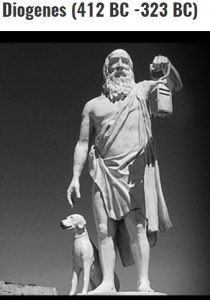
Diogenes of Sinope, the Cynic

Diogenes with his lantern and faithful dog
Diogenes looking for an honest man

Diogenes of Sinope lived in a tub in the marketplace. Since it was a long time ago, around the 4th century BCE, the details are few. He is also known as Diogenes the Cynic. I feel a certain intellectual kinship to Diogenes because I too am a cynic. He must have been a remarkable man, going by the stories told about him.

It is said that he sometimes walked around with a lamp even in broad daylight. When asked why, he replied, “I am looking for an honest man.” A cynic to the core.

He lived an austere life, and claimed (correctly, I believe) that man’s needs are basically simple. He had few possessions and lived in a tub, and I suppose lived on handouts and charity. He must have been like the bhikshus that hung around the Buddha who, one must remember, lived a century before Diogenes.

During a sea voyage in his old age, he was captured by pirates and brought to a market in Crete to be sold. When asked for what he was capable of, he answered, “I can govern men; so sell me to someone who wants a master.”

Xeniades, a rich man of Corinth, heard this and bought Diogenes and gave him his freedom. Diogenes was in Corinth when Alexander the Great sent word through a messenger asking Diogenes to come see him in Macedonia.

What would you do if one of the most powerful men in the world sent word that he would like to meet you since he has heard so much about you?

Not Diogenes, though.

Diogenes told the Alexander’s messenger, “Go tell your emperor that Corinth is as far from Macedonia as Macedonia is from Corinth. So if your emperor wants to see me, he can come and find me here.”

Irrefutable logic and infinite self-assurance. The last bit can only come from someone who really does not need anything from anyone however high and mighty.

Alexander surely was not used to being turned down. But I suppose being a warrior, he admired courage. So he went to Corinth to meet Diogenes. Diogenes was sitting in his tub and enjoying the morning sun when Alexander showed up on his high horse with a whole bunch of soldiers.

After a brief introduction, Alexander proudly offered to give Diogenes anything that he needed. “Is there anything I can do for you, Sir?” asked Alexander. Diogenes replied, “Yes, you could. You are blocking the sun. Please stand aside.”

Just step aside, said Diogenes

Alexander was a megalomaniac — you had to be if you wanted to (and indeed did) conquer a massive part of the world. So impressed he was with Diogenes that he later remarked, “If I had not been Alexander, I would have liked to be Diogenes.”

One more favorite story about Diogenes.

One afternoon, one of the emperor’s ministers was passing through the town square and saw Diogenes in his bathtub, eating gruel. The minister said helpfully, “Diogenes, you would not have to eat gruel, if you only did one thing. If you were friendly to the emperor, you’d be able to feast.”

Diogenes replied, “If you learned how to eat gruel, you would not have to grovel before the emperor.”

{PS: Also see this post from Sept 2009 about Diogenes, “Learning to Eat Gruel.”}

A Modest Proposal — Part 4

Given half a chance, people cheat. Basic human nature. There is little gain in believing otherwise. Taking undue advantage of something to get ahead is part of the basic human DNA. (I admit to being an unabashed hardcore dyed in the wool cynic. Among my all-time heroes is Diogenes. More about him here.) So one has to plan ahead and design mechanisms that account for that fact. Ravikiran asked in connection with my proposal to make India 100 percent literate: What stops the NDS from colluding with the testing centre and making off with the money?. Continue reading “A Modest Proposal — Part 4”

A Modest Proposal — Part 3

This is a continuation of my modest proposal for making India 100 percent literate within three years, Part 1, and Part 2.

I am a firm believer in the use of technology for development, including information and communications technologies (ICT). There is an urgent need for economic growth and development and unless we use the best possible tools available anywhere in the world, we are unlikely to solve the problems which confront us.
Continue reading “A Modest Proposal — Part 3”

Now for something entirely different

Nobody expects the Spanish Inquisition.

Oh, alright. I was getting tired of posting only development related stuff. So I thought that I would intersperse stuff that I write with stuff that I like written by others. Here is a perspective piece written by a Canadian and published by a Canadian newspaper. (I hope that I am not stepping on too many copyright toes.)

~~~~~~~~~~~~~~~~~~~~~~~

Source: ‘The Province’ (Tuesday, May 1, 1990)

ADOLF HITLER IN GOOD COMPANY

by Crawford Kilian

My Lawyer friend Nick Mephisto took me out for a celebration lunch yesterday, which worried me. He is a Devil’s advocate, the infernal version of a Queen’s Counsel. What he likes to celebrate usually appalls any normal person.

‘It’s the 45th anniversary of Adolf Hitler’s death,’ Nick explained. ‘My client has been hosting him-and roasting him-since April 30, 1945.’

‘I suppose your Client is very proud to have such a monster,’ I said.

‘Oh, Hitler was no monster.’

‘What! The cause of World War II, the author of holocaust, not a monster?’

‘Don’t forget my client has known them all. Hitler was just a garden variety politician.’

‘Absurd! He was inhuman.’

‘Well, what was his big offence? He believed in racial and cultural superiority. And he thought superior races and cultures were entitled to invade other people’s countries, enslave them, and even exterminate them.’

‘I said he was a monster.’

‘But isn’t that exactly what other Europeans have been doing since Columbus? In the 80 years after the Spanish conquered Mexico and South America, the native population fell by 90%. That was about 40 or 50 million people. Hitler was faster, but he wasn’t responsible for any more deaths than Spaniards were.’

‘Aw, come on Nick-‘

‘The French conquered parts of Africa and South East Asia, not to mention Quebec. The English thought they deserved to rule what Kipling called ‘the lesser breeds,’ all over the world. The Belgians ran the Congo like a big concentration camp. The Dutch and the Portugese-‘

‘Sure, the old colonial empires were bad, but they weren’t as bad as the Nazis.’

Nick Mephisto shrugged. ‘The Europeans believed that their supposed superiority justified slavery, massacres, deportations and suffocating of other people’s cultures. And Europe has flourished on that basis for centuries. In my client’s opinion, Hitler made just one mistake.’

‘Which was?’

‘He picked on Europeans.’

‘True enough, but-‘

‘If he’s massacred native Indians, African blacks, or Asians, his neighbors wouldn’t have minded much. After all, they’d all done the same thing. But treating his fellow-Europeans that way was simply unforgivable.’

‘That’s enough! If Hitler had won, we’d have centuries of horror.’

‘Just as native Indians have had since 1492, and the Africans for almost as long. Oh, my Client gives full marks for effort, but he saves his real respect for the successful conquerors, the ones who commit genocide and become national heroes.’

‘So you are saying that we’re as bad as the Nazis?’

‘Tut-tut, we’re much more genteel. My Client does point out, though, that Canadian defence policy is based on inflicting nuclear genocide on any nation that threatens to keep us from shopping in the mall of our choice. And the vast majority of Canadians frimly support that policy, no matter how many peace marchers turn out in Vancouver every year.’

Something began to dawn on me. ‘Does this mean Hitler has a lot of company?’

The Devil’s advocate grinned. ‘Plenty, and more coming all the time. You wouldn’t believe the housing crisis created by dead racists. It’s absolute hell.’

~~~~~~~~~~~~~~~~~~~~

Update (Jan 25th, 2006): See this article by George Monbiot “How Britain Denies its Holocausts

A Modest Proposal — Part 2

Today I continue exploring my modest proposal for making India 100% literate. One may exclaim “How can a proposal which seeks to spend $60 billion be considered modest!?” It is a modest proposal considered in relation to the task at hand. We have around 400 million (give or take a hundred million) illiterate humans living in this day and age within the boundaries of India. It is not a small number. Educating one person at the cost of $200 is not an extravagent sum. What I am outlining is a way to use the modest amount efficiently and effectively so as to lay the foundation for a true transformation of India. Continue reading “A Modest Proposal — Part 2”

You might be a third world country if …


Reading some of the more outlandish claims about how India is an IT superpower is a surreal experience. The chest-thumping, right from the highest offices in India to the lowliest journalistic office, is a sight to behold and marvel at. Don’t know why they have to do it. Perhaps they are plain ignorant or perhaps they feel that if they repeat a lie often enough, it will become true in the real world. Their naivete is touching and pathetic.


If you put on airs about being an information and knowledge superpower when about 351,587,482 (more than the combined populations of US and Canada) of your citizens are illiterate, you might be a third world country.