
From Prager University: Was the Constitution written in a way that was designed to protect freedom and limit the government’s size? Has it been effective in doing that? And what’s the Supreme Court’s record when it comes to protecting our rights? Robert George, Professor of Jurisprudence at Princeton University, answers these questions and more.
The Difference Between India and Pakistan
Here’s an interesting tweet
Someone asked me, what is the difference between an #Indian and a #Pakistan. This picture should do the job. pic.twitter.com/txm3GKDSdx
— Tarek Fatah (@TarekFatah) August 23, 2015
//platform.twitter.com/widgets.js
Sure, Indians are better known for being high-powered CEOs in foreign corporations than Pakistanis. Pakistanis tend to specialize more in the “peaceful” pursuits of high-powered terrorism, which is consistent with the fact that Pakistan is built on the peaceful foundation of the Religion of Peace. So naturally Pakistanis spread peace around the world.
As the population of the Religion of Peace grows in any place, it becomes more peaceful. In time, peace finally reigns. Syria is getting more peaceful by the day, to the point that people cannot take any more peace and are fleeing Syria. Heartbreaking stories of people drowning is merely the froth on a deep ocean of peace.
Enough of the Religion of Peace.
Time to once again ponder the question. Indians are obviously not incapable or stupid. So why are so many forced to migrate out of India to become successful? What’s it about India that Indians find it hard to be successful in India?
What’s a Republic?
I have been poking around in The Federalist Papers recently. Written between October 1787 and August 1788, they are “a collection of 85 articles and essays written by Alexander Hamilton, James Madison, and John Jay promoting the ratification of the United States Constitution.” Fascinating stuff. (The complete collection is here at the Library of Congress.) Here’s a bit from James Madison, Federalist, no. 39, on the matter of what a republic is:
. . . we may define a republic to be, or at least may bestow that name on, a government which derives all its powers directly or indirectly from the great body of the people; and is administered by persons holding their offices during pleasure, for a limited period, or during good behaviour. It is essential to such a government, that it be derived from the great body of the society, not from an inconsiderable proportion, or a favored class of it; otherwise a handful of tyrannical nobles, exercising their oppressions by a delegation of their powers, might aspire to the rank of republicans, and claim for their government the honorable title of republic.
Let’s remember that this was written around 1788. That over 225 years ago!
A Favorite Place: Yosemite
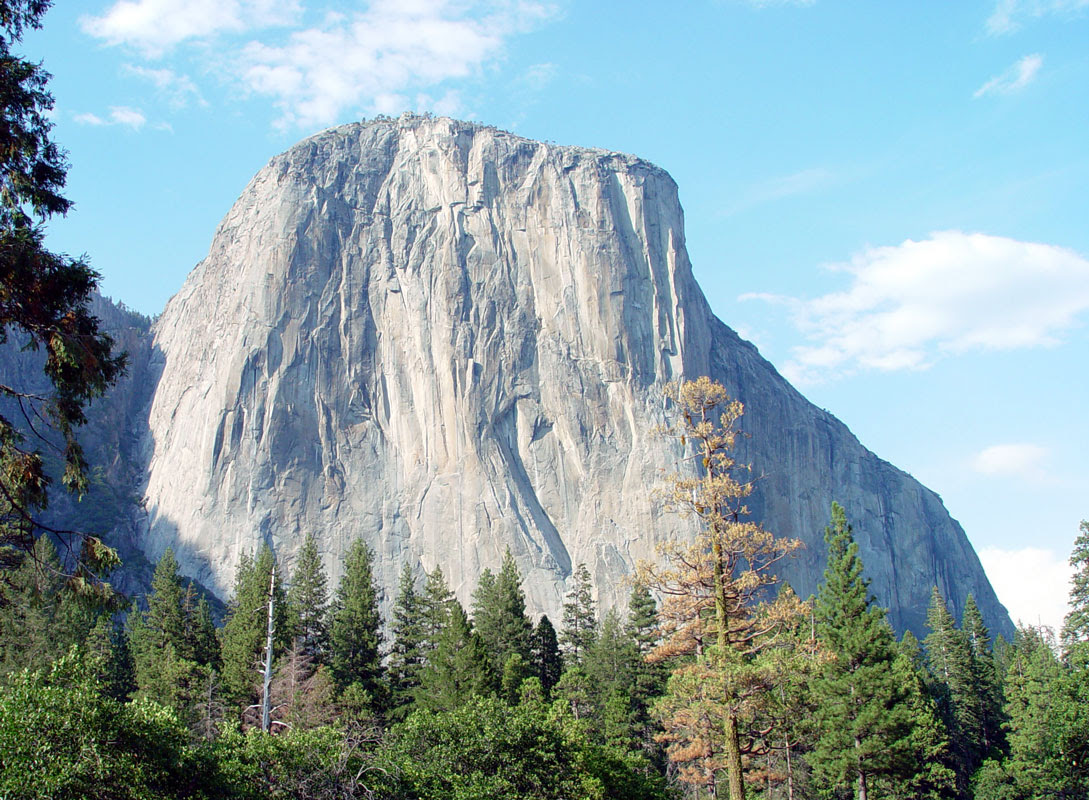
One of my favorite places to visit is Yosemite National Park. Thankfully, since it’s just a few hours drive from home, I have been there dozens of times. Here’s a pretty picture of El Capitan.
Renaming Aurangzeb Road: A Proposal
Indian politicians talk a very loudly talk about India being a democracy, meaning Indians have some say in what happens in India. But when it comes to reality, they are understandably reluctant to put their money where their mouth is. Indian democracy should not be limited to Indians merely having the vote for choosing who is going to be their mai-baap, to dictate to them. To be meaningful, democracy should be extended to the relatively unimportant matter of people deciding who are worthy of being honored by having major roads, schemes and institutions named after them.
So far, most of the major roads, institutions and public schemes have been named after members of the Nehru-Gandhi clan. It’s high time to change that high-handed, dictatorial method and go with a more “democratic” process. The means exist. A significant proportion of the population has the means to vote for all proposed name changes — and there’s a crying need to change all those names. Here’s my proposal.
Continue reading “Renaming Aurangzeb Road: A Proposal”
Naming “Dr” APJ Abdul Kalam Road: The Administrator
The proposed renaming of “Aurangzeb Road” into “Dr APJ Abdul Kalam Road” is doubtless an improvement. It marks a welcome transition from honoring an ancient terrible tyrant to honoring a contemporaneous much-admired administrator who passed away very recently. It could be better but one should be grateful for small mercies in an otherwise merciless world.
I briefly noted in my previous post (“Renaming Aurangzeb Road: The Tyrant“) the tyranny of Aurangzeb. Here I will consider why I believe that we could do better than renaming the road after Mr Kalam. I don’t harbor any illusions that my views will be taken seriously by anybody, least of all the hordes of “Dr” Kalam fans whose first knee-jerk reaction to my characterization of Mr Kalam is name-calling. A thick skin is the first requirement for being a contrarian. I wouldn’t get in the business of calling bullshit if I couldn’t tolerate the reaction from the purveyors of bullshit.
Continue reading “Naming “Dr” APJ Abdul Kalam Road: The Administrator”
Renaming Aurangzeb Road: The Tyrant
Though not unique in that respect, India does appear to suffer from a severely debilitating case of personality cult disorder. It is not a minor affliction because, as I will argue later in a separate post, it leads to serious social, economic, and political dysfunction. The condition is chronic but thankfully it is not incorrigible. A little bit of critical thinking among the public at large can eradicate the disease and with it the harmful consequences. Among the many symptoms of this disorder, particularly evident ones are the naming of roads and a variety of institutions after rulers and politicians (which amounts to the same thing.) It can escape no one’s attention that names of the Nehru-Gandhi clan adorn thousands of roads, institutions, and public schemes in India. I conjecture that a list of institutions and schemes not bearing one of those clan member names would be shorter than a list with their names.
Continue reading “Renaming Aurangzeb Road: The Tyrant”
Flash mob performance of Beethoven’s “Ode to Joy”
One of my favorites, Beethoven’s 9th symphony is his final complete symphony. Composed between 1822 and 1824, it is considered to be his finest and some even think that it is the greatest composition in the Western classical music canon. In the final movement of the choral symphony, the chorus sings the words to Friedrich Schiller’s poem “An die Freude” (composed 1785). Beethoven conducted the symphony when it premiered. He was totally deaf by that time and so he had to see the ovation that followed, rather than hear it.
Continue reading “Flash mob performance of Beethoven’s “Ode to Joy””
EPIC pictures of the Earth
 This is a picture of our earth taken by NASA’s DSCOVR – Deep Space Climate Observatory – spacecraft which is parked in the L1 Lagrange point to observe the sun and the earth. Continue reading “EPIC pictures of the Earth”
The Cycle of Wealth and Poverty
Some years ago, a very wise gentleman told me of a saying that succinctly describes the decline and fall of family fortunes, which happens to cycle in approximately four generations. “Khattu, Nikhattu, Udharichand, Baychumal”.
It begins with the generation that works hard (Khattu) and builds up the family fortune. It is followed by a generation that is lazy (Nikhattu) and lives off the wealth. The third generation becomes more lazy and lives off borrowings (Udharichand) against the remaining assets. Finally, the fourth generation ends up selling the assets and ends up poor.
A version of this cycle must apply at larger scales too, that of societies and nations. It could be a global phenomenon and if so, other societies must have recognized the phenomenon and therefore also have similar sayings. And indeed they do. Here are a few from around the world. I got them off the web.
Continue reading “The Cycle of Wealth and Poverty”
 Atanu Dey : Life is a Random Draw