
 “As per a study by the Federation of Indian Export Organisations, India’s global merchandise exports for 2018 were $324.7 billion, of which $51.4 billion were to the US.” [Source: Donald Trump terminates preferential trade status for India under GSP.]
“China has a $700 billion trade relationship with the U.S., including imports and exports, but it has a $3 trillion trade relationship with the rest of the world.” [Source: Protectionism Is Iatrogenic Government.] Continue reading “India, China and the US trade numbers”
 One major premise of public choice theory is “behavioral symmetry”.
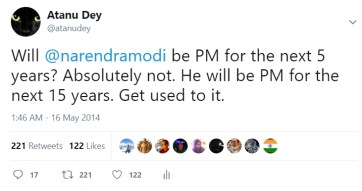 It’s deja vu all over again, as Yogi Berra observed. We’ve seen this play before. Not once but all throughout human history.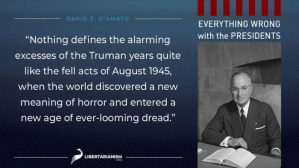
 It’s delightful to read well-written prose. In the following, the author Mark Vanhoenacker, a professional pilot, writes like a poet. I love everything related to aviation. Hence I recommend this to you.

 Since Hayek was an Austrian, the birthday greetings in German is appropriate, wouldn’t you say? He was born May 8th, 1899, and died 23rd March at the age of 92 in 1992.

