

The economy is too important for it to be left to the impersonal machinery of markets. Economics only cares about money and profits, and totally neglects to consider that people matter.
The problem with capitalism is that it neglects the human being and instead deifies profits, productivity and efficiency, and it completely ignores humanity. Socialism, by contrast, cares about people. It’s there in the very word — socialism has social in it. Therefore, it must be good.
Markets are by construction amoral, if not immoral. Therefore, markets must be regulated by the government, and whenever markets fail to work out the socially optimal outcome –which is perennially and everywhere because markets are heartlessly driven by pure greed — the government must intervene and set things straight. Continue reading “Markets”

 The adage “no pain, no gain” is broadly true with two main exceptions. One is that some people put in the pain but because of misguided effort (which is only evident ex post, not ex ante) or being simply unlucky, end up with no gain. The other being that some people put in little effort but with sheer good luck or cunning criminality end up with big gains. Unsuccessful entrepreneurs who are uncountably many belong in the first category, and politicians and gangsters (but I repeat myself) belong to the second.
 I am not against cryptocurrencies. In fact, I am all in favor of alternative currencies, private currencies, LETS, etc. I believe that people should have the freedom to choose what assets they want to hold, and what to use as a medium of exchange for their market transactions. But I have never been in favor of Bitcoin. I think it is a stupid ponzi scheme.
 The
The 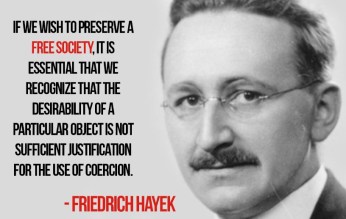 Friedrich August von Hayek was born 123 years ago on March 8th, 1899 in Vienna. His
  Happy Mother’s Day, all. May all beings be happy, may all beings be free of suffering, may all beings become enlightened.
 Democracy is a sacred word in India. As a concept, it is poorly understood (not just in India but across the world) but like people’s attitude towards their own religion, they uncritically subscribe to it without bothering to understand what it is, what it implies, what its premises are, whether or not those premises are true, whether it delivers what it promises, what its track record is, what the alternatives to it are, and whether or not they would be better off without it.
 Oscar Wilde in his play Lady Windermere’s Fan has Lord Darlington describe a cynic as “a man who knows the price of everything, and the value of nothing.”
 Atanu Dey : Life is a Random Draw