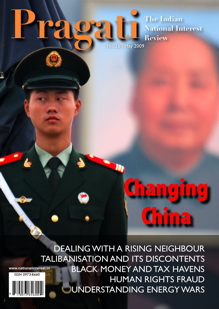
Pragati April 2009: Ideas for the honeymoon

pragati_apr09

This month’s Pragati is about “What the new government should do in its first 100 days.” I have a piece in there about the structural changes required in education. What else is new, you’d ask. Below the fold are the editorial comments for the issue. Please read and distribute.
Continue reading “Pragati April 2009: Ideas for the honeymoon”

Meta Post

If you are one of the three people who regularly read this blog, please pardon the lack of posts the last few days. I finished my brief stint at ISB in Hyderabad and now I am back in Pune after a brief stop-over in Mumbai.
Continue reading “Meta Post”

Reinventing America’s Cities

Nicolai Ouroussoff writes that “We long for a bold urban vision” in his NY Times piece “Reinventing America’s Cities: The Time Is Now.” Below the fold are some selected excerpts.

India too needs a bold urban vision, as I have been arguing for a while. Fortunately (or unfortunately, depending on how you look at it) for India, most of India does not live in cities. India does not have to reinvent its cities — it has to build new ones. Fortunately though, the world has learned a lot about building livable cities and India does not have to go about reinventing the wheel: India has to be smart enough to learn from the mistakes the others have made. India can — and must — build efficient cities. That’s the only way out for the hundreds of millions trapped in villages in rural India.
Continue reading “Reinventing America’s Cities”

YouTube bends over

YouTube has banned the James Randi Educational Foundation channel.

The reason is not yet known. I fear that it did so because of some religious group was offended by the JREF’s rational argument. Can’t really blame them since even governments are bending over. Recently the UN was the site of an unsightly scene where it was decided that any expression that offends the followers of one particular religion was to be banned. In India, they jailed a newspaper editor because thousands of violent thugs demanded his death for offending them by publishing an article that pointed out that certain beliefs are silly.

Be afraid. Be very afraid.

Freeman Dyson: The Civil Heretic

Excellent feature on Freeman Dyson in the magazine section of the New York Times. I like the man and agree with him on — among other things — global warming and the environment. (Or should I say that I agree with the man and therefore I like him?)

A few paragraphs of excerpts below the fold.
Continue reading “Freeman Dyson: The Civil Heretic”

The Sacred Ritual of Elections — Part 1

It’s been a while since I caught up with my contrarian friend CJ. I asked him what he’s been up to. I nearly dropped the phone when he said that he read in the newspapers that Indian elections were announced. It wasn’t the news of the impending elections that jolted me – I knew that already. The admission that CJ read a newspaper that was shocking.
Continue reading “The Sacred Ritual of Elections — Part 1”

The Paucity of Names

It could not possibly be a lack of imagination, could it? Why is everything in India named after Nehru, Indira, Sanjay, and Rajiv? I have pondered that matter here before. Continue reading “The Paucity of Names”

On Education, IT and the Government

In my previous post on “The Rational IT Policy” I claimed that there “is no need for any specific IT policy. The use of tools is the outcome of a set of rational processes which arise from a set of rational policies that address rational goals. IT use is a derivative demand, not a final demand. IT and its tools are an intermediate input to a process whose end result is desired.”
Continue reading “On Education, IT and the Government”

The Rational IT Policy

So it’s time to unveil the IT policy that I had been promising for a while. I have already laid a bit of ground work in the previous three posts — “BJP’s IT for All“, “A Rational IT Policy: The Preliminary Bits“, and “Of IT and Pascal’s Wager.” In the following, I will conclude the introduction with a brief discussion on tools as means, and then present my version of a rational IT policy.
Continue reading “The Rational IT Policy”

Making of a garden city

leekyew

Whether personal or societal, transformations generally require will and vision. In the case of personal transformation, unless one is a schizophrenic, a combination of intelligence, basic human values, determination, foresight and will is sufficient. For social transformation, something more is needed. Clearly leadership matters.

Here’s something to think about. Below the fold is an extended excerpt from the book, “Lee Kuan Yew: The Man and His Ideas” by Kwang, Tan and Fernandez. Indian leaders ought to take note. Or at the very least, they should read what Lee Kuan Yew has accomplished.
Continue reading “Making of a garden city”