The Growth of Inequality

In the context of exponential technological growth (a topic that I explored in the piece “The End of Poverty“), Akshar asked in his comment, “Don’t you think the gap between a poor person in India and a poor person in say USA would only increase ?”
Yes, I think that the gap will only increase with time. But that is just part of a broader trend of increasing inequality in numerous dimensions — within and between nations. In technical terms, the Gini coefficients (a measure of inequality, where 1 means perfect inequality and 0 means perfect equality) will continually increase.  Continue reading “The Growth of Inequality”

The End of Poverty

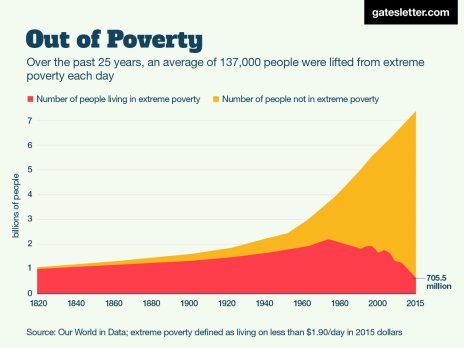
This is an optimistic piece — a rarity for sure around this blog. Here I claim that in 15 years or so, extreme poverty which afflicts around one billion people, mainly in the so-called third world, will be eradicated. That problem has plagued mankind since the beginning but the end is in sight.

Technology

Global extreme poverty will be eliminated as a side-effect of technological advances, primarily made by people who probably neither care about poverty nor do they intend to solve that problem. Which is good news for India. India has the largest number of people suffering extreme poverty in the world. Around half of the billion extremely poor people of the world live in India.

There are two kinds of problems. There are hard problems and there are impossible to solve problems. Given time, with advances in knowledge, all hard problems will be solved. Poverty is a hard problem but not an impossible problem since in many parts of the world it has been solved for all practical purposes. The critically important key to eradicating poverty is knowledge.

Knowledge

Knowledge is what economists call a “public good.” Once produced, knowledge can be repeatedly used without diminishing the available stock. It is “non-rival” in consumption. Technology increases monotonically because of the accumulation of knowledge. And technology (which is essentially knowledge of how to do something) developed somewhere gets adopted in the rest of the world with surprising rapidity. It is very cheap to use once developed.

Consider the cell phone, internet and computer technologies that were developed in the Western economies (they are called developed economies partly because they developed technology) but those advances spread to every part of the globe. Just like the computation and communications technologies, it will be people in rich countries who will develop the technology to eliminate poverty in poor countries, albeit not by design nor intent.

That means India’s dire poverty will be solved not by Indians — least of all by the insanely inept, criminally corrupt government of India which is arguably the fountainhead of India’s poverty — but by others. I note in passing that India’s telecommunications problem was created by the government but it was solved using foreign technology.

In the following I conjecture how the end of poverty will happen.  Continue reading “The End of Poverty”

Encrypted Email to Defeat Mass Surveillance

Alan Turing - A Heroic Criminal
Alan Turing – A Heroic Criminal

One of the benefits of living in a security-state aka mass surveillance state or Big Brother State is that one is constantly under the threat of being put under the microscope and dissected. Benefit? Nope. For those who love freedom, mass surveillance is a cancerous evil that should be resisted.

I came across a May 2015 article You’re a Criminal in a Mass Surveillance World – How to Not Get Caught by David Montgomery. It’s immensely long. But its length is absolutely required to get across the important issues it deals with — how to live in a society where mass surveillance is the norm. I am extracting a bit from that article. A small step toward freedom from Big Brother is to get a secure email channel. Here’s how.  Continue reading “Encrypted Email to Defeat Mass Surveillance”

Why India Needs a Third Party

Leaders Emerge

Leadership is endogenous to the system which selects them. Leaders emerge from within the system and gain legitimacy through the acceptance of the people within the system. Thus there are two components: the people and the system. Both are causally related to some extent but can be considered separate for analysis.

​Bad leadership cannot emerge out of a good system with good people in it. Conversely, good leadership cannot emerge from a bad system and bad people.

That leaves two other scenarios: good people, bad system; and bad people, good system. My conjecture is that in both of those, bad leadership is very likely to happen.  Continue reading “Why India Needs a Third Party”

The Primary Moral Hazard

The lack of basic competence among those who hold political power is very likely one of the primary reasons that some nations suffer needless poverty. The recent cabinet reshuffle (is it a deck of cards in a game of chance that it needs periodic reshuffling, I wonder) in the Modi government prompted this line of thought.

Continue reading “The Primary Moral Hazard”

Road Trip report: Aug 15th, 2017

Aug 15th holds special significance for me. It was on a 15th August that I landed in the US so many years ago. The day is also a friend’s birthday. This year’s August 15th has seen two new things: first time I am in South Dakota and first time I crossed the North American continental divide by road.

If you are wondering where yours truly is, I am on the road. Last week Thursday, I left San Jose CA and visited Courtenay and her family in Oakland CA, the first stop on my journey. Friday evening we all drove to Grass Valley CA, about 140 miles to the north. We were visiting Saundrine and her family. .

The next part of the journey was from Grass Valley CA to Salt Lake City UT on Saturday. I had driven that road some years ago for visiting the Yellowstone National Park.  It was past 10 PM when I reached SLC. Continue reading “Road Trip report: Aug 15th, 2017”

On Selflessness and Nation Building

The other day I learned that David Sedaris, one of my favorite American essayist and public speaker, does a very peculiar thing. These days he lives in England, which is not particularly peculiar. His peculiarity is that every day he spends five or six hours picking up trash along the roads around his home.

Why does he do that? Because, he says, he just likes doing it. He does not do it for some greater good or public service, according to him. Does it make him a public-minded person? Not necessarily. Doubtless, his actions result in a cleaner road than otherwise, but his motivation is not to do good — he merely does what gives him personal satisfaction and which does not harm anybody.

I believe (perhaps mistakenly) that people who are primarily motivated by doing “good” for others often see themselves as morally superior to those who let others alone. If you like to pick up trash, good for you but slipping into the role of a person who is selfless tarnishes the enterprise. Worse, it can persuade the person that he has the moral authority to force others to do one’s bidding. Continue reading “On Selflessness and Nation Building”

The Decline and Fall of Bengal

A long time ago, maybe a thousand years ago but certainly a little over a hundred years ago, Bengal was remarkably prosperous. Something happened that led to its transformation from past prosperity to present destitution. What was it? A natural disaster, meaning something that was not humanly caused but something had natural causes? Or was it something that humans brought about by choice?

Let’s be very clear about one feature of this universe we inhabit. That is, nothing stays the same. Ceaseless change is unavoidable. The great, the seemingly invincible invariably decline and are replaced. The Buddhist call it anicca — impermanence. If you expect a changeless world, you are guaranteed to be disappointed.

Continue reading “The Decline and Fall of Bengal”