

The modern world is different from the world of the recent past of, say, just 50 years ago. The nature of manufacturing, agriculture and services — the three broad categories of human enterprise — have been transformed in just a matter of decades. The biggest change has been that labor productivity has increased tremendously because of technological advances. These technological advances have increased the role of capital in the production process. That means every aspect of production, distribution and consumption of goods and services involves more machines and more automation now than it used to be the case. Continue reading “This Policy, Alone – Part 3”
Category: Uncategorized
Wildfires in the Western United States
Weather.com reports that nearly 100 wild fires are burning in the western states of California, Oregon and Washington. Here’s a photo taken yesterday around noon without filter somewhere in Oregon. (Image credit: @BuitengebiedenB)

Why do the skies appear red and orange? Nasa.gov explains —
The smoke particles from the fires allow sunlight’s longer wavelength colors like red and orange to get through while blocking the shorter wavelengths of yellow, blue and green. Those longer wavelengths give the sky a red or orange tinted appearance. Similarly, during sunrise and sunset times when the sun is near the horizon, sunlight has to travel through more of Earth’s atmosphere to get to you. The additional atmosphere filters out the shorter wavelengths and allows the longer wavelengths to get through, providing reds and oranges during those times.
Here are a couple of videos of the skies. Continue reading “Wildfires in the Western United States”
This Policy, Alone – Part 2
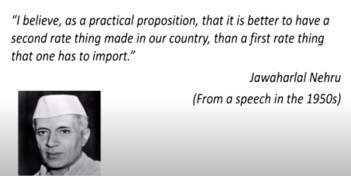 The claim in the previous part of this essay was that one of the most important policies changes that India needs is to liberate the education sector from political and bureaucratic control, and that the free market must be allowed to operate in the educational sector.
Why do I stress education? It’s important to me because I have benefited enormously from being educated. It has enabled me to make a net positive contribution to the world — which is reflected in the fact that people voluntarily pay me in exchange for my services.
Education enables a person to do well and achieve his potential. An uneducated person is handicapped. And that handicap is a tragedy if it can be easily avoided. Aside from that pragmatic and utilitarian reason, it increases a person’s capacity to enjoy and appreciate the world around him. Continue reading “This Policy, Alone – Part 2”
This Policy, Alone
 And now for the big reveal that is the answer to the post “A Policy Question” I had posed. That policy is simply this: Make the education sector absolutely free-market. I will attempt to justify why this simple policy change meets all the criteria I had listed.
A few people have responded to me privately and some have posted public comments to that post. Reader baransam1 replied “stop funding government schools.” Close but not quite, as it will become clear later. Sri suggested “currency should be pegged.” That may or may not be a positive. I don’t understand monetary policy and don’t have any confidence in macroeconomic policies. Aks rambled for a bit but in some sense came close to the policy I recommend. He wrote, “We need to free education from government.” Good job. My friend APD too reached a similar position. Continue reading “This Policy, Alone”
MRCA
 I confess to a digression from the usual here and that I am indeed avoiding writing about that policy question I asked. But give me a break, will you! I promise that I will get to it tomorrow.
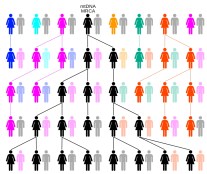
Here’s what’s on my mind — MRCA or “Most Recent Common Ancestor.” The question is how recent is the most recent common ancestor to all contemporary humans today? Beyond a certain time in the past, all of us have all our ancestors in common — going back all the way to three or four billion years. The question is restricted to our most recent common ancestor. Continue reading “MRCA”
Sometimes Being Right is Depressing
 I’ve been reading the archives of this blog the last couple of weeks. The goal is to extract and aggregate some useful bits to make some ideas accessible to those who don’t have the time to read a random collection of irregularly posted articles. Continue reading “Sometimes Being Right is Depressing”
The George Burns Syndrome
 One time I was asked to explain how Israel, despite being a socialist country, was successful in light of the fact that I keep claiming that socialism is a recipe for disaster. My response was this.
Let me tell you about what I call the “George Burns Syndrome.” Continue reading “The George Burns Syndrome”
A Policy Question
 The question is this. What specific policy change would meet the following criteria:
- It would immediately start the process of unshackling the Indian economy (or even any backward economy) and put it on a path to reaching its potential
- It would not involve any public expenditure (that is, it would not impose a burden on public finances)
- It would be popular with the public (meaning it would be not opposed by any significant segment of the population) almost immediately
- It would not involve the development of any new technologies
- It would not be adopted by any politician, political party or the government (because it would hurt their narrow, financial interests)
Hauled from the Archive: Cargo for Pakistan
 Look here, now, I don’t have all day to sit around writing stuff on this blog, ok. 😉 So here’s what I’m going to do. Haul stuff out of the archive. Good stuff, mind you. Check out Cargo for Pakistan. It’s from December 2007.
Excerpt: Continue reading “Hauled from the Archive: Cargo for Pakistan”
Lysander Spooner

The US presidential elections are on the horizon. Which brings to mind what Lysander Spooner said. “The principle that the majority have a right to rule the minority, practically resolves all government into a mere contest between two bodies of men, as to which of them shall be masters, and which of them slaves.”
Lysander Spooner (1808 -1887) was an American political philosopher and abolitionist. This note is an invitation to read a post I’d written about him in August 2018.
 Atanu Dey : Life is a Random Draw