
This video explains a great deal about how a well-functioning economy works.
Category: Uncategorized
This Policy Alone – Part 6
 Let’s start with a conjecture. The more rigid and government dominated a country’s education system is, the poorer the country; and conversely, the more flexible and accommodating the education system is, the more prosperous the country. India belongs to the first kind, and is remarkably poor; the US belongs to the second kind, and is remarkably prosperous.
It’s just a conjecture, not an established fact. But something to think about.
Unchanging
If Adam Smith (1723 – 1790), the father of the modern discipline called economics, were to find himself in the 21st century CE, he’d probably not recognize anything from his time — except the educational system. Everything has been unrecognizably transformed except schooling. Like in his time, it’s essentially the same system in which students are age-segregated and instructed in an uniform way, with teachers transferring information to a group of generally unmotivated young people. Continue reading “This Policy Alone – Part 6”
A Call to Prayer
 Among the infinite variety of things that people do, one of the most puzzling to me is the act of prayer. It’s some sort of a special communication. The message is addressed to some supernatural entity. If spoken, the message is transmitted magically to the realm where the entity resides — usually heaven. You don’t need the postal service, or the telephone, or any material medium. But prayer can be unspoken too: one just has to think in some particular way and once again magically it gets to that special being.
This special being is, among the monotheists, the One True GodTM. Hindus, who don’t go for the monotheist nonsense and believe in a vast multitude of gods (all of whom are radically different from the One True GodTM), usually direct their special communications to specific gods depending on the situation. For example, my favorite god Ganesh — the one with the crooked trunk, immense body, and the brilliance of a billion suns, the remover of obstacles — is the one to address if you want to succeed in your ventures. Continue reading “A Call to Prayer”
AMA — October Edition
So what’s on your mind? Here are a few random pictures for your entertainment. The relative frequency of English words used:

Eta Carinae

The universe is amazing. The more you learn about it, the more you realize how absolutely, unbelieveably amazing it is. A related amazing thing is that these days you can learn about the universe from the comfort of your living room or study.
This may seem unrelated to what has been a major focus of this blog recently but actually it is related. I will point out the connection later. For now, let’s talk about Eta Carinae, which xkcd notes (click on the image above) is a luminous blue hypergiant with anomalous FeII emission spectra. Continue reading “Eta Carinae”
From the Archives: US Elections are a Sideshow

The dictionary definition of a sideshow is “a minor show offered in addition to a main exhibition (as of a circus); an incidental diversion or spectacle.” I think all elections are sideshows. I used to consider them as mostly innocuous but I have been persuaded that they are actually a significant part of the pernicious scheme that enslaves people.
Elections are used to maintain the illusion that the people are in charge of their lives, that they are involved in their government and therefore the government they elect is legitimate, and consequently whatever the government does is also legitimate. Democracy is a big fat lie that the people have been brainwashed into swallowing. This will naturally stick in the craw of many of my readers (the majority of whom are Indians.)
I wrote the following piece in Oct 2012, just before the US presidential election. Much of what I wrote holds true in this US presidential election season. Please note that the trade figures mentioned in the following must have changed over time. Continue reading “From the Archives: US Elections are a Sideshow”
Anatomy of the State
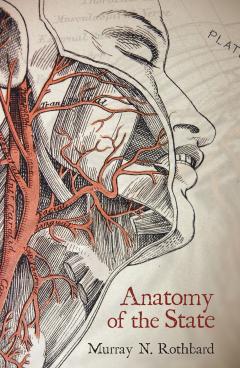 Murray Rothbard (1926-1995) — Austrian school American economist, economic historian and political theorist — was committed to individual liberty. He was dedicated to analysing the nature of the state and why it is always an enemy of freedom. His book Anatomy of the State (free download at Mises.org) is a must-read for anyone interested in understanding how the state functions and why. About the book:
[It] gives a succinct account of Rothbard’s view of the state. Following Franz Oppenheimer and Albert Jay Nock, Rothbard regards the state as a predatory entity. It does not produce anything but rather steals resources from those engaged in production. … How can an organization of this type sustain itself? It must engage in propaganda to induce popular support for its policies. …
This Policy, Alone – Part 5

There’s something peculiar about the world today that was not true about the world of the past. It’s this: the world of today is about ideas whereas the world of the past before the recent 500 years or so was a world that was about objects. Ideas, and not objects, characterize today’s world. This distinction between ideas and objects lies at the core of the argument of why freeing education from the clutches of the government of India is central to India reaching its potential. Continue reading “This Policy, Alone – Part 5”
Victor Davis Hanson on Immigration
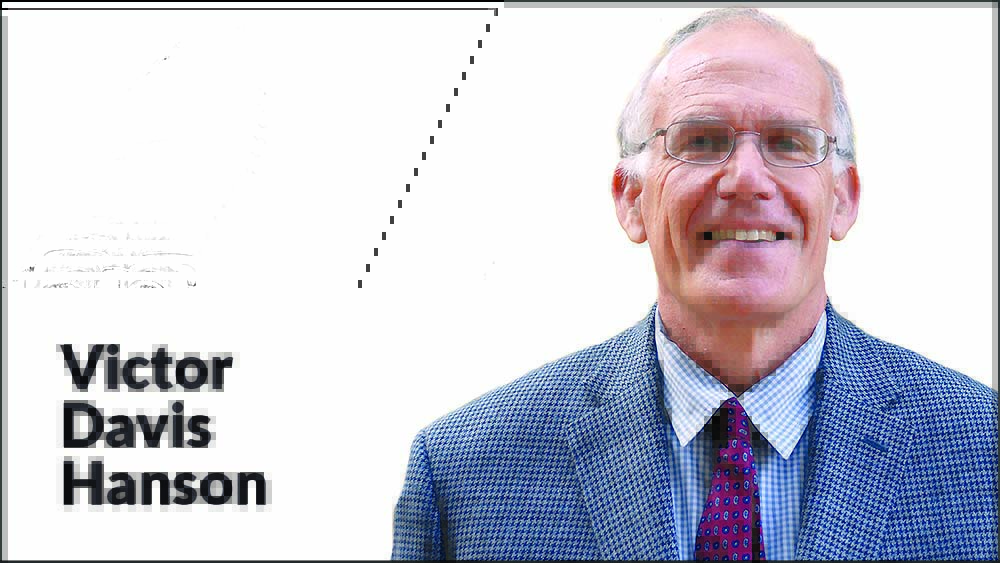 Victor Davis Hanson of the Hoover Institution is one of my favorites. Historian and classicist, he helps make sense of the world. Here’s an audio extract from one of his videos. The video is around 24 minutes long; the excerpt is half as long. In it he addresses the question of why people migrate to the West and not from the West.
As I am an immigrant, I can relate to the topic. After I got to the US, I began to understand that countries differ significantly in what they have to offer. The US is obviously more prosperous than India. At first I did not know nor did I particularly care why the US was so rich. But soon enough the matter intrigued me. Why was India so poor in comparison to the US? Continue reading “Victor Davis Hanson on Immigration”
This Policy, Alone – Part 4
 In this essay I aim to argue that if the education sector is totally deregulated and the free market is allowed to operate in it, then it will bring about a transformation that will enable the Indian economy to reach its potential by liberating the human capital that is the limiting factor now.
(Previously Part 1, Part 2, Part 3.)
For the moment I will leave the matter of why liberalization of education will transform the sector and how the free market will meet the obvious challenges. For now, I will address the point about why the government will not allow the liberalization of education regardless of how urgently necessary that may be or how unimaginably beneficial it could be for the country. Continue reading “This Policy, Alone – Part 4”
 Atanu Dey : Life is a Random Draw