Albert Einstein was born on 14th of March in 1879. Happy birthday dear Albert, happy birthday to you.
In the US, March 14th is 3/14. Since 3.14 is an approximation of π — the mathematical constant of the ratio of a circle’s circumference to its diameter — Americans celebrate today as Pi Day. It began in 1988 at the Exploratorium in San Francisco. Continue reading “Happy Pi Day & Happy Birthday, Einstein”
The remarkable thing about the most successful mass murderers of the world is that they are great leaders. Great leaders are great persuaders.
You’d have to get up pretty early in the morning and work very hard all day if you aimed to kill a few million single-handedly by the end of the day. No, that won’t work. You have to persuade a whole lot of other people to do the slaughtering for you. Meaning a lot of people have to think you are a pretty neat guy and they are lucky that they get to do the great work you command them to do. Mass murderers have to be dictators because otherwise you can’t murder that many.
Lenin, as Stephen Kotkin says, is the gold standard in brutal dictators. Here’s Kotkin in conversation with Peter Robinson. A brilliant video.
I don’t know if I’m being smart with my occasional “Ask me anything” or not. Perhaps I should charge for answers. I could use an old price list from a couple of decades ago — adjusted for inflation. But for now, I’ll keep all answers free. You’ve got a deal because all my answers require thought and are guaranteed correct.
Alright, Mohan Boggara’s question was (paraphrased): given the acceleration of digital technologies and the Covid situation, what will the future of education be? Since digital technologies allow easy partnership between content creators and learners, and allow flexibility in time and space, will in-class education as we know it end? And what will be the future of schools and universities? Continue reading “Answers”
1. Roses are flowers.
2. Some flowers fade rapidly.
3. Therefore, some roses fade rapidly.
Clearly it is logically invalid but it appears logical because it accords with our knowledge of the world — that some roses do fade rapidly.
The logical validity of a conclusion depends entirely on the premises, not on whether the world is some particular way. The statement “some roses fade rapidly” may be true in reality but it does not logically follow from the two premises, and therefore it is logically invalid. Continue reading “Ask me anything — the Logic edition”
If President Donald J Trump has any sense, he would do this. Give a presidential pardon to Julian Assange on the final day of his presidency. Listen to Tucker Carlson make the case.
Trump should also pardon Edward Snowden so that he can end his self-imposed exile in Russia. Will Trump do that? I don’t think so. He’s too stupid to do something that important.
“There is no God separate from you, no God higher than you, the real ‘you’. All the gods are little beings to you, all the ideas of God and Father in heaven are but your own reflection. God Himself is your image. ‘God created man after His own image.’ That is wrong. Man creates God after his own image. That is right. Throughout the universe we are creating gods after our own image. We create the god and fall down at his feet and worship him; and when this dream comes, we love it!”
― Swami Vivekananda, The Complete Works of Swami Vivekananda, Volume 3
“Astrology and all these mystical things are generally signs of a weak mind; therefore as soon as they are becoming prominent in our minds, we should see a physician, take good food, and rest.”
It’s hard to argue that people generally are not stupid. Just look at the Americans. They aren’t the worst of the lot but still they are bad.
The Dems and Repubs end up competing with each other on who can choose the worse presidential candidate. Four years ago the choice was between the evil witch Clinton and the stupid imbecile Trump — and the majority of the voters chose Clinton. By sheer luck, Clinton did not win the needed 270+ electoral college votes. So Americans got a break from suffering the consequences of their stupidity.
This time around Americans have not had that luck. Sleepy Joe did win, although with some ballot fraud, a great deal of help from Silicon Valley tech giants (Google, Facebook, Twitter, etc.) and the corrupt main stream media that buried the Hunter Biden case.
Joe Biden is quite senile but he is not a retard. He knows — or his advisors do — that poverty cannot be cured by promising to distribute checks. But it is the right thing to do to get popular support. Continue reading “Joe Biden is not a Retard”
“We will not solve our problem by electing the right people. We will only solve our problem by making it politically profitable for the wrong people to do the right thing.” — Milton Friedman.
He was one of the greatest economists of the 20th century not just because of his academic contributions but also because he was tireless in his public outreach. Unlike his colleagues whom he greatly respected, such as Friedrich Hayek and James Buchanan (both amazing scholars) who did not address the general public, Friedman patiently explained economics to everyone who cared to ask him.
The world economy was pretty huge at the start of the Covid-19 pandemic. The aggregate global GDP was US$ 88 trillion according to howmuch.net.
US continued to lead at $21.43T, about 50% larger than the next biggest, China at $14.34T. China, which used to be neck and neck with India around 40 years ago, is now five times as large as India in annual GDP terms: China’s $15T versus India’s $3T. The US and China together account for 40% of the world GDP and 23% of the world population. India accounts for 3.3% of the world GDP and 17% of the world population.
China’s economy grew from 2018 to 2019 to $14.34, but the country is still nowhere close to catching up to the U.S.
The rest of the world’s economic powerhouses have comparatively much smaller economies, including Japan ($5.08T), Germany ($3.84T) and India ($2.88T).
Our visualization doesn’t take into account the size of each country’s population.
My focus here is on India. India’s economy is estimated to have shrunk by 10% in 2020, thanks to the usual brain-dead economic policies of the Indian government; China’s economy expanded by 2%. In 2021, China’s GDP is expected to grow by 8% or so in 2021.
Well, the one constant in this world is change. The world’s biggest economies move in their rankings over time. According to satista.com, this is projected: Continue reading “The World Economy”
I am offering an online 10-week course titled “How the world works – an introduction.” The course will be on zoom for one hour every week on Friday at 9 PM IST (10:30 AM Eastern) starting Jan 15th. Homework will be announced a week in advance of class. Click the link (pdf) above for details.

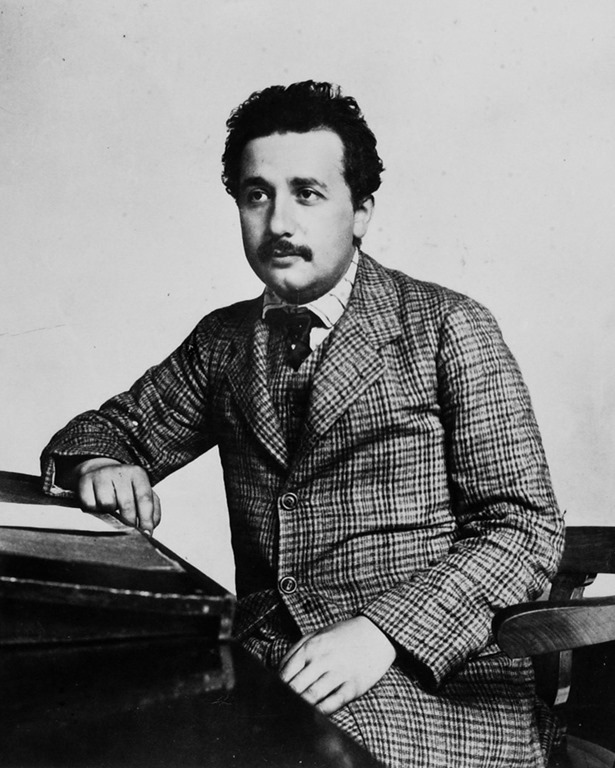 Albert Einstein was born on 14th of March in 1879. Happy birthday dear Albert, happy birthday to you.







 Atanu Dey : Life is a Random Draw