
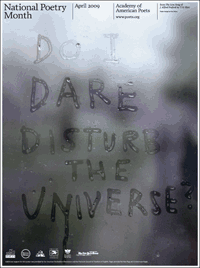
“Till human voices wake us, and we drown”

do_i_dare_poster

April is the National Poetry Month in the US. “Inaugurated by the Academy of American Poets in 1996, National Poetry Month is now held every April, when publishers, booksellers, literary organizations, libraries, schools and poets around the country band together to celebrate poetry and its vital place in American culture.”
Continue reading ““Till human voices wake us, and we drown””

The War and the Circus

Perhaps most humans are congenitally belligerent and can be reasonably expected to get into fights. But it takes institutionalized big businesses to create a war machine that raises ordinary human belligerence to levels of superhuman insanity. The war machine — and one can argue that indeed there is only one such thing but with a global reach, even though its components are multinational in the sense that people from various nations participate in their creation and maintenance — is so pervasive that it seems to be as natural, unchangeable, and logical as the seasons. Like the seasons, the war machine dictates how people carry on with their lives unquestioningly. People generally accept the war machine as naturally they do the seasons.
Continue reading “The War and the Circus”

The Lady Who Could Sing: A Parable

There was a young lady who could sing so beautifully that she would enchant every listener. Her songs could be heard everywhere. She was very good for the music lovers.

She became rich and famous. Lots of people wanted her to sing their songs. Because she was in demand, she began demanding things — such as not allowing any of her competitors to sing. She silenced her opposition.

Time goes by, and the young lady became an old lady. Her voice had become shrill and painful to listen to. But still she insisted on singing. The music lovers are eagerly waiting for her last song because only after she departs will sweet songs be heard once again.

A certain political organization has also grown old and unbearable. Isn’t it time we heard the last of it?

Comment on a blog post

Came across this comment by someone who signs off as “d.srikanth mbbs caims”:

plz convey my suggestn 2 shri advani

y dont they use dis point in campaign

nehru family ruling our country since 50 yrs they r rich by birth ,b4 d independence
wt abt aii other freedom fighters
wt abt mahatma gandhi family

I believe that it was made in earnest. I hear claims all the time that the Indian education system is excellent. You could have fooled me.

In Praise of Dead White Men

Brazilian President Luiz Inacio Lula Da Silva’s recent accusation that the financial crisis was caused by “white people with blue eyes” at a joint press conference with UK Prime Minister Brown is illuminating if not entirely accurate. [1] Everyone involved in the financial crisis certainly does not have blue eyes, although they may all be uniformly white. Da Silva claimed that he had never met a black banker. Continue reading “In Praise of Dead White Men”

Freeman Dyson: The Civil Heretic

Excellent feature on Freeman Dyson in the magazine section of the New York Times. I like the man and agree with him on — among other things — global warming and the environment. (Or should I say that I agree with the man and therefore I like him?)

A few paragraphs of excerpts below the fold.
Continue reading “Freeman Dyson: The Civil Heretic”

On Education, IT and the Government

In my previous post on “The Rational IT Policy” I claimed that there “is no need for any specific IT policy. The use of tools is the outcome of a set of rational processes which arise from a set of rational policies that address rational goals. IT use is a derivative demand, not a final demand. IT and its tools are an intermediate input to a process whose end result is desired.”
Continue reading “On Education, IT and the Government”

How New Zealand Tamed the Great Depression

Gordon Dryden is a Kiwi friend of mine. Born in 1931, he dropped out of school at age 14 and went on to become — as he puts it — a legend in his own mind. He lives in Auckland and is co-author of UNLIMITED: The new learning revolution and the seven keys to unlock it.

Below the fold you will find an article adapted from a presentation by Gordon to New Zealand Futures Trust, Wellington, on March 17, 2009. As Gordon writes in an email to me, “The first bit might remind you of parts of India today – and the second half: other parts of India today.”
Continue reading “How New Zealand Tamed the Great Depression”

A Rational IT Policy: The Introductory Bits

Follow up to BJP’s Policy of “IT for All”.

In the following, I will present the features of a rational “IT Policy” and argue why it makes sense. This is only an academic exercise as this is not likely to be followed by the policymakers of India. Color me cynical but if Indian policymakers were in the habit of making rational policies, India would not be a desperately poor country, would it? Why India gets saddled with moth eaten policies made by inept policymakers is a different matter that we will save for a rainy day. But first, let’s talk IT and what it is.
Continue reading “A Rational IT Policy: The Introductory Bits”

Is Karan Thapar an idiot?

I ask if Karan Thapar is a idiot or is he just a clueless retard? You might say that this is a false dichotomy — hardly much to choose from, you’d say. OK. How about if I rephrase that question: Is Karan Thapar a lobotomized cretin or is he a bottom-feeding douche bag? There, now you have a clear distinction. You may still reject the assumption implicit in the question — that he is either one or the other — and say that he is both. OK, I hear you and agree that my question is poorly phrased and so I conclude that he is all of the above.
Continue reading “Is Karan Thapar an idiot?”