Violence and Development

A couple of quotes related to violence and development.

“. . . all societies must deal with the problem of violence. In most developing countries, individuals and organizations actively use or threaten to use violence to gather wealth and resources, and violence has to be restrained for development to occur. In many societies the potential for violence is latent: organizations generally refrain from violence in most years, but occasionally find violence a useful tool for pursuing their ends. These societies live in the shadow of violence, and they account for most of human history and for most of today’s world population. Social arrangements deter the use of violence by creating incentives for powerful individuals to coordinate rather than fight.”

Source: In the Shadow of Violence: Politics, Economics, and the Problems of Development. Edited by Douglass C. North, et al. Cambridge Univ Press 2013.

“Political development occurs when people domesticate violence, transforming coercion from a means of predation into a productive resource. Coercion becomes productive when it is employed not to seize or to destroy wealth, but rather to safeguard and promote its creation.”

Source: Prosperity and Violence: The Political Economy of Development. Robert H. Bates. (2001)

A related post worth a read is “Of Kakistocracies, Principals and Agents.

Open Thread: The Directed Society

Long time since we had an open thread. So say what you will. Today’s quote is by Walter Lippmann (1889 – 1974), the celebrated American writer, political commentator and journalist. I am currently reading his book The Good Society (1937). A brief quote below the fold.
Continue reading “Open Thread: The Directed Society”

Karl Popper on the Limits of Tolerance

“Unlimited tolerance must lead to the disappearance of tolerance. If we extend unlimited tolerance even to those who are intolerant, if we are not prepared to defend a tolerant society against the onslaught of the intolerant, then the tolerant will be destroyed, and tolerance with them. — In this formulation, I do not imply, for instance, that we should always suppress the utterance of intolerant philosophies; as long as we can counter them by rational argument and keep them in check by public opinion, suppression would certainly be unwise. But we should claim the right to suppress them if necessary even by force; for it may easily turn out that they are not prepared to meet us on the level of rational argument, but begin by denouncing all argument; they may forbid their followers to listen to rational argument, because it is deceptive, and teach them to answer arguments by the use of their fists or pistols. We should therefore claim, in the name of tolerance, the right not to tolerate the intolerant. We should claim that any movement preaching intolerance places itself outside the law, and we should consider incitement to intolerance and persecution as criminal, in the same way as we should consider incitement to murder, or to kidnapping, or to the revival of the slave trade, as criminal.”

– Karl Popper, The Open Society and Its Enemies (1945), Vol. 1, Notes to the Chapters: Ch. 7, Note 4.

“I have insisted that we must be tolerant. But I also believe that this tolerance has its limits. We must not trust those anti-humanitarian religions which not only preach destruction but act accordingly. For if we tolerate them, then we become ourselves responsible for their deeds.”

— Karl Popper. After the Open Society.

Adam Smith on the Division of Labor

This is from An Inquiry into the Nature and Causes of the Wealth of Nations [1776] by Adam Smith (1723 – 1790), the great Scottish moral philosopher and the granddaddy of classical economics.
Continue reading “Adam Smith on the Division of Labor”

The Dreamer and the Dream

“I am not what happened to me, I am what I choose to become.” That’s Carl Jung (1875 – 1961). Wiki says, he “was a Swiss psychiatrist and psychotherapist who founded analytical psychology. His work has been influential not only in psychiatry but also in philosophy, anthropology, archaeology, literature, and religious studies. . . . Jung created some of the best known psychological concepts, including the archetype, the collective unconscious, the complex, and extraversion and introversion.”

A few quotes follow.
Continue reading “The Dreamer and the Dream”

Open Thread: Ask me anything

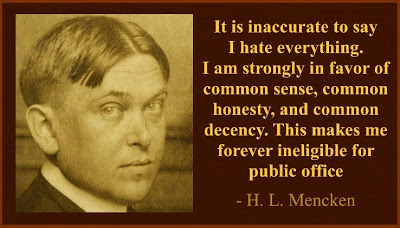
h l mencken_1Long time since we had an open thread. This is an “Ask me anything” post. What’s on your mind?

Apropos nothing, let’s read Mencken. Mencken was insightful. For instance, he noted the “basic delusion that men may be governed and yet be free.”
Continue reading “Open Thread: Ask me anything”

PJ O’Rourke: Every government is a parliament of whores

From PJ O’Rourke’s Parliament of Whores:

“Authority has always attracted the lowest elements in the human race. All through history, mankind has been bullied by scum. Those who lord it over their fellows and toss commands in every direction and would boss the grass in the meadow about which way to bend in the wind are the most depraved kind of prostitutes. They will submit to any indignity, perform any vile act, do anything to achieve power. The worst off-sloughings of the planet are the ingredients of sovereignty. Every government is a parliament of whores. The trouble is, in a democracy the whores are us.”

And a bonus quote:

“No drug, not even alcohol, causes the fundamental ills of society. If we’re looking for the source of our troubles, we shouldn’t test people for drugs, we should test them for stupidity, ignorance, greed and love of power.”

I believe that most of those in government today — everywhere, not just in third world countries — would test positive for stupidity, ignorance, greed and love of power.

Happy 4th of July.

Herbert Simon — Information consumes attention

Herbert Simon (1971) “Designing Organizations for an Information-Rich World”

In an information-rich world, the wealth of information means a dearth of something else: a scarcity of whatever it is that information consumes. What information consumes is rather obvious: it consumes the attention of its recipients. Hence a wealth of information creates a poverty of attention and a need to allocate that attention efficiently among the overabundance of information sources that might consume it.

Hayek on “The Mirage of Social Justice”

Such is the current state of public debate and understanding that anyone who is against or even questions the presumed desirability of what is known as “social justice” is axiomatically equated with being a monster lacking basic human morality and compassion. Friedrich Hayek (1899 – 1992), one may say, was one such monster. He began by trying to make as good a case in support of the ideal of ‘social justice’ as he could but realized that the concept was meaningless. “I have now become convinced, however, that the people who habitually employ the phrase simply do not know themselves what they mean by it and just use it as an assertion that a claim is justified without giving a reason for it.” That’s from his book The Mirage of Social Justice, the second volume of his magnum opus Law, Legislation and Liberty (1973). Here’s an extended quote from it.
Continue reading “Hayek on “The Mirage of Social Justice””

Man versus the State

HerbertSpencer English philosopher, biologist, anthropologist, sociologist, and prominent classical liberal political theorist of the Victorian era, Herbert Spencer (1820-1903) wrote this in “The Man versus the State” (1884).
Continue reading “Man versus the State”