His Most Exalted Holiness Sri Maha Param Pujaniya Gurudevji Bhagwanji Sriman Sri Sri Ravi Shankarji Mahadevji, I presume

Time for a little diversion, don’t you think? Of late this blog has been too involved with serious matters and I think it is time for something entirely different. Many of you regulars know that SSRS — a.k.a Sri Sri Ravi Shankar, a.k.a Param Pujaniya Gurudev Sri Sri Ravishankarji, a.k.a His Most Exalted Holiness the Maha Param Pujaniya Gurudev Bhagwan Sriman Sri Sri Ravi Shankarji Mahadevji, etc etc — is a favorite diversion for this blog. As luck would have it, another of His Most Exalted Holiness Sri Maha Param Pujaniya Gurudevji Bhagwanji Sriman Sri Sri Ravi Shankarji Mahadevji’s (henceforth shortened as HMEHSMHPGBSSSRSM) devotees has deigned to write me a note instructing me to mend my ways.

[I know that this naming of the man is getting a bit out of hand. Previously I had been persuaded by his worshipers that the proper title for the man should be “the Supreme Commander of the Universe out of whose Nether Regions the Sun shines in all its Splendor” which for convenience one should write as SCOTUOOWNRTSSIAIS. So I say, take your pick — use HMEHSMHPGBSSSRSM or SCOTUOOWNRTSSIAIS — whichever you fancy, until of course another embellishment comes along to do proper justice to the amazing abilities of this god on earth.]
Continue reading “His Most Exalted Holiness Sri Maha Param Pujaniya Gurudevji Bhagwanji Sriman Sri Sri Ravi Shankarji Mahadevji, I presume”

Happy Birthday, Mr Jefferson

Thomas Jefferson (April 13, 1743 – July 4, 1826) was the third President of the United States (1801–1809), the principal author of the Declaration of Independence (1776), and one of the most influential Founding Fathers for his promotion of the ideals of republicanism in the United States. [Wikipedia]

Happy birthday, Mr Jefferson.

Here’s something that Jefferson insisted upon that the Indian government would do well to adopt. In the Virginia Statute of Religious Freedom, Jefferson wrote:
Continue reading “Happy Birthday, Mr Jefferson”

Nehru’s Arrogant Ambition

[From the Berkeley blog June 2003 archives.]

Why is India poor? As some have argued, India is poor by choice. I will explore that idea a bit here.

Of course, that does not mean that every poor Indian has chosen to be poor. Someone else in a position of power made choices whose consequences are evident. India’s leaders – past and present – have consistently made choices that have had, and are having, a disastrous effect on the lives of hundreds of millions of human beings. What motivates these people is a question that directly follows from any attempt to answer the question of why India is poor. Nehru epitomizes the class of people that have through their choices doomed India to being an almost irrelevant nation of one billion humans.
Continue reading “Nehru’s Arrogant Ambition”

Arthur C Clark: The Final Odyssey

Sir Arthur C Clarke 1917–2008 departed the planet yesterday for his rendezvous with Rama in geosynchronous orbit.

Like millions of others of my generation, I grew up reading science fiction. I liked Arthur C Clarke the best. Based on his story “The Sentinel,” the movie “2001: A Space Odyssey,” is one of my all-time favorite movies. He collaborated with Stanley Kubrick on the book and the film. I suppose I will have to watch it again soon in his memory.

Whenever I am astounded by technology, I am reminded of Clarke’s Law: “Any sufficiently advanced technology is indistinguishable from magic.”
Continue reading “Arthur C Clark: The Final Odyssey”

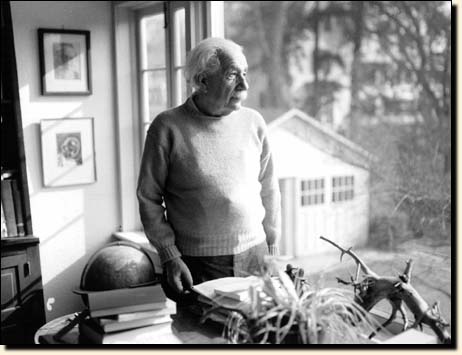
A bit from Einstein

I confess that if there is one human whom I come close to worshiping, it is Albert Einstein.

[Picture source.]

“The important thing is not to stop questioning. Curiosity has its own reason for existing. One cannot help but be in awe when one contemplates the mysteries of eternity… Never lose a holy curiosity.”
Continue reading “A bit from Einstein”

Ridiculing Religious Insanity

Religious insanity should be ridiculed as strenuously and as frequently as one can. Here I am talking about the recent demand by the Pastafarians that since their religion forbids the eating of pasta without meatballs, all vegetarian pasta dishes be banned. It offends the Pastafarians that people can even contemplate the eating of pasta without the required half a dozen meatballs.
Continue reading “Ridiculing Religious Insanity”

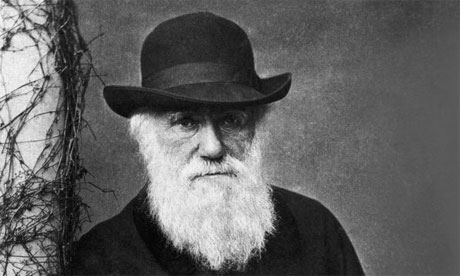
Darwin’s Big Idea

Richard Dawkins summarizes Darwin’s big idea in one sentence: “Given sufficient time, the non-random survival of hereditary entities (which occasionally miscopy) will generate complexity, diversity, beauty, and an illusion of design so persuasive that it is almost impossible to distinguish from deliberate intelligent design.”

Dawkins remarks on the amazing explanatory power of the idea of natural selection. I find reflections of that sort of explanatory power in Adam Smith’s idea that markets work and lead to social welfare gains.

It is interesting that it takes many years of internalizing of a big idea before one can fully comprehend it. It is only after it has been comprehended that one can then express it succinctly and accurately. And to understand why some others find it hard to comprehend certain ideas. Dawkins writes:

It is mainly its power to simulate the illusion of design that makes Darwin’s big idea seem threatening to a certain kind of mind. The same power constitutes the most formidable barrier to understanding it. People are naturally incredulous that anything so simple could explain so much. To a naive observer of the wondrous complexity of life, it just must have been intelligently designed.

I have worked out a model why we find it hard to comprehend — internalize — certain ideas. I will go into it one of these days. For now I would like to note that Charles Darwin (1809 – 1882) was influenced by the ideas of a fellow Englishman, the great economist Thomas Malthus (1766 – 1834).

Great ideas are the greatest achievements of humans. What is worth pondering is why these ideas arise among certain people and not among others. Are there any regularities that characterize the populations within which great ideas arise? In 1776, Adam Smith (1723 – 1790) published his An Inquiry into the Nature and Causes of the Wealth of Nations. In the same year, the founding document of the United States of America, the Declaration of Independence, was written (principally) by Thomas Jefferson (1743 – 1826). And again it was in 1776 that Thomas Paine (1737 – 1809), “The Father of the American Revolution,” published Common Sense.

Why?

[Link: Richard Dawkins on “Why Darwin Matters.”]

Was Nehru a Dictator? — Part 2

I had arrived at the hypothesis that Nehru was a dictator not from a careful reading of history but rather a careful observation of contemporary reality. First, I saw that Nehru was clearly considered one of the greatest leaders of India — so much so that his descendants were considered by a very large segment of Indians to be natural born leaders. Second, Nehru’s name graced too many institutions for my comfort. It reeked of idol worship. Third, he appeared to be a person of very limited intelligence and even more limited wisdom. The development path of India was perhaps set back a couple of generations at least and at the horrible human cost of hundreds of millions of lives lived in abject misery.
Continue reading “Was Nehru a Dictator? — Part 2”

The Resurrection of Gandhi

Arvind Lavakare in an article titled The Myth of Mahatma Gandhi notes that the Gandhi icon had been losing its sheen for years until the present government began giving it a nice new varnish. Maybe it is an attempt to “to fuse the original Gandhi image with the Italian one” he hints. I am convinced of that, however. Reading the comments on that article is instructive. Many of them are the equivalent of sticking one’s fingers in one’s ears and loudly repeating “I am not listening. nana nana nana.” If people who are literate and supposedly educated are brainwashed enough to not even entertain an argument supported by evidence, what hope is there for the vast majority who have no access to alternative viewpoints to ever recover from the effects of the constant barrage of images promoting Gandhi as the sole savior of India?

If I were an illiterate person, I would be convinced that Gandhi is goodness personified. After all, doesn’t Indian money carry his image? Isn’t he the father of the nation? And should I not vote for Gandhi’s children — Rajiv, Sonia, Rahul, whoever? And should I not vote for the party that Gandhi founded? And should I not believe everything from a person who says he is a Gandhian?

Anyway, I must admit that the Congress party of India has a winning formula and they know it. Gandhi is the biggest brand name in the world — forget Coca Cola and McDonalds. Mera Bharat Mahan!