Solar Power

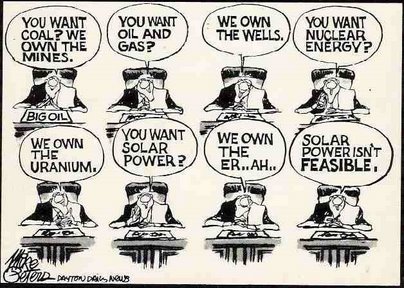
In the earlier post on Public Investment for Solar Power I had advocated that the government of India should spend a huge deal of money in research and development of the technology for using solar power.
This is a brief response to a couple of comments to that post. First, let’s recognize that the current state of the art does not allow the harnessing of solar energy on a scale that will make conventional fuels obsolete or even make a significant dent in their demand. That is precisely why more research and development is required. If doing the R&D were cheap and easy, we would not be having this discussion because it would have been done by some enterprising corporation already. The reason I put the figure around US$100 billion is because it is going to be a hard problem — you have to solve all sorts of related issues, from storage technology to fabrication of photo-voltaic devices to the mass manufacture of associated equipment.
Second, public investment does not mean that a bunch of government entities will be doing the R&D. Funding is public but the actual work can be entirely in the private sector. The hard problem is to create the mechanism which would allocate the funds to the most productive teams. One way would be to create an independent authority or an institution along the lines of the National Science Foundation or NASA of the US.
Technology does not spontaneously arise out of thin air. Someone somewhere at some time has to have the will to make the effort to develop it. So far for all practical purposes all the modern technologies are developed in the West, particularly in the US. It is time for us to pause and wonder why it never happens in India. Are Indians incapable of developing technology? Surely they are not dumber than any other large aggregate of people. Are they lacking resources? Not really, because India is a large country, even though it is poor in per capita income and wealth. So what is the missing ingredient? I think it is a lack of vision, a lack of national pride. Sometimes in a dark mood I think that Indians are a nation of followers, not leaders.
All processes in our universe, from the sub-atomic to the super-galactic, involve the use of energy. The fundamental laws of thermodynamics attest to that. So it should come as no surprise that energy rests at the core of all human advancement and economic growth. The story of human civilization is principally that of an increasing ability to find and exploit energy sources. Until relatively recently in human history, animals and humans were the principle sources of energy. Slavery was an unfortunate consequence of that need for energy. Coal later powered the industrial revolution. The discovery of petroleum oil about 150 years ago literally fueled such phenomenal growth that it increased human population six-fold to its present over 6 billion.
Continue reading “Public Investment in Solar Power”
[Previous Posts on “Free Energy”: Part 1, Part 2]
Keith Hudson, the author of the outstanding Daily Wisdom postings, recently commented on the matter of free energy. With his permission, I am sharing his post with the readers of this blog. Continue reading ““Free” Energy? Not Really — Part 3″
Magical thinking and wishful thinking are fraternal, if not identical, twins. Both are cognitive traps that our emotional selves stumble into. Both are characteristically childlike. While childlike behavior and mentation is adorable in small children, when adults do it, it is childish and not cute. There is no law which says that adults cannot, or should not, behave childishly if they so wish. But they should do so in the privacy of their own homes, and I suspect most people do behave childishly occasionally in private with their significant others. If they do so in public, we are justified in telling them, “Sheesh, get a room.” Continue reading ““Free” Energy? Not Really — Part 2″
This is getting curiouser and curiouser. First there was “free textbooks.” Now there is free energy. Scientific American: Irish tech firm throws down “free energy” gauntlet
Perpetual motion machines of the first, second, and third kind? Not going to happen.
Markets Work
Economists have a mantra which says “Markets work” and mumble under their breath the disclaimer “subject to a bunch of conditions, of course.” By “markets work” they mean that when a whole lot of buyers and sellers get together and buy and sell stuff, magic happens through Adam Smith’s invisible hand, and everyone ends up better off than they were before the trades took place. Each market participant has to be concerned with only his objective (maximizing utility in the case of consumers, and maximizing profits in the case of producers) and the maximization of social welfare is assured.
When you go to buy, say, fuel for your home, you check out the alternatives and buy what suits your purpose cheapest. Basically, subject to the thickness of your wallet, you demand a quantity based on the price which you take as a given and which you cannot alter. You really don’t care how the fuel was produced or mined, how it was transported, how it was stored, and a million other things that went it to the process of getting that fuel to the store. All you care about is the price, and rightly so, because the price encapsulates within itself all the information you need to make the decision.
Continue reading “Ethanol and Mr Vinod Khosla”
“Fossil fuel is dead,” declared CJ.
CJ likes to make those kinds of superficially profound statements. We were meeting after a long time. I was in Delhi for a conference and caught up with CJ at the Taj Mansingh Hotel coffee shop. We were discussing the spike in the gas prices.
“Dead or not, seventy dollars a barrel for crude was bad news for India considering that India imports about half of its energy needs. Will slow down the economy a bit, won’t it?” I said.
Continue reading “The Future of Energy”
Here is an item of interest that I got from Reuben’s weblog.
Bajaj Auto’s 3-wheeler utility vehicles are about to be released in the US.
Now that is precious, ain’t it?
A number of interesting lessons can be drawn from that. First, and foremost, that Indian innovation is not something that can be easily dismissed. Indian firms can come up with solutions that have wide applicability. Second, that of learning by doing and the importance of a large domestic market for creating comparative advantage. Third, the need to think and act locally and then move to act globally. Continue reading “Solar Power Super Power”
 Atanu Dey : Life is a Random Draw