
Making of a garden city

leekyew

Whether personal or societal, transformations generally require will and vision. In the case of personal transformation, unless one is a schizophrenic, a combination of intelligence, basic human values, determination, foresight and will is sufficient. For social transformation, something more is needed. Clearly leadership matters.

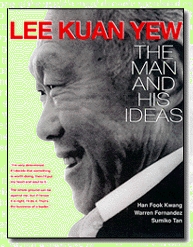
Here’s something to think about. Below the fold is an extended excerpt from the book, “Lee Kuan Yew: The Man and His Ideas” by Kwang, Tan and Fernandez. Indian leaders ought to take note. Or at the very least, they should read what Lee Kuan Yew has accomplished.
Continue reading “Making of a garden city”

BJP’s “IT for All”

Information technology (IT) is arguably one of the more remarkable products of the advanced industrialized countries (AIC). Its development in the AICs and subsequent widespread use there indicates that IT tools are not only a consequence of economic growth and development, but is also the cause of further economic growth. Developing countries such as India are attempting to catch up and they are fortunate to have the use of IT at an earlier stage of their development than the currently developed countries had when they were developing.

I am pleased to note that the BJP believes in the use of technology for development. The BJP recognizes that IT enhances productivity and increases production. Their press release on the IT vision document is unequivocal and clearly lays out the components of the policy. It should be required reading for pundits and lay persons alike. Their policy declaration “IT for All” is bold, visionary, timel and ambitious. It is also fatally flawed and wrong-headed.
Continue reading “BJP’s “IT for All””

Manufacturing Wealth: The Economics of Urbanization

That’s the title of the course I am conducting at the Indian School of Business, Hyderabad. It is a small class of about 15 students. It’s a half-credit elective in the final term of the year.

We have had two lectures so far. I am having fun — which is another way of saying that I am learning quite a bit. I think I will share some of what I have learned on this blog in the next few weeks.
Continue reading “Manufacturing Wealth: The Economics of Urbanization”

LK Advani’s speech to the FICCI

If you want to build a ship, don’t drum up people together to collect wood and don’t assign them tasks and work, but rather teach them to long for the endless immensity of the sea,” advised Antoine de Saint-Exupery.

Does makes sense, doesn’t it? Motivating the task is the real job of the leader, not messing around with petty details.
Continue reading “LK Advani’s speech to the FICCI”

BBC Program on Cities and Rural Development.

I have been promoting that idea — that the solution to rural development lies in urban planning — for a few years. The RISC model (Rural Infrastructure & Services Commons) is about planting the seeds of in situ urbanization in rural India. Glad to see that the idea that urbanization is essential for development and growth is gaining momentum. One of these centuries, the government of India may even wake up. Although by then, I will be with yesterday’s seven thousand year.
Continue reading “BBC Program on Cities and Rural Development.”

Indian Reforms

Pranab Bardhan on why any Indian government’s claim that it supports reforms is not credible:

. . . it is anomalous to expect reform to be carried out by an administrative setup that for many years has functioned as an inert heavy-handed, corrupt, over-centralized, and uncoordinated monolith. Economic reform is about competition and incentives, and a governmental machinery that does not itself allow them in its own internal organization is an unconvincing proponent or carrier of that message.

Lee Kuan Yew on PURA

In an article in the Business Line titled “Kalam’s PURA will not work,” Lee Kuan Yew makes the case for urbanization of the population for India to develop.
Continue reading “Lee Kuan Yew on PURA”

Pranab Bardhan on Authoritarianism and Democracy

Prof Pranab Bardhan in the Financial Times on “What does this authoritarian moment mean for developing countries?

India’s experience suggests that democracy can also hinder development in a number of ways. Competitive populism– short-run pandering and handouts to win elections– may hurt long-run investment, particularly in physical infrastructure, which is the key bottleneck for Indian development. Such political arrangements make it difficult, for example, to charge user fees for roads, electricity, and irrigation, discouraging investment in these areas, unlike in China where infrastructure companies charge full commercial rates. Competitive populism also makes it difficult to carry out policy experimentation of the kind the Chinese excelled in: for example, it is harder to cut losses and retreat from a failed project in India, which, with its inevitable job losses and bail-out pressures, has electoral consequences that discourage leaders from carrying out policy experimentation in the first place. Finally, democracy’s slow decision-making processes can be costly in a world of fast-changing markets and technology.

Pro-poor policies work

Pro-industrial policies promote industry, pro-health policy promote health, pro-education policies promote education. So it is natural that India’s pro-poor policies — and let’s be very clear that every single one of India’s economic policies have been pro-poor — work and promote poverty and the number of poor keeps on going up. The absolute number keeps growing. What about the percentage? It does keep improving.

So what’s the latest on poverty in India from the World Bank? It is reported that the WB released some study which talks about the changes in the recent past. Good news or bad new? Depends on who is reporting the study. Sort of like assessing beauty — which we all know lies in the eyes of the beholder. Rediff says “India has fewer poor people: World Bank“. IBNLive reads the same report and says “Number of poor in India has gone up: World Bank.” (Thanks Dr A for the links.)

How’s that for objective reporting?

India and Australia

There can be no doubt that Australia is looming larger and larger on the Indian horizon. Speaking personally, thanks to my participation with the LAFIA2008 — Leading Australia’s Future in Asia-Pacific — delegation in July, I have gained an increased appreciation of the issues that will draw Australia and India into a deeper strategic and economic relationship.
Continue reading “India and Australia”