
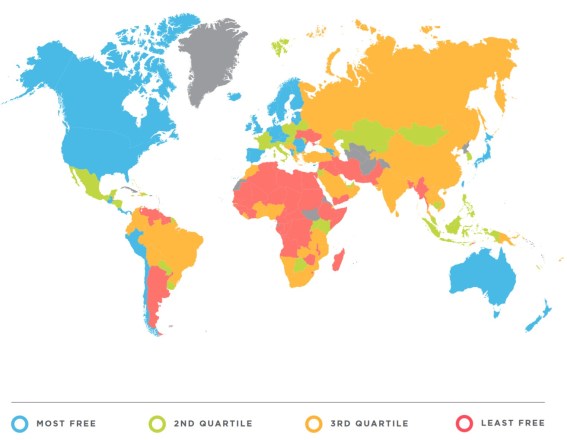
 The Economic Freedom of the World Annual Report 2022, published by the Fraser Institute, is available for download (pdf) here. It reports on the economic freedom for the year 2020. The exec summary begins with: Continue reading “Economic Freedom of the World 2022”
Author: Atanu Dey
Economist.
Ganapati Vighan Haran
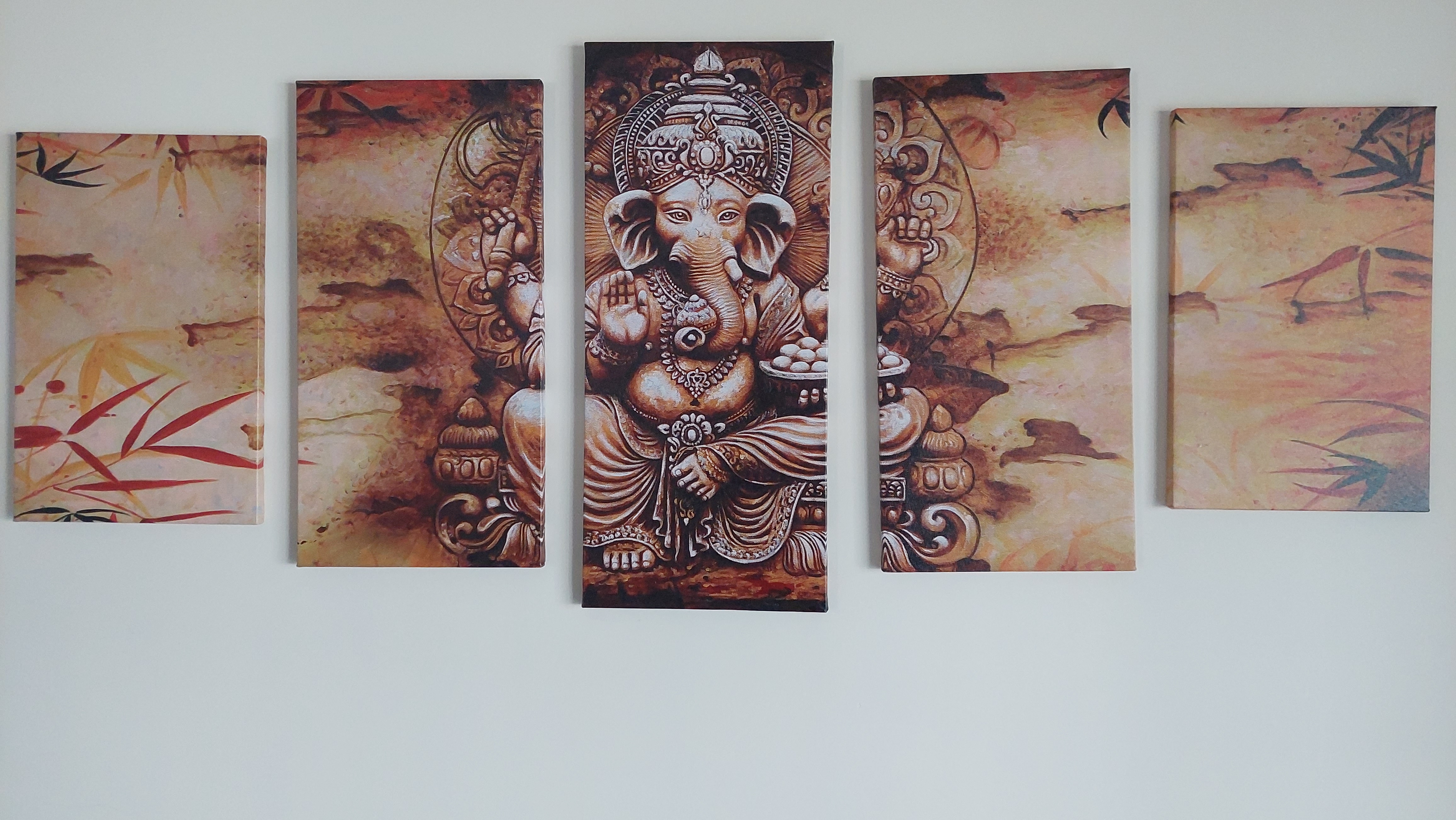 This is a tradition I stick to. I try to post on Ganesh Chaturthi every year, and today is no exception.
Born in Nagpur, Maharashtra, two Hindu festivals were paramount for me — Durga Puja is common to all Bengalis, and then there’s Ganesh Puja which is common to people in Maharashtra. That’s central to who I am.
My home in the US is sparsely decorated but I have a wall-hanging in the kitchen. It was a house-warming gift from my friend Yoganand. That’s a picture of it at the top of this post. Continue reading “Ganapati Vighan Haran”
Dhan Vapasi — Credit Constraint
 How can the poor be helped is the most insistent question that the bleeding-hearted ask but only the hard-headed can answer. The fact that one has to understand is that the state of being poor is the background, default, standard state of every one of us.
No one is born wealthy. Everyone is born naked, helpless and poor. Sure, some are born to sweet delight but most us reading this were not born to an endless night.[1] We were born to parents who were not poor, and could afford to give more us than what was needed for basic survival. And that makes all the difference. Non-poor parents are able to provide “credit” to their children. That credit helped us, their children, to become capable of producing wealth. We, in turn, can then provide credit to our own children — and the cycle continues. Continue reading “Dhan Vapasi — Credit Constraint”
Dhan Vapasi – not a Batshit Crazy idea
 In the previous piece on Dhan Vapasi, I declared that the government must not own any property. The government’s job is to provide a service to the community. Provision of a service does not require ownership of property or even the tools. One could have tools one uses to provide a service — a vacuum cleaner if you are in the house-cleaning business, for example — but you if you don’t own one, you rent one. The government provides governance services and that does not in any way require those in government to own anything at all, let alone owning private property and least of all people. This is not that hard to understand. Continue reading “Dhan Vapasi – not a Batshit Crazy idea”
Dhan Vapasi – Public Property
 In a previous post, Restitution of Stolen Property, I had offered to answer questions on “Dhan Vapasi.” Anirudh asked a set of questions, which I answer here.
To understand the concept of Dhan Vapasi (that’s Hindi for “wealth return”), I recommend a visit to the DhanVapasi.com site. I recommend reading the Dhan Vapasi booklet (pdf) for a getting a good understanding of the idea. Rajesh Jain and I had proposed the idea about five years ago. Continue reading “Dhan Vapasi – Public Property”
Airports

The answer to the post A Simple Puzzle is “the number of airports.” The US has the largest number of airpots in the world: around 20,000 — give or take a few dozens.
It’s not hard to explain why this is so. The US is vast, is rich, and has been the pioneer in aviation since the beginning of powered flight in 1903.
August 15th — National Relaxation Day
 This day is one of the most important days of my life. But not because it’s National Relaxation Day in the US. Everyday is a relaxation day for me, anyway.
I know that Aug 15th is publicly celebrated across India as “Independence Day” but that, to my mind, is totally idiotic because Indians are not independent even 75 years after India became “independent” of colonial rule. Indians are still under colonial rule — the difference is that instead of foreign colonial rule, now the rule is by domestic colonial rulers. This is actually worse than what it was before 1947. At least the Britishers were foreigners. But now Indians oppress their own. They enslave their own. Pitiable. Continue reading “August 15th — National Relaxation Day”
Restitution Revisited
 In a previous post, I laid out a method for the restitution of properties that have been taken by invaders. In it I argued among other things that “all property that have been acquired through plunder should be methodically auctioned, and the proceeds from them be distributed to every citizen, regardless of whether they are the descendants of the plundered or the plunderers.”
That principle of restitution is simple enough to provide guidance in matters that relate to compensation for harm caused by historical events. One commentator to that piece raised a question. His comment outlines a scenario I paraphrase as: Continue reading “Restitution Revisited”
Fun Con
 Creativity, innovativeness, inventiveness — all fine and necessary characteristics of any prosperous and flourishing people. The US has heaps of that good stuff, evidently. But then those same characteristics are also necessary for being a good con artist. The US has also has had loads of them.
One of the best of the lot was portrayed by the superbly talented Leonardo DiCaprio in the 2002 Steven Spielberg movie Catch Me If You Can. It was based on the
I enjoyed the movie. Just recently I came across a June 1978 episode of Johnny Carson’s The Tonight Show in which there’s the real Mr Frank Abagnale telling his story. His story is not fictional — because fiction has to be believable. Only a real story can be this unbelievable. Here’s a prediction: I bet you will have a big smile on your face, or even burst out laughing at the genius of the guy. Here it is. Continue reading “Fun Con”
JWST

Two facts about our modern world: one, human-created technology reveals to us a universe that is beyond human imagining and comprehension; two, nearly all of us are either totally unaware of what we as a collective are discovering or, even if we catch fleeting glimpses of what is being discovered, we are so blasé about it that it does not move most of us.
That attitude of being uninterested in the modern marvels is understandable because we really don’t have the time. We have stuff to get done. However, though getting mundane things done matters, it is also important to take a bit of time to pause and wonder at the the vision of the universe that lies beyond, and which technologies like the James Webb Space Telescope enable us to see. What are we capable of seeing today has not been seen by anyone ever. Of the countless trillions of living things that have ever lived on earth, we — the present around 8 billion humans — are the only ones who have that opportunity. Continue reading “JWST”
 Atanu Dey : Life is a Random Draw