
Free speech has always been under attack. Throughout history, there have always been people who claim to know the truth and to possess the right to silence others who hold contrary views. So also throughout history, there have been defenders of free speech. The great English political theorist and moral philosopher John Stuart Mill (1806-1873) was a formidable force in defending the freedom of speech. He devoted the second chapter of his book “On Liberty” (1859) on the topic of the freedom of thought and expression. Here’s a brief excerpt from it.
Continue reading “John Stuart Mill on the Liberty of Thought and Discussion”
Author: Atanu Dey
Economist.
Reading Ronald Coase
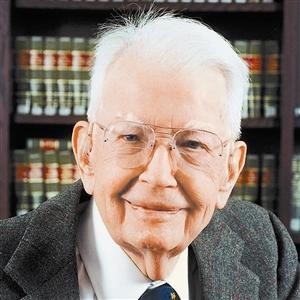 Are you a well-read economist?
You aren’t if you cannot appreciate the Coase Theorem. (That theorem is one of the most cited in all of academic literature. Note, not just econ literature but all academic literature.) In other words, understanding the Coase theorem is part of being a complete economist.
Here are a few references to Ronald Coase, winner of the Economics “Nobel” Prize 1991, and his work:
Ronald Coase (Dec 1910 – Sep 2013) wiki page.
“The Nature of the Firm” (1937) wiki page.
“The Problem of Social Cost” wiki page.
Ask me anything
It’s time to have a conversation. I intend to have google hangouts on a regular basis. I am taking suggestions on the day and time. But first, would you like to join? Would the weekends be a good time for you? And if so, what time? Of course, you can ask me anything by leaving a comment on this post. I hope to hear from you on this open thread.
An ad from 1947: “The Uphill Task Ahead”
My friend Veer shared this advertisement from 1947.
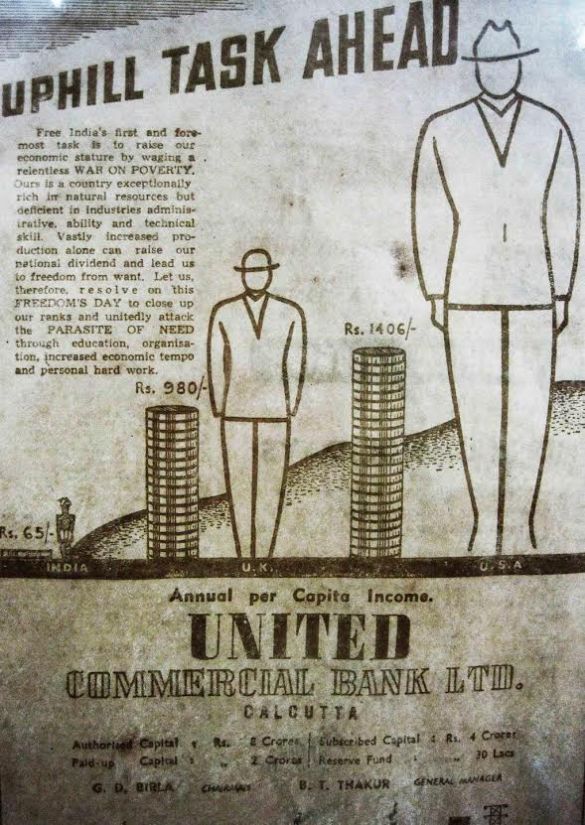
After 68 years, Indians are still fighting a war on poverty and it is still an “Uphill Task Ahead.” Very little has changed since 1947 in the economic environment, and what little change there has been regressive. Certainly relative to 1947, Indians have progressed but relative to others, India has slipped further behind.
Continue reading “An ad from 1947: “The Uphill Task Ahead””
Pohela Boishakh, Vishu, and Puthandu Greetings
It’s a new year for the people of Bengal, Kerala and Tamil Nadu. Happy New Year wishes.
ॐ सर्वे भवन्तु सुखिनः
सर्वे सन्तु निरामयाः ।
सर्वे भद्राणि पश्यन्तु
मा कश्चिद्दुःखभाग्भवेत् ।
ॐ शान्तिः शान्तिः शान्तिः ॥
Om Sarve Bhavantu Sukhinah
Sarve Santu Nir-Aamayaah |
Sarve Bhadraanni Pashyantu
Maa Kashcid-Duhkha-Bhaag-Bhavet |
Om Shaantih Shaantih Shaantih ||
Om, may all become happy,
All be free from illness.
All see what is auspicious,
May no one suffer.
Om peace, peace, peace.
Rich People Spend More
It is very satisfying when research corroborates naive intuition. We expect water to flow downhill and when research after much painstaking data analysis concludes that indeed water flows downhill, it is a valuable addition to human knowledge and understanding. Switching off sarcasm mode now. I entered that mode when I read “Rich People Are Great at Spending Money to Make Their Kids Rich, Too” in The Atlantic. (Hat tip: Rajan.) An accompanying graphic shows “Share of Spending on Certain Categories, by Income Group” —

Watching the Lunar Eclipse
Right now, as seen from San Jose, CA, the moon is close to totally eclipsed. The footage from Los Angeles’s Griffith Observatory below.
http://rt.com/on-air/blood-moon-total-eclipse/embed/

 This is the third in a series of four total lunar eclipses that began in mid-April last year.

Goodbye, Mr Lee Kuan Yew

Friday the 13th, Pi Day the 14th & Beware the Ides of March
But first, if you are superstitious then be wary since it is Friday the 13th. If you know anything about numbers, and you live in the US, then you can be irrational on Saturday which is Pi Day.

This pi day stuff works only in the US convention of writing mm/dd/yy for dates.
But whatever you do, beware the Ides of March.
Public Choice Society Conference at San Antonio TX Mar 12-15
Well, I am off to a conference. Public Choice Society Conference in San Antonio TX.

