
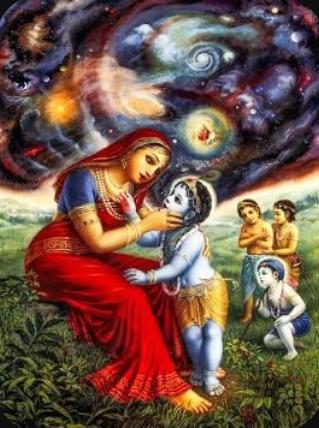
 Today is Janmashtami, the day Krishna was born. Hindu dharma considers him to be the eighth avatar of Vishnu. See note 1 below for details of the dashavatara (10 avatars).
There are dozens of lovely stories about Krishna. I’d like to tell you one of my favorite stories. It is from the Bhagavad Purana. As a child Krishna was a handful and got up to all sorts of mischief. He loved butter and was known as a “makhan chor” (butter thief.)
One time Krishna’s elder brother and other cowherd playmates snitched on him to his mother, Yashoda, that he had been eating dirt. His mother scolded him severely but Krishna maintained his innocence and said, “Ma, I have not eaten dirt. If you don’t believe me, look for yourself.”
Yashoda looked into his open mouth expecting to see dirt or butter. Instead, she saw the entire cosmos: outer space, the sun, moon, stars, planets, wind, and fire. She saw all living beings, time (kala), the nature of cause and effect (karma). She even saw the village of Gokula, and in it her own home, and herself standing there, staring down into the mouth of the boy before her.
Overwhelmed with awe and trembling at the divinity of the vision, Yashoda was paralyzed by cosmic consciousness. Seeing her bewilderment, Krishna deployed his Yogamaya (divine curtain of illusion), causing her memory of the vision to fade instantly so she could once again embrace him simply as her beloved child.
A brief digression into the two divisions of Hindu sacred literature that establishes both the epistemology and authority hierarchy of Hindu philosophy: Śruti (what is heard) and Smrti (what is remembered)
Śruti is authorless and represents primary, timeless revelation. Smrti is the secondary canon preserved through human memory and transmitted across generations. It represents human interpretation, tradition, and practical application adapted to historical contexts.
Among the Śruti, there are the Vedas (with all their layers.) As lay persons, most of what we learn are from the Smrits, particularly the Itihāsas, the principal two being the epics Ramayana and the Mahabharata. The Ramayana is a simple story; the Mahabharata is long and complex. It is widely recognized as the longest epic poem in world literature.
In its standard critical edition, the Mahabharata contains roughly 100,000 couplets, or about 1.8 million words. It is roughly ten times longer than Homer’s Iliad and Odyssey combined. It is about four times the length of the Ramayana and more than three times longer than the Christian Bible.
Bhagavad Gita
The Bhagavad Gita is an episode embedded directly within the narrative framework of the Mahabharata.
After years of exile, failed diplomacy, and broken treaties, the rival Pandava and Kaurava armies assemble at the battlefield of Kurukshetra. Just as the battle is about to begin, the Pandava champion Arjuna asks his charioteer, Krishna, to drive between the opposing battle lines. Seeing his teachers, grandfathers, and kin arrayed against him, Arjuna collapses in moral paralysis, refusing to fight.
Arjuna sees the pointlessness of the situation. He tells Krishna that he is not willing to fight because it will cause a lot of misery and death. Victory is simply not worth the suffering.
Arjuna foresees dynastic ruin, moral degradation, social chaos, and the slaughter of kin. He weighs the predicted utility of victory against its human cost and concludes that retreat maximizes moral good. His argument is purely consequentialist. The dialogue that follows resolves this paralysis, allowing the central conflict of the epic to proceed.
Krishna rejects this utilitarian calculation, shifting the ethical locus from outcomes to obligation. He teaches Arjuna the core principle of dharma or duty. The moral architecture of the Bhagavad Gita centers on deontological ethics—evaluating an action by intrinsic duty (kartavya) rather than anticipated consequences, emotional attachment, or personal gain.
Krishna argues for epistemic humility. The fruits of action depend on vast, interlocking causal variables beyond an individual’s control. Therefore judging the moral validity of an act by its outcome binds virtue to uncertain external contingencies.
Detachment from outcome (nishkama karma) purifies the motive. Acting out of desire (kama) or aversion (dvesha) reduces duty to instrumental barter.
Deontological Ethics
There is a distinction between Hindu dharma deontology and Western deontology. The latter is generally identified with Immanuel Kant’s universal categorical imperative which requires that an act’s underlying maxim be applicable universally to all rational beings without contradiction.
In contrast the Gita constructs an agent-relative, metaphysically grounded system anchored in three concepts: Nishkama Karma, Svadharma, and Lokasamgraha.
Nishkama karma is the philosophical doctrine of acting without attachment to the fruits or outcomes of one’s actions. It is the core ethical foundation of the Gita and of Karma Yoga.
Svadharma is situational and contextualized. Duty is tailored to an individual’s ontological temperament (svabhava), social station, and life stage. For Arjuna, a warrior, engaging in a just war to halt tyranny is an inescapable moral requirement. For a warrior pacifism is not compassion, but is adharmic cowardice, a dereliction of duty.
Krishna says to Arjun (in Bhagavad Gita 2.47):
Karmany-evadhikaras te ma phaleshu kadachana
Ma karma-phala-hetur bhur ma te sango ’stvakarmani
“You have a right to perform your prescribed duty, but never to the fruits of action. Never consider yourself the cause of the results of your activities, and never be attached to inaction.”
Core Principles
Agency vs. Outcome: You control the effort, intentionality, and execution of an act, but the outcome is governed by a web of external variables—time, environment, chance, and the actions of others. Claiming ownership of the result is fundamentally a cognitive error.
Non-Attachment (Anasakti): It is not indifference or apathy toward doing the job well; it is psychological detachment from whether the outcome brings praise, blame, profit, or failure. Excellence in the execution remains paramount.
Rejection of Inaction (Akarma): Nishkama karma explicitly warns against fatalism or withdrawal. Giving up action because results cannot be guaranteed is viewed as cowardice or ignorance. One acts decisively out of duty (dharma), not out of desire (kama).
Ego Transcendence: When actions are performed for personal gain or self-aggrandizement (sakama karma), the ego fluctuates between anxiety before the result, elation upon success, and despair upon failure. Removing the ego from the outcome preserves equanimity (samatvam).
We Hindus grow up listing to hundreds of stories from the Ramayana and the Mahabharata, and also from the Panchatantra. It takes several decades before we understand the deeper meanings of those stories. Good thing is that as one matures, the more one learns from the stories.
I had to wait until well into my twenties to understand the distinction between consequentialist and deontological ethical principles. As a Hindu and as a student of Advaita Vedanta, I am firmly in the deontological camp.
So that’s it for now. Now a song about Krishna, the boy. He asks his mother Yashomati (Yashoda) why his sweetheart Radha was fair but he was black. His mother gives a couple reasons. It was a dark night when he arrived; and the one with the dark eyes (Radha) cast a spell a dark spell on him.
Manna Dey (no relation) and Lata Mangeshkar sang this song.
Happy Birthday, Krishna.
Notes
[1] The ten principal avatars of Vishnu are known as the Dashavatara. The traditional order, as you can appreciate, anticipates biological evolution. Begins with fish, then reptile/amphibian, then animal, then half-man-half-animal, then a dwarf, then a man, then a great man, then a wise man, then an enlightened man. There they are:
-
- Matsya — fish
- Kurma — tortoise
- Varaha — boar
- Narasimha — man-lion
- Vamana — dwarf
- Parashurama — warrior-sage with an axe
- Rama — hero of the Ramayana
- Krishna — the advisor to Arjuna
- Buddha — enlightened being
- Kalki — the future warrior who appears at the end of Kali Yuga
The first four avatars are placed in Satya Yuga, the next three in Treta Yuga, Krishna in Dvapara Yuga, and Buddha plus Kalki in Kali Yuga.
In Hindu cosmology, time is cyclical and moves through repeating epochs known as Yugas. A complete cycle of four yugas is called a Mahayuga lasting a total of 4.32 million years. The successive yugas follow a 4:3:2:1 mathematical ratio.
1. Satya Yuga 1,728,000 years
2. Treta Yuga 1,296,000 years
3. Dvapara Yuga 864,000 years
4. Kali Yuga 432,000 years

 Atanu Dey : Life is a Random Draw
Superb post!
LikeLiked by 1 person
Thanks, K. I appreciate your comment.
LikeLike