
 The word trillionaire has been in the news since SpaceX’s IPO a few weeks ago. I have no idea what it feels like being a trillionaire (and I bet neither do you.) A net worth of a trillion dollars is several orders of magnitude above mine and yours.
Besides, I have a hard time dealing with large numbers.
Large numbers are unnatural. Understanding them is not part of our cognitive endowment. We don’t have an instinctive feel for them. We have to develop the skill needed to do arithmetic using them. The legendary Stanford computer and cognitive scientist John McCarthy (1927 -2011), the man who coined the term artificial intelligence, had in his email signature the line, “He who refuses to do arithmetic is doomed to talk nonsense.”
Economists, my tribe, have to do arithmetic and algebra if we are committed to not talking nonsense. Arithmetic and algebra are unnatural. Without instructions, we are totally incapable of learning them.
Speaking and comprehending language comes naturally to us. As does bipedal locomotion. Nor do we need to learn the physics of ballistics to be able to throw and catch a ball. But we have to be taught to learn reading and writing because those two are as unnatural as arithmetic and algebra.
Large numbers are hard. We are not equipped to have an intuitive understanding of large numbers because of our evolutionary history. We humans evolved over millions of years in an environment where we did not need the ability to comprehend numbers larger than what was needed for survival.
Evolution provided us the cognitive capacity to distinguish between, say, four and twenty—quantities we could apprehend in a glance—but we never had to be concerned about and distinguish between large numbers like a hundred thousand and a million because in our evolutionary history, we never encountered thousands or millions of things.
We cannot deal with and intuitively grasp large numbers because we never had the need to until about six or eight generations ago (out of the roughly 10,000 generations of anatomically modern humans.)
I find it amusing how people attempt to make large quantities accessible. Astronomical distances are stated as so many—often millions—of light years.
Light travels at roughly 300,000 kms/second. That’s fast. The sun is around 150 million kms from the earth. It takes light only about 8.3 minutes to reach us from the Sun.
How long is a light year? There are 31,557,600 seconds in a year. Multiplying the speed of light per second and the number of seconds in a year give us approximately 9,460,730,472,580 kms. A light year is therefore around 9.46 trillion kms. We are told that that’s approximately 236 million times the circumference of the Earth.
But of course we don’t have an intuitive sense of how large the Earth’s circumference is. Therefore 236 million times that is not helpful in understanding the distance expressed in light years. Our Milky Way galaxy is about 10,000 light years in diameter. It’s all gobbledygook.
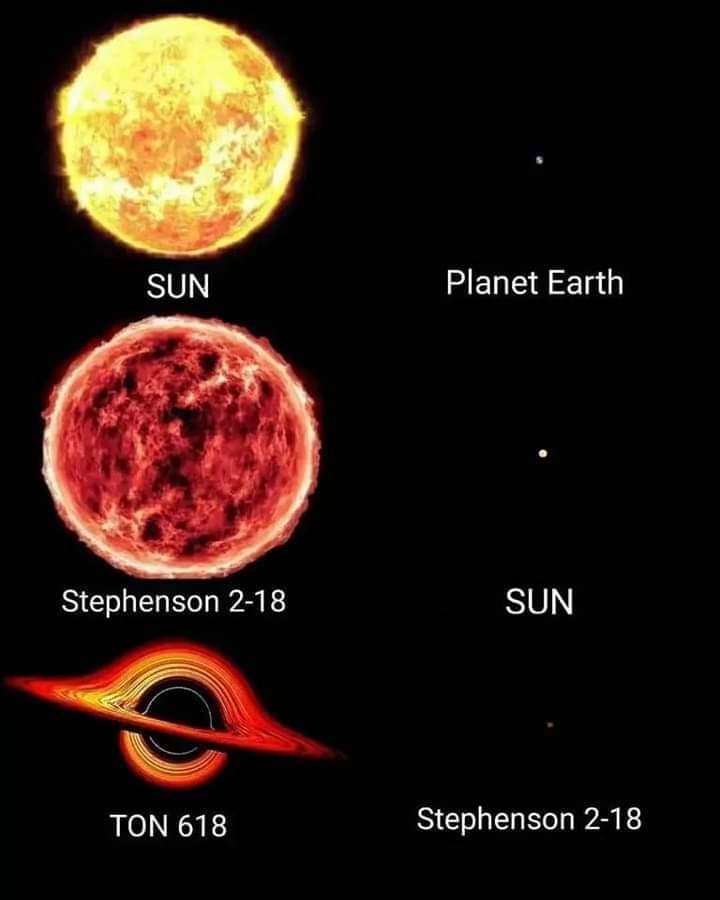
Every attempt to make the size of the universe—or astronomical objects with it—is doomed to fail. We are simply too limited to comprehend large numbers and large objects.
Our planet Earth is tiny. A million Earths can comfortably fit in our Sun. The Sun is tiny relative to the red giant Stephenson 2-18. Stephenson is a tiny dot compared to the black hole TON 618.
Quite late in the day, humanity learned how to represent and manipulate large numbers. Roman numerals were adequate to represent small numbers but are entirely inadequate for large numbers. Roman numeral representation of a small number such as 24 is fine (XXIV) but totally impractical for large to code a large number such as 2,437,522 in.
I asked Gemini to represent that number in Roman numerals. It came up with MMCDXXXVII. That’s ten symbols to code for the 2,437 part only. Then it suggests a bar above that part to show that it is multiplied by 1,000; and finally to append the 522 at the end. It’s cumbersome to say the least.
Fortunately, the Roman numerals were replaced. Ancient Indian mathematicians developed the positional decimal number system between the 1st century BCE and the 6th century CE. The Hindu numeral system combined three critical concepts:
1. A Base of 10 — counting by tens.
2. Positional Notation — the value of a digit changes depending on where it sits.
3. A Symbol for Zero— acting as both a placeholder and an algebraic value.
(For more on the development timeline of the system see Note 1 below.)
Using the Hindu system, it is trivial to encode very large numbers. However, that still did not completely solve the difficulty of representing extremely large and extremely small numbers. That needed the development of the scientific notation, the modern notation system.
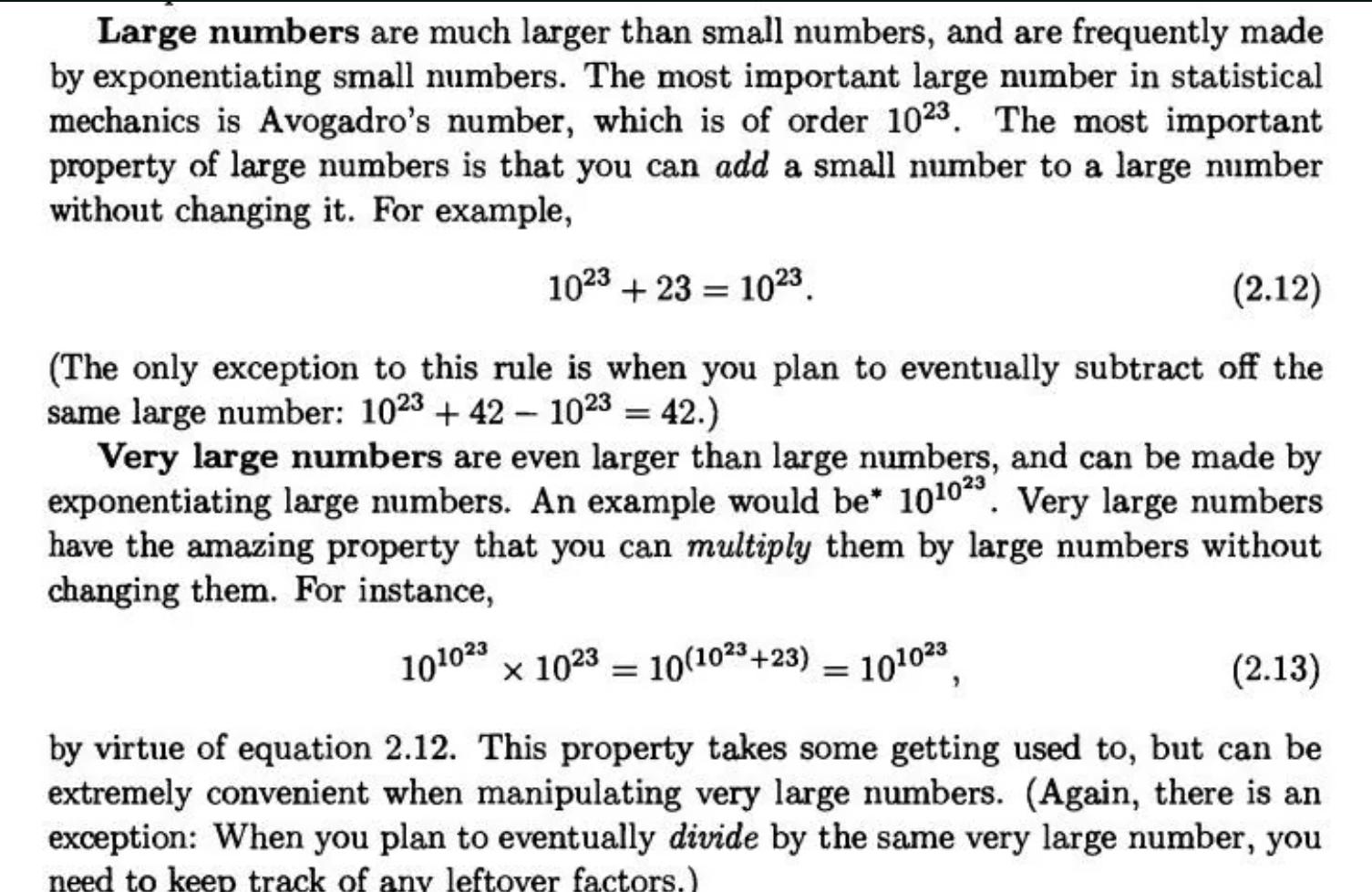
A digression. Here’s a page from Daniel Schroeder’s book Introduction to Thermal Physics (Oxford University Press, 2021.) The abstract beings with
Thermal physics deals with collections of large numbers of particles—typically 1023 or so. Examples include the air in a balloon, the water in a lake, the electrons in a chunk of metal, and the photons given off by the sun. We can’t possibly follow every detail of the motions of so many particles. So in thermal physics we assume that these motions are random, and we use the laws of probability to predict how the material as a whole ought to behave.
The page beings with—
There are three kinds of numbers that commonly occur in statistical mechanics: small numbers, large numbers, and very large numbers. Small numbers are small numbers, like 6, 23, and 42. You already know how to manipulate small numbers.
It continues with—
Advances in astronomy and physics in the 17th and 18th centuries required dealing with vast cosmic distances and tiny microscopic measurements. Navigating strings of dozens of zeros became a frequent headache for calculation.
Two major breakthroughs in Europe paved the way for the modern scientific notation. The Flemish mathematician Simon Stevin (1585) popularized decimal fractions in the Western world, making it easier to represent numbers smaller than 1 without using clumsy fractions.
Next, the French philosopher and mathematician René Descartes (1596- 1650) introduced the modern superscript notation for exponents (e.g., writing x2 or 103) in 1637. That improved readability and precision.
For instance, it is incredibly easy to miscount the zeros in the charge of an electron which is 0.0000000000000000001602176634. Writing it as −1.602176634 × 10¹⁹ eliminates visual fatigue and drastically reduces errors in transcription.
For more on the scientific notation, see Note 2 below.
Time for a bit of music. Let’s listen to One by Three Dog Night.
Be well, do good work and keep in touch.
NOTES
[1] Development timeline of the positional numeral system
Vedic Period (c. 1500–500 BCE): Long before a written positional system existed, ancient Indians mastered base-10 verbal arithmetic. The Vedic texts used specific Sanskrit names (such as dasa for 10, sata for 100, and sahasra for 1,000) for powers of 10 up to 1053.
Formalizing Place Value (499 CE): The Indian mathematician and astronomer Aryabhata formally defined the decimal place-value system in his treatise, the Aryabhatiya.
The Oldest Epigraphic Evidence (595 CE): The oldest known physical document explicitly featuring this system is a copper-plate donation charter of in Gujarat. It contains a date written in a fully functional decimal place-value notation.
Zero as a Fully Functioning Number (628 CE): The system reached its modern complete form when Brahmagupta wrote the Brahmasphutasiddhanta. He defined “shunya” (zero) not just as an empty placeholder, but as a formal number with its own mathematical properties, defining rules for adding, subtracting, and multiplying with it.
Prior to this innovation, other civilizations used number systems that were incredibly cumbersome for complex math. For example, writing the number 888 in Roman numerals requires twelve characters (DCCCLXXXVIII).
This allowed humanity to represent any number, no matter how vast or small, using just ten simple symbols (0–9). By the 8th century, Islamic scholars encountered this system and transmitted it to Europe, where it became the global standard for mathematics.
[2] Scientific notation
It is a standardized way of writing very large or very small numbers using powers of 10. Instead of writing out dozens of zeros, which is tedious and prone to error, numbers are expressed in a compact, highly readable format.
In scientific notation, every number is written in the form mx10n where:
m (the mantissa or significand): A number whose absolute value is greater than or equal to 1 and strictly less than 10.
n (the exponent): An integer (positive, negative, or zero).
Example large Number: The distance from the Earth to the Sun is roughly 149,600,000 kilometers. In scientific notation, this is written as 1.496×10⁸ km.
Example small number: The diameter of a hydrogen atom is about 0.0000000001 meters. In scientific notation, this becomes 1×10⁻¹⁰ m.
The History of Scientific Notation
The journey toward modern scientific notation spans over two millennia, driven by our need to quantify the unimaginably large and the invisibly small.
The formalized system we use today crystallized in the late 19th and early 20th centuries. This period coincided with the rapid expansion of chemistry (e.g., Avogadro’s number 6.022 x 10²³) and thermodynamics, which demanded a standardized, global mathematical shorthand.
Scientific notation leverages the laws of exponents to make complex multiplication and division trivial to perform by hand. To multiply, multiply the mantissas and add the exponents. To divide, divide the mantissas and subtract the exponents.


