
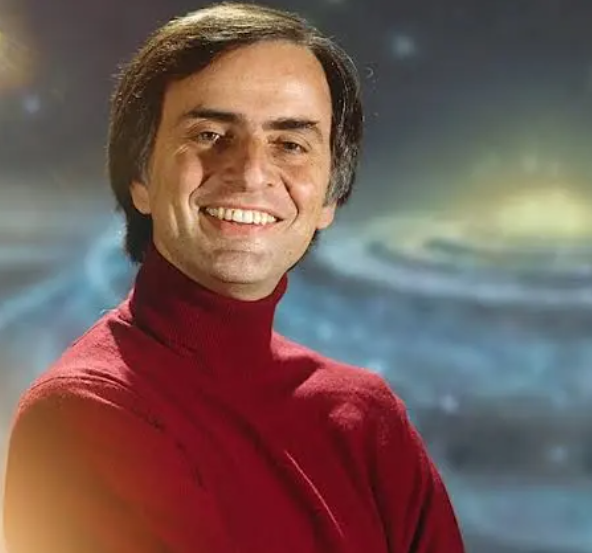
 Carl Sagan was one of the greatest popularizers of science the world has seen. Born in Brooklyn, NY in 1934, he sadly passed away relatively young in 1996 in Seattle, WA. A trained astronomer and astrophysicist, he inspired generations of scientists through his popular books and his brilliant TV series, Cosmos, one of the most beloved science programs ever made.
Sagan authored, co-authored, or edited around 20 books total, along with hundreds of scientific papers.[1] One could not read him without being moved by the poetry and the lyrical quality of his prose. It was inspired and inspiring. I believe that reading his popular books is great training on how to express oneself verbally.
He had a distinctive speech style. His soft, resonant voice had a melodic and resonant intonation. It was punctuated with pauses for emphasis. Most memorable was how he said the word “billions” — which he had to do with some regularity since his subject involved astronomical numbers. Though he never uttered the phrase “billions and billions,” it was associated with him in the popular mind. The title of the final book he wrote, “Billions & Billions,” shows that he did not lose his sense of humor even while suffering terminal cancer.
The image below is from 1990. Sagan asked NASA to point Voyager 1 spacecraft’s camera toward earth to show the earth suspended like a mote of dust in a sunbeam.
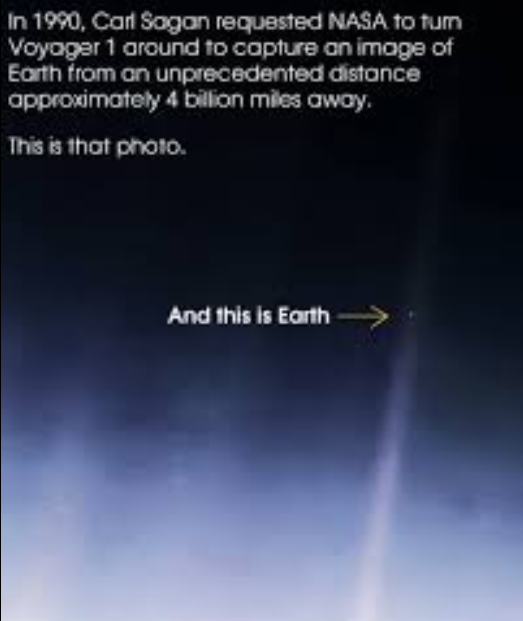 About that image he says:
“Look again at that dot. That’s here. That’s home. That’s us. On it everyone you love, everyone you know, everyone you ever heard of, every human being who ever was, lived out their lives. The aggregate of our joy and suffering, thousands of confident religions, ideologies, and economic doctrines, every hunter and forager, every hero and coward, every creator and destroyer of civilization, every king and peasant, every young couple in love, every mother and father, hopeful child, inventor and explorer, every teacher of morals, every corrupt politician, every ‘superstar,’ every ‘supreme leader,’ every saint and sinner in the history of our species lived there—on a mote of dust suspended in a sunbeam. The Earth is a very small stage in a vast cosmic arena. Think of the rivers of blood spilled by all those generals and emperors so that, in glory and triumph, they could become the momentary masters of a fraction of a dot. Think of the endless cruelties visited by the inhabitants of one corner of this pixel on the scarcely distinguishable inhabitants of some other corner, how frequent their misunderstandings, how eager they are to kill one another, how fervent their hatreds. Our posturings, our imagined self-importance, the delusion that we have some privileged position in the Universe, are challenged by this point of pale light. To me, it underscores our responsibility to deal more kindly with one another, and to preserve and cherish the pale blue dot, the only home we’ve ever known.” (Carl Sagan, Pale Blue Dot, 1994)
I re-read this excerpt from Sagan’s Pale Blue Dot (1994) frequently just for the sheer joy of it. Listen:
Sagan has a deep, almost religious, reverence for the natural world. The real world, he felt, was too marvelous for us to believe in made up stuff. He was an outspoken atheist. He had a visceral understanding of how unimaginably vast the universe was temporally and spatially to believe in the tiny world that the monotheistic religions peddle.
His disdain for religious fables was like Richard Feynman’s. Feynman said:
“It doesn’t seem to me that this fantastically marvelous universe, this tremendous range of time and space and different kinds of animals, and all the different planets, and all these atoms with all their motions, and so on, all this complicated thing can merely be a stage so that God can watch human beings struggle for good and evil – which is the view that religion has. The stage is too big for the drama.”
(Source: James Gleick’s 1992 biography, “Genius: The Life and Science of Richard Feynman”.)
Sagan relentlessly fought against ignorance, superstition and irrationality. He decried the fact that the politicians who made public policy were scientific and technological ignoramuses.
It is always a source of satisfaction to me that I was a contemporary of his on this pale blue dot for a few decades. Sagan too was at UC Berkeley for a while from 1960 to 1962. At Berkeley, he worked under the guidance of astronomer Gerard Kuiper (of the Kuiper belt fame.[2])
When I watched the Cosmos TV series on public TV in the 1980s in California, I was delighted to see Sagan at a Chola temple in Darasuram in Tamil Nadu. A few years ago, thanks to the generosity of a friend I visited that temple. Read about it here: Chola Temples.
Sagan knew science and what’s more, he was a master in his ability to communicate its magic and mystery. Very few people can compare to him in his understanding of astrophysics.
We are unequal when it comes to what we know. Sagan knew 1,000 units of knowledge, while I know about 1 unit. Sagan and I are unequal. But there are billions & billions of units of knowable stuff. Therefore, relative to what is potentially knowable, in our ignorance we are all equals.
I know some bits that Sagan did not know. His understanding of political economy was rather naive. Even the great Einstein’s understanding of that was lacking. (See this this piece of mine Einstein, the Physics Giant, the Economics Dwarf)
In 1989, during a CNN interview, Ted Turner posed the question, “Are you a socialist?” to Sagan. He replied:
“I’m not sure what a socialist is. But I believe that the government has a responsibility to take care of people. I’m not talking about handouts. I’m talking about making people self-sufficient, capable of taking care of themselves.”
Listen to the rest of Sagan’s reply.
I respectfully disagree. It’s not the job of the government to take care of people. People—voluntarily and without coercion—must take responsibility of their own welfare. The state cannot be—must not be—allowed to be a nanny. Child mortality or homelessness or whatever problems society suffers is the sole responsibility of civil society, not the government. Making the government (the state) in charge of social problems is the road to serfdom, the road to socialism.
Carl Sagan is one of the best examples of our kind. He was intelligent and wise. He was not only loved, but he was also a lovely man. Generations to come will continue to learn from him.
Let me conclude this with an episode from Desert Island Discs from the BBC. It is from July 1981, decades before the BBC turned into the dumpster fire it is now. You can download it here. BBC Radio 4 – Desert Island Discs, Carl Sagan. Or listen here:
I like that BBC series. You get a glimpse of the music that accomplished people, people who have contributed to the world, enjoyed. Sagan says that he cannot go without listening to music for long. Me too, dear Carl, me too.
Let’s listen to some music on the way out.
It’s all karma, neh?
NOTES:
[1] A short list of his books include
-
-
-
- The Dragons of Eden: Speculations on the Evolution of Human Intelligence (1977) — Pulitzer Prize winner
- Broca’s Brain: Reflections on the Romance of Science (1979)
- Cosmos (1980) — Companion to the TV series
- Murmurs of Earth: The Voyager Interstellar Record (1983, with others)
- The Cold and the Dark: The World After Nuclear War (1984, with others)
- Comet (1985, with Ann Druyan)
- Contact (1985) — His only novel
- Shadows of Forgotten Ancestors: A Search for Who We Are (1992, with Ann Druyan)
- Pale Blue Dot: A Vision of the Human Future in Space (1994)
- The Demon-Haunted World: Science as a Candle in the Dark (1995)
- Billions & Billions: Thoughts on Life and Death at the Brink of the Millennium (1997, published posthumously)
-
-
[2] The Kuiper Belt is a vast, doughnut-shaped region of the outer Solar System filled with icy small bodies, dwarf planets, and other remnants from the formation of the Solar System. It begins roughly at 30 AU (astronomical units) just beyond Neptune and extends outward to approximately 50 AU.


This desire for government to do something for people comes from the kindness of people’s heart. But unfortunately being kind does not mean you are correct.
Wise folks like Milton Friedman understood this and this is when in his speeches and QnA sessions he never came across as condescending to those people who held opposite views.
People want lower rents, cheaper food, lower gas prices and accessible healthcare but lack the training to see how government control generally does not lead to those outcomes.
LikeLike