
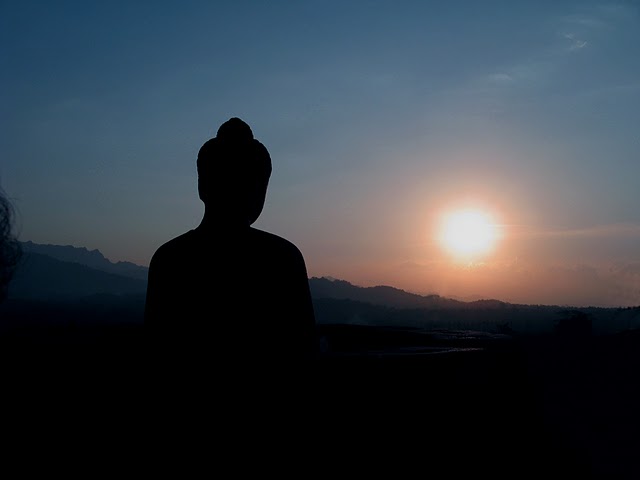
 Happy Buddha Purnima.
Buddha Purnima—the first full moon in May—is considered an important day in the life of Siddhartha Gautama, the one who became the Buddha.
Thus have I heard that he was born on this day in north east India in Lumbini over 25 centuries ago, attained enlightenment in Bodh Gaya on this day, and died in Rajgriha on this day.
In 1993, I went on a pilgrimage which I call “Following the footsteps of the Buddha.” Of course, I didn’t walk. I took cars, buses and trains. I spent a day in Lumbini at the place where he was born, sat under the tree (a descendent of the original) under which he attained enlightenment, visited the garden in Sarnath where he gave his first sermon (“the Turning of the Wheel of Dharma”), sat in contemplation at the shrine where he died in Rajgriha at the age of 80.
Of the three dharmas, all of which originated in India, only Buddha dharma left India to become a world religion. Hindu dharma and Jain dharma continued to be nearly exclusively Indian. The dharmas have a family resemblance (just as the religions do.) They share core ideas such as karma, dharma, kama, and moksha. Alan Watts, who knew the dharmas as well as any layperson can, described Buddhism as Hinduism packaged for export.
To most Hindus like yours truly, all the dharmas are accessible. We worship our Hindu devas, revere the Buddha and the Jain tirthankars without a second thought. We recognize the differences but we know that at its core, the differences don’t matter. We say “to each his own” and get on with life. To dharmic persons, it doesn’t matter what one believes in; it’s what one does that matters.
Now back to the Buddha. Since he was born around 2,500 years ago, most of the stories are simply legends. No reasonable person would take them to be literal truth. We should keep in mind a disclaimer to the effect: “All stories associated with the Buddha are for instruction purposes only and no representation is claimed for their veracity.”
Thus have I heard that when Queen Mahamaya gave birth to the Buddha, he immediately stood up straight, took seven steps in each of the cardinal directions and declared, “I am the Supreme in the world. This is my final birth. I will attain enlightenment in this birth and never be reborn.”
Quite the dramatic entrance, wouldn’t you say. Here’s another story.
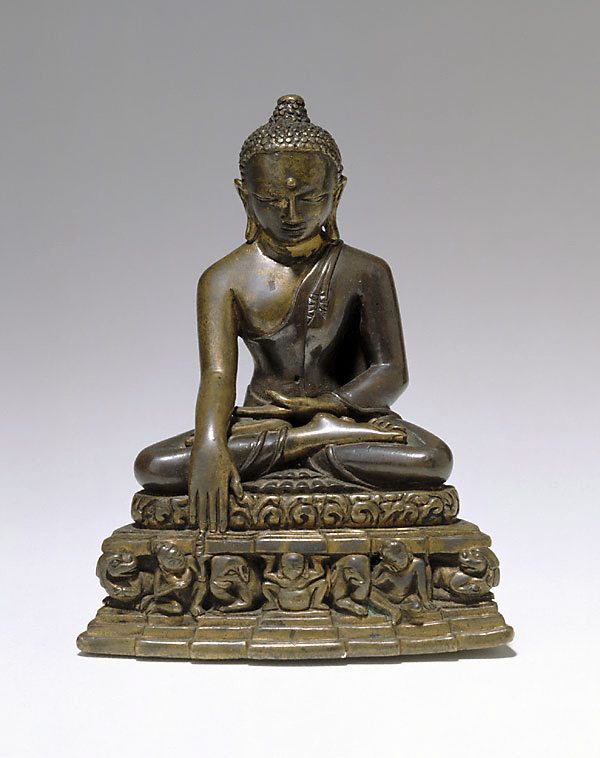
Thus have I heard that just before Siddhartha Gautama realized enlightenment, the demon Mara attacked him with armies of monsters to frighten him from his seat under the bodhi tree. But the about-to-be Buddha did not move. Then Mara claimed the seat of enlightenment for himself, saying his spiritual accomplishments were greater than Siddhartha’s. Mara’s monstrous soldiers cried out together, “I am his witness!” Mara challenged Siddhartha, “Who will speak for you?” Then Siddhartha reached out his right hand to touch the earth, and the earth itself roared, “I bear you witness!” and Mara disappeared. And as the morning star rose in the sky, Siddhartha Gautama realized enlightenment and became a Buddha.
My favorite Buddhist sutra is the Prajñāpāramitā Hṛdaya Sutra which in English is “The Essence of the Perfection of Wisdom Heart Sutra.” It is one of the most widely recited texts in Mahayana Buddhism.
It distills the profound philosophical core of the vast Prajñāpāramitā (“Perfection of Wisdom”) literature. It is traditionally attributed to Avalokiteśvara (the bodhisattva of compassion), who speaks the teaching while in deep meditative absorption, addressing the monk Śāriputra.
At its heart, the sutra radically deconstructs our ordinary way of perceiving reality. It teaches the doctrine of śūnyatā (emptiness): that all phenomena are empty of inherent, independent existence. Nothing exists on its own, separate from causes, conditions, and the web of interdependence.
This includes the five aggregates (form, feeling, perception, mental formations, and consciousness) that we conventionally take to be “me” or “mine,” as well as all categories of Buddhist analysis — the sense faculties, the elements of existence, the stages of the path, and even the Four Noble Truths themselves.
The most famous line captures this insight with precision:
“Form is emptiness, emptiness is form. Emptiness is not other than form; form is not other than emptiness.”
The sutra goes on to apply the same logic to feeling, perception, formations, and consciousness — the five skandhas — showing that they too are empty. From this realization flows the famous negation: there is no birth, no death, no defilement, no purity, no increase, no decrease.
Because nothing possesses an intrinsic self-nature, all dualistic extremes and conceptual fixations dissolve. The teaching on emptiness is liberating. By seeing through the illusion of solid, independent entities (including our own ego), we are freed from attachment, aversion, and ignorance — the root causes of suffering.
The sutra culminates in the powerful mantra of the Perfection of Wisdom:
OM Gate gate pāragate pārasaṃgate bodhi svāhā
(“Gone, gone, gone beyond, gone completely beyond—Enlightened mind, so be it!”)
Let’s listen to the Heart Sutra:
Thank you, good night and may your god go with you.


