
 I Grew Up Clueless
Growing up in India, I was fortunate enough to attend a pretty decent school (SFS school) in a second-tier city (Nagpur). I say I was fortunate because at that time only a small percentage of Indian children could attend school and of those who could, most got a fairly mediocre education at best.
Our school was good by the prevailing standards. By sheer good fortune, many of my classmates ended up being fairly successful in various professions. Half a dozen became doctors, a couple very successful lawyers, a dozen engineers, a couple US-trained PhD economists (including yours truly), many teachers, a tenured US professor, and a handful businessmen. A fairly large cohort ended up migrating to the US.
Looking back at it, I’d say that the education we received was passable in math and science but sorely lacking in the social sciences. That was because education was controlled by government bureaucrats who knew little of any relevance and had no clue what education was about. I suspect that they were uneducated themselves.
This preamble is to explain (perhaps explain away) why I grew up clueless about the world. Certainly I learned a bit of physics and chemistry (how many electrons in the outer shell of the sulfur atom) and trigonometry and algebra but had no idea how the world of people worked. That would have helped me more than knowing about valence electrons of atoms.
Now I recognize that I would have understood the world a lot better had I been exposed to various political and economic systems that exist in the world and their effects on the fortunes of various countries. I believe that my lack of social consciousness was to a large degree due to that gap in my education.
I believe that Indians (not just Indian students) are systematically brainwashed into a secular religion whose dogma states that the government and its functionaries are omnibenevolent and wise, and India’s greatest strength is that it is a democracy. Of all the cows that Indians worship, the holiest of the lot is democracy. Closely related to that comes the worship of the holy cows Gandhi and Nehru. And now that’s been updated to Modi. Modi is the updated version of Gandhi and Nehru.
Only after I went to the US for my PhD in computer science, did I notice that India was pathetically poor relative to the US. In my naivety, I thought that India’s poverty was because it was over-populated and that being poor was a price that Indians chose to pay for the moral superiority of being citizens of a democracy.
Fortunately, I stumbled into economics. As I learned the basics of economics the root cause of India’s persistent poverty began to dawn on me: the lack of freedom. True, India gained independence from British Raj in 1947 but Indians continued to be a colonized people. Unlike the US which is a constitutional republic where the people are the sovereign, India was a democracy with a constitution that vests all powers in the government and little if any in the people.
Unlike the citizens of the US, Indians do not have a Bill of Rights. Most Indians don’t know what that is and why it matters. I didn’t until quite late in life. I should have been told when I was in my teens.
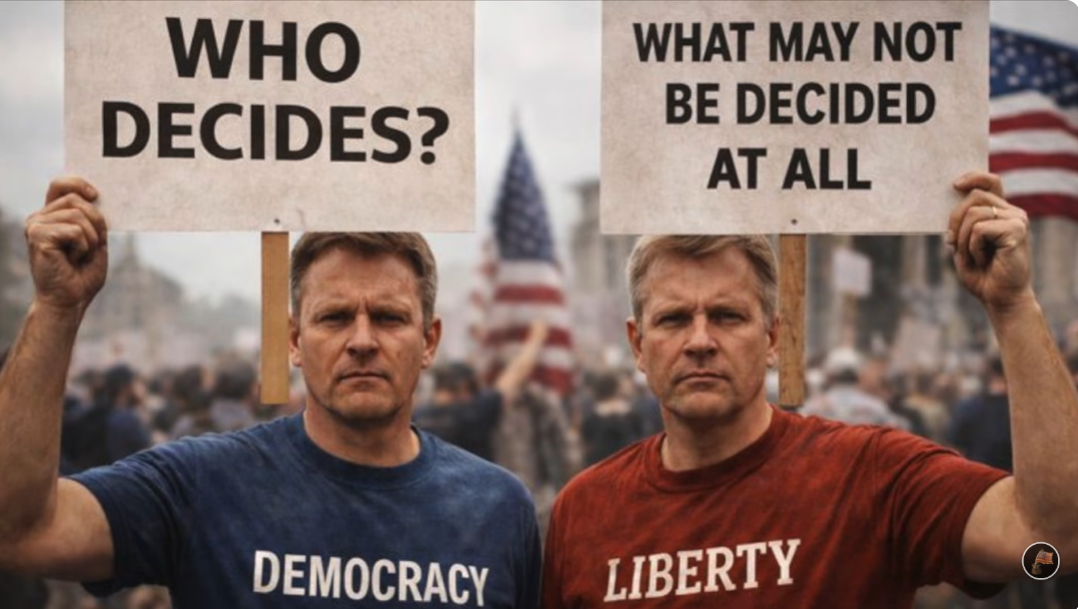
That led me to detest the idea of democracy. I was gratified to learn that I was in good company. The Founding Fathers of the US detested democracy. The word democracy does not appear even once in the two foundational documents of the US — the Declaration of Independence (1776) and the US constitution (ratified in 1788.)
At the close of the Constitutional Convention in Philadelphia in September 1787, Benjamin Franklin was approached by a prominent socialite who asked him: “Well, Doctor, what have we got—a republic or a monarchy?” Franklin replied: “A republic, if you can keep it.”
Constructing a republic is hard enough but keeping it is harder still, as we can see. The US is degenerating in front of our eyes. The constitution is being perverted. More about that later. For now, I’d like to review the distinction between a democracy and a constitutional republic. I asked my AI assistant to explain.
Democracy vs. Constitutional Republic
Democracy is often celebrated as the voice of the people, but stripped to its essence, it is nothing more than majority rule. That very principle is its greatest weakness. When 51% can dictate terms to 49%, liberty becomes fragile. The majority’s passions, prejudices, or whims can override justice, leaving minorities exposed to oppression. History is littered with examples where democratic votes endorsed disastrous policies—from mob-driven populism to economic mismanagement—because popularity triumphed over principle.
A constitutional republic, by contrast, is democracy disciplined. It acknowledges the sovereignty of the people but refuses to let raw numbers alone determine the fate of a nation. Instead, it binds government within the framework of a constitution, ensuring that certain rights are untouchable, no matter how loudly the crowd clamors against them. In a republic, the majority may govern, but it cannot abolish free speech, confiscate property without due process, or silence dissent. The constitution stands as a bulwark against the volatility of public opinion.
Democracy’s critics rightly point out its susceptibility to demagogues. Charismatic leaders can manipulate emotions, promising quick fixes while eroding long-term stability. In a republic, however, checks and balances blunt such dangers. The legislature, executive, and judiciary are deliberately set against one another, preventing any single faction from seizing unchecked power. This deliberate friction is not a flaw but a safeguard, ensuring that liberty survives even when passions run high.
Moreover, democracy often rewards mediocrity. Leaders must appeal to the broadest base, which encourages pandering rather than principled statesmanship. A constitutional republic elevates deliberation over impulse. Representatives are chosen not merely to echo the crowd but to exercise judgment, weighing immediate desires against enduring values. The result is governance that aspires to wisdom rather than popularity.
In short, democracy risks becoming rule by numbers; a constitutional republic insists on rule by law. Democracy alone can devolve into tyranny of the majority; a republic tempers majority will with constitutional limits. Democracy is vulnerable to the winds of passion; a republic anchors itself in enduring principles. If liberty is the goal, then democracy is not enough. Only a constitutional republic secures freedom against both the mob and the monarch.
Let’s listen to a couple of people explaining the difference between the two. Here’s Dan Smoot in 1966. It’s from 70 years ago — not exactly modern.
For a bit more on that subject, let’s watch this video on the “myth of virtuous democracy.”
All the above is interesting only if one cares about the question of how we should organize society so that it works the best for all under given constraints. Most of us are too busy with our immediate concerns to bother. But for our own benefit it is important that we take a bit of time to ponder these ideas. Maybe we will reject the brainwashing and make better choices.
I grew up clueless but as my example demonstrates, we can escape our programming with not too much effort.
It’s all karma, neh?


Very well written. Parts of the Indian Constitution are structured to create checks and balances among the executive, legislature, and judiciary. Several landmark judgments highlight this tension. In 1975, the Supreme Court invalidated Indira Gandhi’s election to Parliament. In 2012, it struck down the appointment of the CVC made by Sonia Gandhi. The anti-defamation bill passed in 1985 killed dissent by the legislature (with a bigger impact in state legislatures) and overall, our system has miserably failed.
LikeLiked by 1 person