
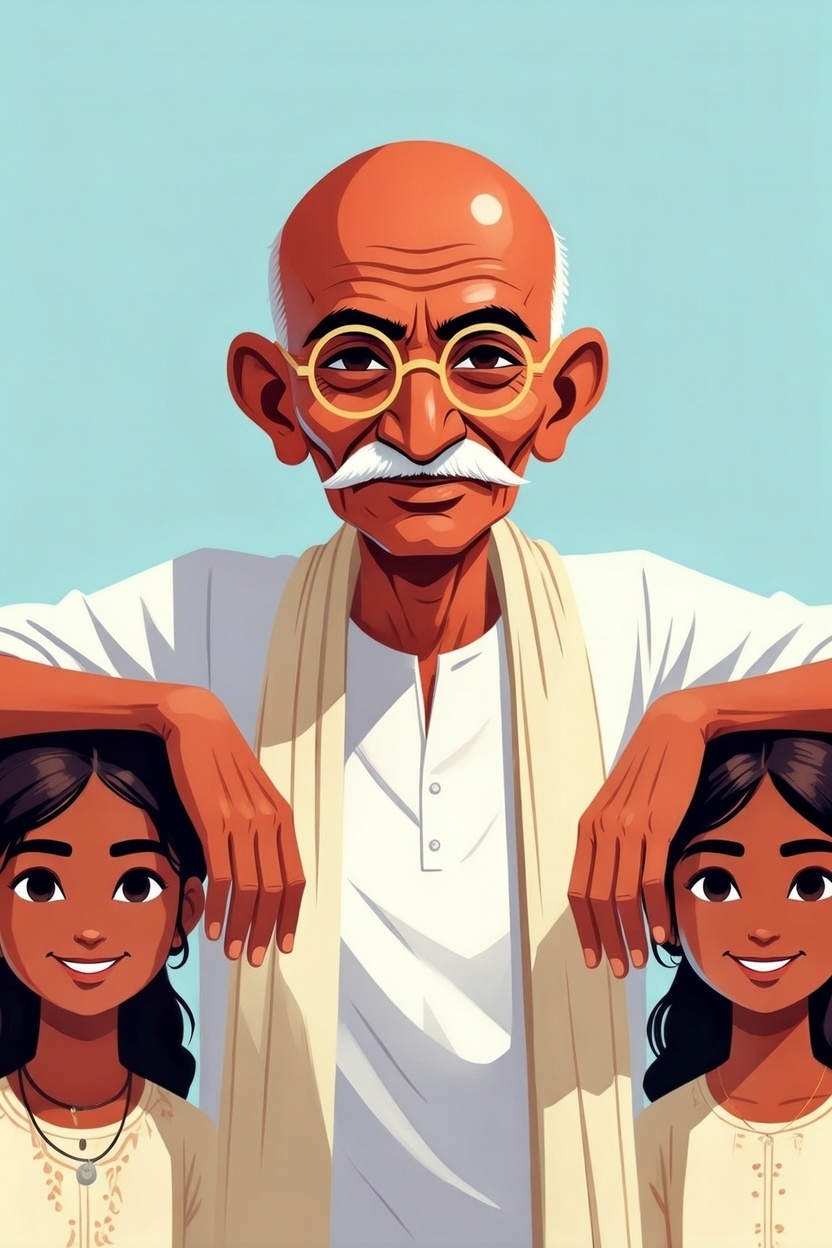
AI agents are the coolest innovation of our modern world. Every time you turn around, one more appears. It’s becoming hard to keep up with the advances. I am amazed. So should you be. Just for fun, I gave grok a simple prompt: “Summarize Atanu Dey’s views on Gandhi.”
Here’s the response. Begin quote:
Atanu Dey, an economist and classical liberal, holds highly critical and negative views on Mahatma Gandhi (whom he often refers to as Mohandas K. Gandhi to reject the “Mahatma” title as inaccurate and undeserved).
Based on his blog posts, X (formerly Twitter) statements, and writings, Dey portrays Gandhi as one of the most harmful figures in history, responsible for perpetuating India’s poverty, misery, and underdevelopment. He dismisses Gandhi’s deification as a myth propagated for political control and argues that Gandhi’s ideas and actions were delusional, manipulative, and evil. Below is a structured summary of Dey’s key opinions across themes, drawn from his own content.
On Gandhi’s Character and Personal Traits
Dey describes Gandhi as vain, egotistical, delusional, and ignorant, claiming he fancied himself an expert in economics, history, science, and morality despite lacking knowledge or training. For instance, Gandhi allegedly believed earthquakes were divine punishment for social evils like untouchability.
Dey calls him “one of the world’s greatest egotists,” a “tyrannical control freak,” and a “cunning” manipulator who used threats of self-harm (like fasting) as blackmail to impose his will. He accuses Gandhi of being a “sexual deviant” tormented by “abnormal appetites” and an “unhealthy fascination with matters sexual,” citing behaviors like sleeping naked with young women in his ashram while preaching celibacy to others. Dey quotes the Prime Minister of Travancore calling Gandhi “a most dangerous, semi-repressed sex maniac” and suggests his perversions drove many actions.
Additionally, Dey labels Gandhi a “racist and casteist,” noting his views that Africans were racially inferior to Caucasians and Indians, and his promotion of “Harijan” (people of God) as elevating one caste while associating others with the devil. He also calls Gandhi a “crypto Christian” who hypocritically advocated non-violence while supporting British wars.
Dey expresses personal disdain, stating, “I have a visceral hatred of Gandhi,” and compares him to an “evil genius” whose self-hatred (stemmed from sexual obsessions) led to hatred of Hindus. He argues Gandhi’s “good intentions” were indistinguishable from malice, making him “the most evil person who has ever lived so far,” causing more misery than Stalin, Mao, or Hitler.
On Gandhi’s Actions and Ideology
Dey rejects Gandhi’s philosophy as harmful and hypocritical. He criticizes non-violence as a “cunning device” dressed in piety, used to discourage retaliation—e.g., advising Hindus not to harbor anger against Muslims intent on destroying them, or telling Hindu women to commit suicide if raped by Muslims. Gandhi reportedly urged Hindus, Jains, Buddhists, and Sikhs in Lahore during Partition violence to “die with what you think is the dying city” rather than flee. Similarly, he advised Jews in Nazi Germany to commit suicide for a “moral victory.” Dey mocks Gandhi’s famous quote, “An eye for an eye will make the whole world blind,” as “absolute feces” and “moralistic stench.”
On economics, Dey condemns Gandhian self-sufficiency as preserving “poverty in body and mind,” insisting humans are interdependent. He argues Gandhi opposed industrialization, railways, and mass production as “evil,” promoting village economies and manual toil as virtuous while viewing comfort and prosperity as sinful. Dey calls this ideology a “defunct” disaster that “paved the way [to] India’s descent into hell,” comparable to communism’s havoc.
Politically, Dey sees Gandhi as a British “stooge” and “useful idiot” who delayed independence by cooperating with them—e.g., recruiting Indians for British wars and keeping natives in check. He claims the Khilafat movement encouraged Muslims to kill non-Muslims. Dey dismisses Gandhi’s role in independence as “Mi-ni-mal” (quoting Clement Attlee), attributing freedom more to economic unviability for Britain and figures like Subhas Chandra Bose. He accuses Gandhi of forcing Jawaharlal Nehru (whom “no one wanted”) into power over Vallabhbhai Patel, leading to socialist policies and enduring poverty.
On Gandhi’s Impact and Legacy
Dey blames Gandhi for India’s “pathetic and perennial” poverty, calling him the “Father of Indian poverty and endless misery” and “god’s curse on India.” He argues Gandhi’s promotion of Nehru created “British Raj 2.0″—a tyrannical, bureaucratic system where Indians became subjugated by homegrown overlords, denying true freedom despite independence. This “command, control, license, permit, quota” government enriched rulers while impoverishing people, condemning billions to suffering. Dey claims foreign powers like the US invoke Gandhi to lecture India on non-violence and poverty, preventing it from arming or prospering, while hypocritically not applying the same to themselves.
He warns that venerating Gandhi keeps India irrelevant and poor, urging rejection of his myth: “Until and unless Indians know the truth about the so-called ‘Mahatma’ Gandhi, I am afraid that India will continue to be pathetically and perennially poor.” Dey notes Gandhi was not awarded the Nobel Peace Prize, sarcastically calling it a “pity” given later recipients like Kissinger and Arafat.
In summary, Dey’s views are unrelentingly negative, framing Gandhi not as a hero but as a delusional tyrant whose legacy is a barrier to India’s progress. He emphasizes, “All things considered he was not good for India.”
End quote.
I would say that that’s a fair summary. Frankly, I would not have been able to summarize my writings so well. I am amazed, as I said before.
Next, I will post what grok’s response was to my query, “What are Atanu Dey’s views on Nehru?”


I fully subscribe to these views. Gandhi and his philosophy continue to be dangerous and hold back the most populous nation and its mind.
LikeLiked by 1 person
Aha… I asked grok “Summarize Atanu Dey’s views on Narendra Modi.” and the answer is:
Atanu Dey, an economist and classical liberal blogger (known for his site deeshaa.org and X handle @atanudey), has evolved from one of Narendra Modi’s strongest early supporters to one of his sharpest critics. Early Support (Pre-2014 and Initial Years)
Dey was an enthusiastic backer of Modi well before the 2014 elections. He viewed Modi as a potential transformative leader who could dismantle India’s socialist legacy, promote economic freedom, and steer the country toward prosperity. Dey:
His support was described as contingent and instrumental — not blind loyalty, but based on the expectation that Modi would deliver bold liberalization and reduce government overreach. Growing Disillusionment (2015–2018)
By around 2015–2016, Dey began expressing disappointment. In blog posts and articles (e.g., “An Open Letter to PM Shri Modi” in 2015 and assessments around the government’s second anniversary), he argued that:
Strong Criticism and Withdrawal of Support (2019 Onward)
The turning point came prominently in early 2019. In a widely shared piece titled “Modi Has Become Who He Despised and I Am No Longer His Supporter” (published in The Quint), Dey declared:
Since then, Dey’s commentary on his blog and X (as recent as 2025) has been consistently critical:
In summary, Atanu Dey’s current view is that Modi started with promise but ultimately failed to deliver economic liberalization, instead perpetuating and intensifying state socialism, coercion, and self-aggrandizement — becoming the very type of leader he once fought against. His stance is rooted in classical liberal principles of freedom, limited government, and individual rights.
LikeLike
This is what Ambedkar said on Gandhi’s death –
LikeLike
Anirudh. Thank you much for that Ambedkar quote. Excellent.
LikeLiked by 1 person
Summarize Atanu Dey:
A failed Engineer, he goes about as a self-styled Economist. Atanu Dey never distinguished himself for data analysis or hands-on-work, a trait that made him run away from a career in Engineering. His interest in Science is mostly a bluffer’s fascination for one-liners.
LikeLike
Interesting take. An anonymous guy who most likely (from the IP) lives in Mt. View CA. I wonder what is it from what I have published on this blog that gored his ox. Perhaps he’s one of those brainwashed Indians who worship the holy cow Gandhi. If so, I am delighted.
LikeLike