
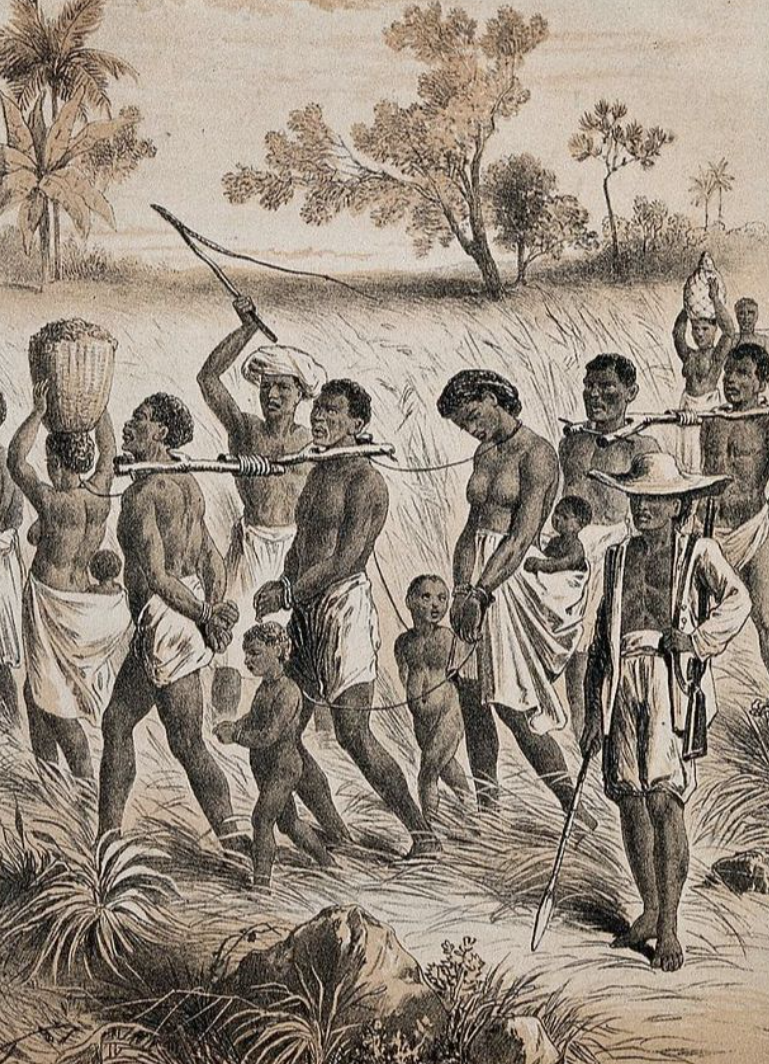
 Slavery is as old as civilization. As hunter-gatherers, humans could not have held slaves. Only with the advent of settled agriculture it became possible for some people to own other people. Every civilization has had the institution of slavery although one may get the impression that only the whites have enslaved blacks, and that the Americans in particular are guilty of the crime of slavery.
Although that’s a common enough misconception, there’s no justification for it in this day of easy access to historical information. A quick question to any of the AI engines is all you need to learn about the awful history of slavery.
The Atlantic slave trade is the most cited but was neither unique nor even the worst. During the Atlantic slave trade, which lasted from the sixteenth to the nineteenth century, around 12 million Africans were put on slave ships, sailed across the Atlantic Ocean and sold into slavery. Of this approximately 600,000 were transported to north America, which means that about 5% of all African slaves from the Atlantic slave trade were brought to America.
The Europeans did not capture slaves in Africa. The job of capturing Africans and selling them to Europeans was done by Africans. Africans enslaved Africans. They were the original slavers.
Did you know that blacks owned slaves in the American south? Only about two or three percent of Americans in the southern American states owned slaves and a good fraction of the slave owners were black.
The monotheistic religions are quite supportive of slavery. Judaism, Christianity and Islam have rules on how to treat slaves. They don’t have any prohibition on slavery but they do have all sorts of dietary prohibitions. That should tell you a lot about how enlightened those creeds are.
Even before the trans-Atlantic slave trade, the Arabs captured millions of slaves around the world. The etymology of the word slave is revealing. It comes from Slav because many Slavs were sold into slavery.
The Arab slave trade, also known as the Trans-Saharan, Red Sea, or Indian Ocean slave trade, was a system of enslavement primarily conducted by Muslim traders and states from the 7th century AD through the 20th century, spanning over 1,300 years. It involved the capture, transport, and sale of slaves from sub-Saharan Africa, Eastern Europe (such as Slavs and Circassians), the Caucasus, Central Asia, and parts of India and Southeast Asia.
I have appended a brief note composed by grok (lightly edited) about the Arab slave trade at the end of this piece. It’s a horror show. Read 15 Forgotten Slave Trades Outside the Atlantic World
A friend asked me to write about the economics of slavery. Slavery is in essence robbery. It involves the use of force to deprive a person of the use of his body and mind for his own purposes. Slavery is immoral, for certain but like theft or robbery, it’s not economically inefficient in its first-order effect. If I steal $10 from you, your loss is my gain. That is Pareto efficient because that theft in itself did not lead to any loss of the total amount of money; it only affected the distribution.
The second-order effects of theft or robbery are more likely to lead to social losses. If your property is likely to be stolen or property rights are not enforceable, then you may not put in the effort to create wealth.
If the product of your labor is going to be stolen, you will not work as hard and therefore society loses wealth. That makes slavery economically inefficient. In other words, slavery is beneficial to the slave owner but the gain to the slave owner is lower than the loss to the enslaved person.
Slavery ended because the economics of slavery changed. It is true that the abolitionists did have a hand in it. But in the end, economic forces abolished slavery in the developed world more than any humanitarian forces.
Quick lesson. As you know, economics is called the “dismal science.” Economics earned its “dismal” reputation by standing against slavery and for human equality, even when that stance was unpopular. Economists generally held that people of all races were fundamentally similar, entitled to liberty.
The phrase “dismal science” was coined by the Scottish historian and essayist Thomas Carlyle in his 1849 essay “Occasional Discourse on the Negro Question.” He used it derogatorily to criticize economics (then called political economy) for its opposition to his pro-slavery views.
He argued that blacks were inherently idle and inferior. He mocked philanthropists and economists who advocated free labor markets. Classical economists like John Stuart Mill responded vigorously. Mill’s 1850 rebuttal, “The Negro Question“, defended emancipation and free labor.
A widespread myth attributes the phrase to Carlyle’s reaction to Thomas Robert Malthus’s pessimistic predictions of population growth outstripping resources, leading to famine and misery. While Carlyle did criticize Malthus elsewhere, the specific term “dismal science” originated in the slavery debate, not population theory.
The end of traditional chattel slavery (legal ownership of people as property, inheritable across generations) began to end in the Western world around the beginning of the 19th century but did not end in the Islamic world until the middle of the 20th century.
Though slavery is abolished around the world, it still exists in the world today. Modern forms of slavery—as defined by the International Labour Organization (ILO)—persist in many Muslim-majority countries. These include forced labor, human trafficking, debt bondage, forced marriage, and exploitative domestic work, affecting an estimated 50 million people globally in 2023, with disproportionately high prevalence in some regions of the Islamic world.
A clue to what explains the end of slavery is contained in the fact that the beginning of the end of slavery coincided with the beginning of the Industrial Revolution in England and then spread to the rest of the industrialized world, and then to the developing world.
Slavery was abolished in the US with the end of the American Civil war in 1865. (I recommend Ken Burns’ documentary “The Civil War.” It is available free on YouTube.) The southern states did not wish to be forced by the northern states to abolish slavery. The southern states were economically dependent on slave labor to work their cotton plantations. Eli Witney’s cotton gin made it efficient to separate the cotton seeds from the fiber but picking cotton required labor.
The industrial revolution began in the second half of the 18th century. Between 1760s and 1780s, James Watt improved Thomas Newcomen’s 1712 steam engine. That powered the industrial revolution with coal as the major source of energy.
About a century later, in 1859, commercial oil wells came into operation in Pennsylvania. That was the beginning of the displacement of human muscle power with power from crude oil. It became possible — not just morally justifiable — to end slavery.
Consider this. A barrel of oil has roughly 1700 kwh energy. That’s equivalent to five human-years of work. The use of oil, coal and natural gas provides the equivalent of ~500 billion humans’ worth of energy. On average, every human alive today has around 50 “slaves” working for him or her. It would be economically inefficient to enslave people.
We don’t need slaves because we have technology. And as we get more technology, the world will become a lot better. “The better angels of our nature” is credited for our moral progress but a look behind the curtain will reveal that technology has made it possible for us to become good.
Time for a bit of music.
That’s it for now. Thank you, good night, and may your god go with you.
Appendix: The Arab Slave Trade
The Arab slave trade, also known as the Trans-Saharan, Red Sea, or Indian Ocean slave trade, was a system of enslavement primarily conducted by Muslim traders and states from the 7th century AD through the 20th century, spanning over 1,300 years. It involved the capture, transport, and sale of slaves from sub-Saharan Africa, Eastern Europe (such as Slavs and Circassians), the Caucasus, Central Asia, and parts of India and Southeast Asia. Key routes included overland caravans across the Sahara Desert to North Africa, maritime paths via the Red Sea to Arabia, and the Indian Ocean to regions like Zanzibar, Oman, and the Persian Gulf.
Slaves were sourced through raids, warfare, kidnappings, and tribute from African kingdoms, with major markets in cities like Cairo, Mecca, Khartoum, and Zanzibar. Estimates suggest 11–17 million Africans were enslaved over the centuries, with additional millions from other regions (e.g., up to 1.25 million Europeans via the Barbary Coast between 1530 and 1780).
High mortality rates occurred during transport, with up to 50% dying from exhaustion, disease, or exposure.
Slaves were used for domestic service, concubinage (especially women, who comprised a higher proportion), military roles (e.g., Mamluk soldiers or Janissaries), eunuch guards (many males were castrated), and limited agricultural labor, as large-scale plantations were discouraged after major revolts like the Zanj Rebellion (869–883 AD).
Islamic law regulated slavery, prohibiting the enslavement of fellow Muslims but allowing it for non-Muslims captured in jihad; it encouraged manumission as an act of piety, and children born to enslaved concubines and free Muslim fathers were often free and legitimate.
Racial prejudices existed, particularly against Black Africans, but slavery was not strictly racialized in doctrine.
Abolition was gradual, influenced by Western pressure, with bans in places like Zanzibar (1909), Saudi Arabia (1962), and Mauritania (1981, though enforcement lagged), and some modern revivals attempted by jihadist groups.
Contrast with the Atlantic Slave Trade
The Atlantic slave trade, driven by European powers (primarily Portugal, Britain, Spain, France, and the Netherlands), lasted about 400 years from the 15th to 19th centuries, peaking in the 18th century. It focused exclusively on Africans from West and Central Africa (e.g., regions like Angola, the Bight of Benin, and the Gold Coast), with an estimated 10–12.8 million people forcibly transported across the Atlantic Ocean in the infamous Middle Passage, where 12–15% died en route from disease, overcrowding, and abuse, contributing to total deaths of 4–5 million including pre-shipment losses.
Slaves were destined for the Americas, with Brazil receiving about 4.8 million (38%), the British Caribbean 2.3 million (18%), and the U.S. around 300,000 directly (plus internal trade).
They were primarily used for intensive plantation labor in crops like sugar, cotton, tobacco, and coffee, under a system of hereditary, racialized chattel slavery where enslaved status passed through the mother, and manumission was rare.
Key contrasts
-
-
- Duration and Scale: The Arab trade endured far longer (1,300+ years vs. 400) but at a lower annual intensity, with similar total African victims (11–17 million vs. 10–12.8 million).
- The Atlantic was more concentrated and industrialized, driven by colonial demand.
- Sources and Routes: Arab trade drew from diverse regions (Africa, Europe, Asia) via land and sea routes; Atlantic was limited to African coastal areas and transoceanic voyages.
- Demographics and Treatment: Arab trade favored females (2:1 ratio) for concubinage and castrated many males, leading to limited reproduction and integration through conversion/manumission; Atlantic favored males (2:1) for labor, with high reproduction in the Americas but brutal, non-integrative conditions and explicit racial hierarchies.
-
Uses and Economy
Arab slaves often filled domestic, military, or sexual roles with some social mobility (e.g., Mamluks rising to power); Atlantic emphasized exploitative agricultural and mining labor with no upward paths.
Abolition and Legacy
The Atlantic ended earlier due to humanitarian campaigns (e.g., British ban 1807, U.S. 1865), while the Arab trade persisted longer without equivalent internal movements, only curbed by external pressure.
The Atlantic created a large African diaspora in the Americas with lasting racial impacts, whereas the Arab trade’s effects are more integrated into Middle Eastern and North African societies, though less publicly acknowledged.

 Atanu Dey : Life is a Random Draw
I read the whole piece.
I wondered what Adam Smith thought of slavery and found this.
Adam Smith was a staunch critic of slavery, attacking the institution from both economic and moral perspectives. While he is most famous for his economic arguments in The Wealth of Nations, his moral condemnation in The Theory of Moral Sentiments was equally severe.
LikeLike
Sharing this because I think you will like the video or at least like the subject:
https://www.youtube.com/watch?v=Gc_LSTh7meA
LikeLike