

Life is a random draw. Much of life is contingent and it’s like a random walk with many unpredictable twists and turns. Many unforeseen events have taken me down roads that I had no inkling about even a few months before I embarked on an adventure. One of those lucky turns happened around 33 years ago.
I was at the Sunnyvale Public Library, waiting in line to check out a few books. SPL was close to home. I would go there a few times a month. While waiting to check out books, I randomly picked up a book from a sorting cart. It was titled “Micromotives and Macrobehavior.” I glanced at a few paragraphs and decided to borrow the book.
That evening, I started reading the book. In a day, I had read the book. I found it fascinating. The author, it turned out, was someone named Thomas Schelling. He was an economist. It dawned on me for the first time that I was an economist. Until that point, I had not only not known what economics was but I had no idea that I was actually an economist.
A few months later, I was telling about that to a friend of mine, VA, in Palo Alto. He said, “Hey, I think you should get a Ph.D. in economics!” That planted a seed.
 Years ago, I had enrolled for a Ph.D. in computer science at Rutgers, the State University of New Jersey. I was advanced in the program (“all but the dissertation”) when I visited a friend (same guy, VA) in Sunnyvale, CA, for the summer in 1994. I got to know many people. One of them said, “Hey, get a job.” So, I wrote up a resume and a week later I had a job at HP in Cupertino. (That HP site is where the Apple headquarters is now. Picture above.)
In a sense, I was not unfamiliar with the rigors of a Ph.D. program. But there was a little problem: I did not have any background in economics. Getting into a Ph.D. program in econ at a world-class university without any background is not an easy job. If I had been asked the simplest of questions — “Why does a demand curve slope downward?” — I would have replied “what’s a demand curve?”
Anyhow, my determination and persistence (unusual for me) paid off. UC Berkeley admitted me but I was told by the chairman of the admissions committee that I was most likely to fail out of the program.
As it happened, I did get through. My doctoral dissertation was on the Indian telecom sector. It investigated “the welfare consequences of the universal service obligation imposed cross-subsidies on the demand for telecommunications in India.”
I am pretty proud of that but I admit that now if I try to read my thesis, I can’t make head nor tail of it. Too much heavy mathematical modeling and then of course the econometrics is completely opaque. Anyway, I did learn a bit of economics at graduate school.
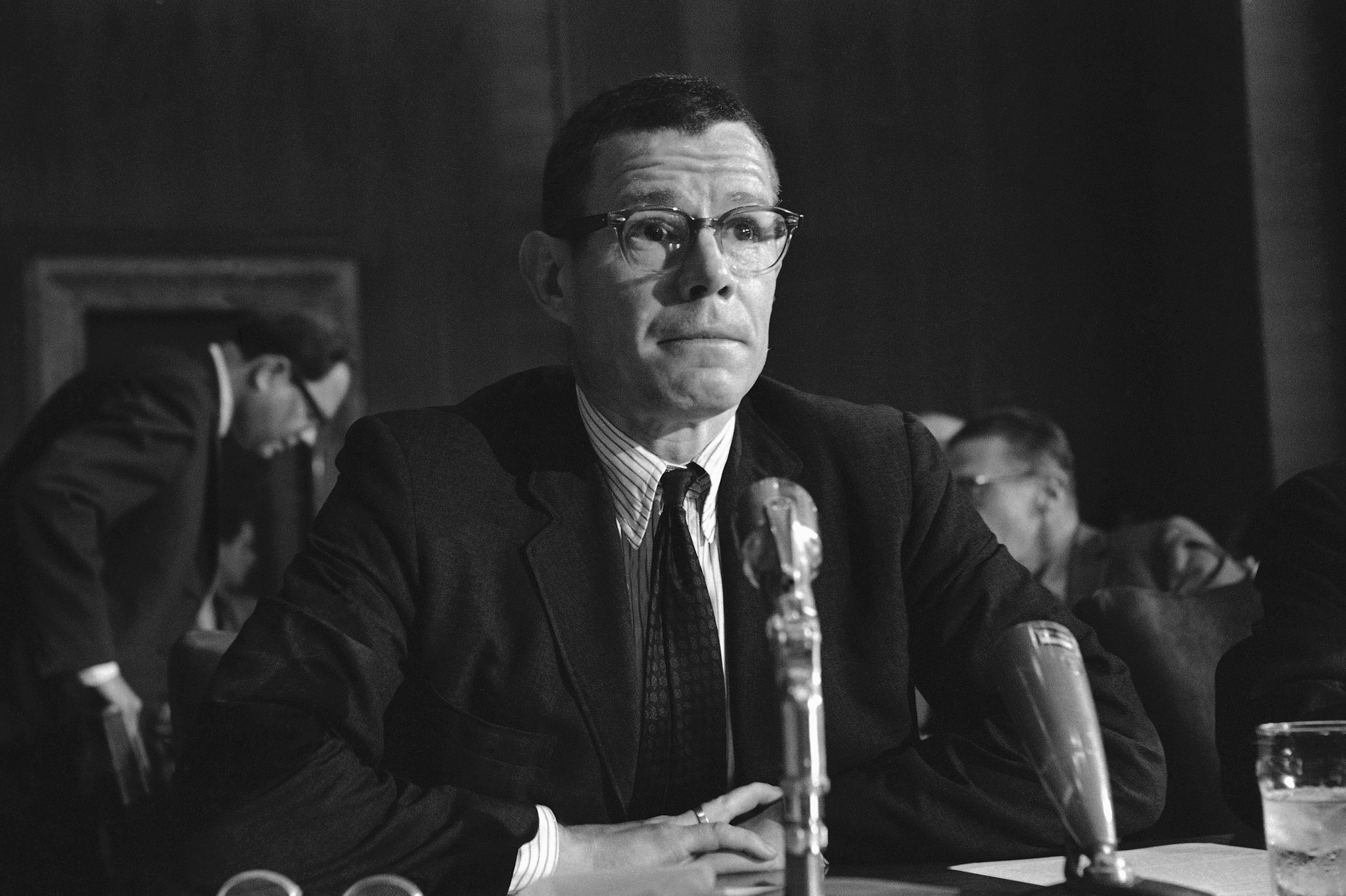 It all began with Thomas Schelling’s book. He was a brilliant man. Nine years ago, on Dec 13, 2016, Schelling passed away. I write to acknowledge a debt of gratitude to him.
Here’s a brief summary of his work.
Thomas C. Schelling (1921–2016) was an American economist whose pioneering application of game theory to real-world strategic interactions profoundly shaped economics, particularly in understanding conflict and cooperation. He shared the 2005 Nobel Memorial Prize in Economic Sciences with Robert Aumann for “having enhanced our understanding of conflict and cooperation through game-theory analysis.”
His key contributions are:
Strategy of Conflict and Bargaining (The Strategy of Conflict, 1960)
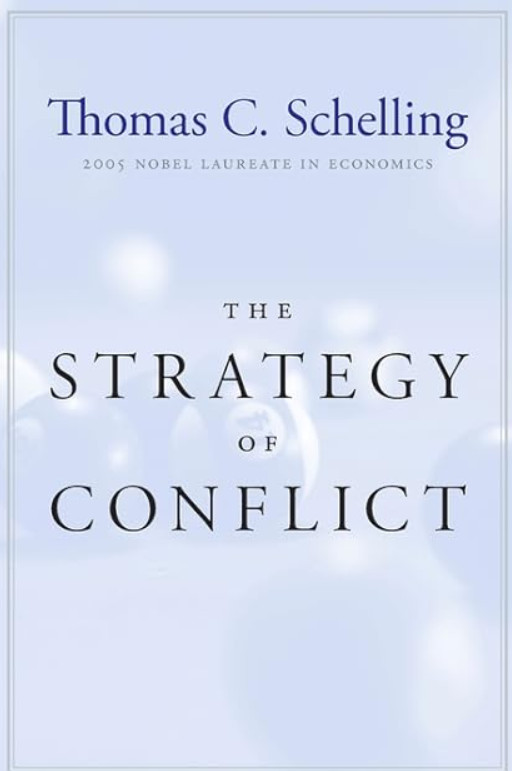 Schelling’s seminal book reoriented game theory toward mixed-motive situations, where parties have both conflicting and shared interests. He introduced concepts like:
-
- Credible commitments: How promises and threats can be made believable (e.g., by irreversibly limiting one’s own options, such as “burning bridges”).
- Focal points (Schelling points): Tacit coordination without communication, where people converge on salient solutions (e.g., meeting in a city at a prominent landmark).
- Deterrence and brinkmanship: In nuclear strategy, the value of deliberate uncertainty or “threats that leave something to chance” to deter aggression.
These ideas influenced Cold War policies, arms control, and broader negotiations in trade, business, and international relations.
Models of Segregation (Dynamic Models of Segregation, 1971; expanded in Micromotives and Macrobehavior, 1978)
Schelling developed an early agent-based model showing how mild individual preferences for similar neighbors (e.g., wanting at least 30–50% like oneself) can lead to extreme macro-level segregation through “tipping points.” This demonstrated unintended emergent outcomes from individual “micromotives,” influencing urban economics, sociology, and behavioral economics. It highlighted how segregation persists without strong prejudice or external forces.
Applications
-
- Extended ideas in Arms and Influence (1966) to coercion and diplomacy.
- Contributed to behavioral economics by exploring self-commitment (e.g., in addiction or decision-making) and coordination problems.
- Later work touched on climate change (advocating carbon taxes), health policy, and global issues like nuclear taboos.
Schelling’s accessible, non-mathematical style—relying on logical reasoning and vivid examples—made his insights widely influential across economics, political science, and beyond, bridging theory with practical policy. His work remains foundational in strategic thinking.
Be well, do good work and keep in touch.
Previous 2005 post on the passing of Thomas Schelling.


What would be a good book you recommend to understand and apply game theory in one’s life
LikeLike
For someone new to game theory without a background in mathematics or economics, I’d recommend “The Art of Strategy: A Game Theorist’s Guide to Success in Business, Politics, and Everyday Life” by Avinash Dixit and Barry Nalebuff. This book is one of the most accessible introductions to the subject. It explains core concepts—like the prisoner’s dilemma, Nash equilibrium, strategic moves, and commitment—through engaging real-world examples from sports, politics, business negotiations, history, and daily life (e.g., brinkmanship in poker or salary negotiations). There’s minimal math; instead, it focuses on intuitive reasoning and practical insights into how people make decisions in competitive or cooperative situations. It’s fun, clear, and applicable without requiring technical prerequisites. An alternative is “Prisoner’s Dilemma” by William Poundstone. It’s a narrative-driven book blending history (e.g., John von Neumann’s life, Cold War applications) with key ideas.
Start with Dixit and Nalebuff—it’s the sweet spot for beginners seeking basics without formulas.
LikeLike