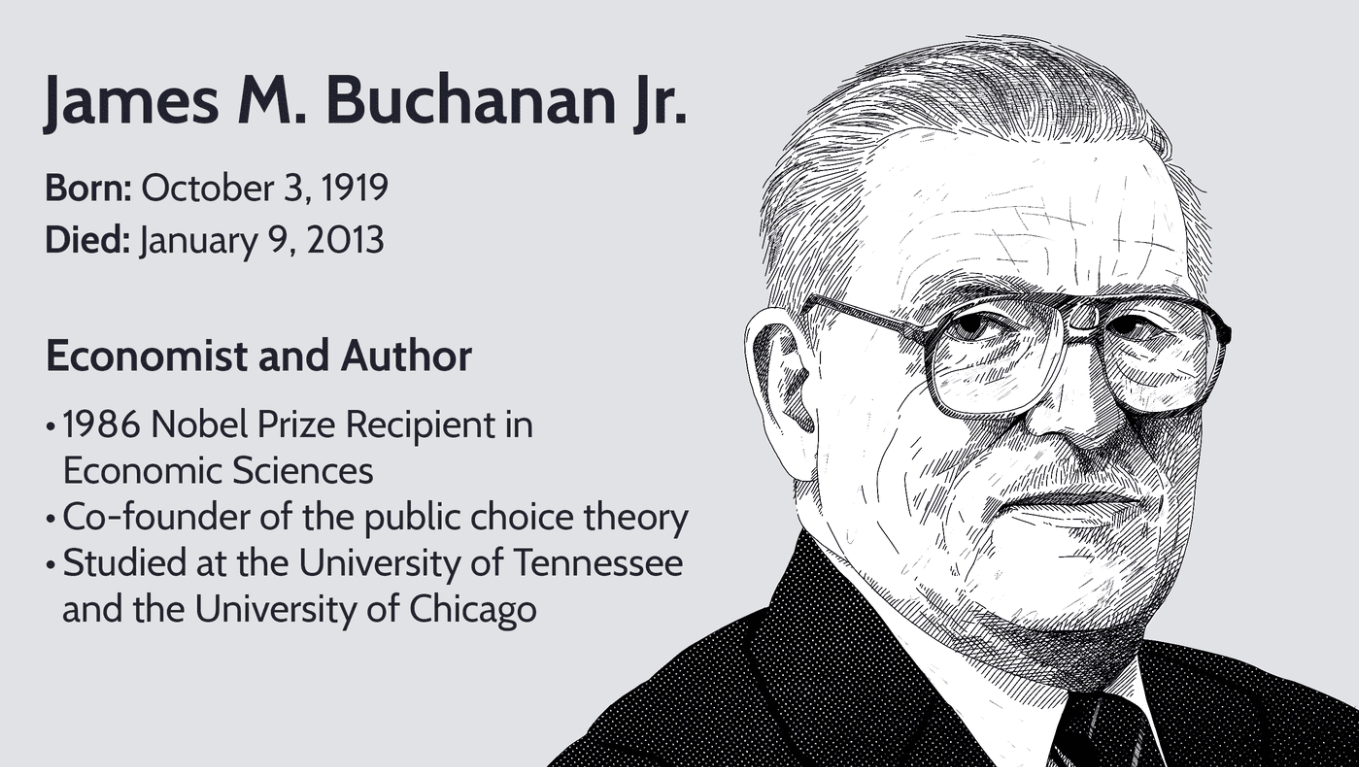
The Political Economy of James Buchanan

Among the many economists I have deep respect and reverence for are the classical economists like Adam Smith, David Hume, David Ricardo, and John Stuart Mill. Among the neoclassicals are William Stanley Jevons, Leon Walras, Carl Menger, Alfred Marshall, Vilfredo Pareto, Francis Edgeworth, and Lionel Robbins.

Jevons, Walras, and Menger were the founding figures of the marginalist revolution that established neoclassical economics, with Jevons and Walras independently developing the theory of marginal utility in the 1870s.

Alfred Marshall synthesized classical and neoclassical ideas in his influential textbook Principles of Economics. Pareto, a successor to Walras in Lausanne, Switzerland advanced the field, especially in general equilibrium theory. Edgeworth developed a mathematical economic theory based on utility maximization, and later economists like John Hicks and George Stigler helped broaden the scope of neoclassical thought. Continue reading “The Political Economy of James Buchanan”
Cost

We all understand what price means — whatever we have to pay for it. We also know that the price has something to do with the cost and we often use the two words interchangeably. But it is not clear what precisely is the difference between them.

For example, when we buy a widget for $5 — the price — but it could very well be that its cost of production and distribution was above or below that price. But generally, on average the price of stuff closely tracks its cost. If the revenue obtained from sales is below cost, the product or the firm is forced out of the market.

Where does cost arise from? Here I argue that the cost of anything is ultimately the cost of the energy that went into its production and distribution. Therefore, prices fall when energy costs fall, and vice versa. Continue reading “Cost”

Energy Matters

I find planes fascinating. Those humongous machines are capable of flying thousands of miles at speeds just below the speed of sound, cruising over  35,000 feet above MSL, with hundreds of passengers in comfort and safely at prices that billions of people can afford.
If in the year 1900 — that wasn’t too long ago — you had told someone that traveling at 500 miles per hour would be commonplace by the year 1970 (the year the jumbo jet Boeing 747 entered service), they would worry about your sanity. Furthermore, if you insisted that people would be traveling around 7 miles above the earth while crossing continents, they would have you committed to a lunatic asylum.

It’s hard enough to get up to 7 miles above ground. But on top of that, to move at 500 miles per hour? That’s two impossible feats at the same time. That’s unbelievable squared.

I often meditate on the fact that these commercial jetliners evolved from their ancestral form around the year 1900 in less than half a century. Their progenitor was built out of wood, fabric and wires by a couple of bicycle mechanics from Dayton, OH. They started with experimenting with gliders for several years, and then having figured out the physics of flight, added an engine that they built in their shop. The first powered flight was on 17th December 1903 in Kitty Hawk, NC. Continue reading “Energy Matters”

On Bullshit

Among contemporary historians, I rate the American historian Stephen Kotkin (Ph.D, UC Berkeley) at the top of a very short list. He focuses on Russian and Soviet politics and history, communism, global history, authoritarianism, and geopolitics. I learned a lot from him on the Stalinist era, and the life of Joseph Stalin. I couldn’t possibly read his biography of Stalin (three volumes, each 1000+ pages) but fortunately his talks and conversations provide what we non-specialists should know.

Another historian I like happens to be a farmer and a scholar: the classicist Victor Davis Hanson. He’s a conversative and comments on contemporary politics. VDH is an expert on military history, ancient warfare, ancient agrarianism, and the classics. VDH divides his time between Stanford University and Fresno, a small town in the Central Valley of California. He works on his family farm which has been with them for six generations.

Continue reading “On Bullshit”

Cheaper All the Time

In general, everything everywhere is getting cheaper all the time. This claim is counter-intuitive because in our experience, with a few notable exceptions, we see prices going up all the time. Economists have a word for that: inflation. It’s a broad increase in the prices of goods and services, which decreases the purchasing power of money. While inflation is a reality, it is not the whole story.

It is useful to distinguish between the “real” and the “nominal.” The sticker price is the number of dollars you pay at the store. That’s the nominal price. Inflation is an increase in the nominal price level. Price level refers to the nominal prices of a very large collection of goods and services. Inflation is a universal phenomenon, although it varies greatly in time and place. 

 It is also true that on average, the real prices of most goods and services are falling all the time. Evidence for that is not hard to find. Continue reading “Cheaper All the Time”

The Economics “Nobel” Prize

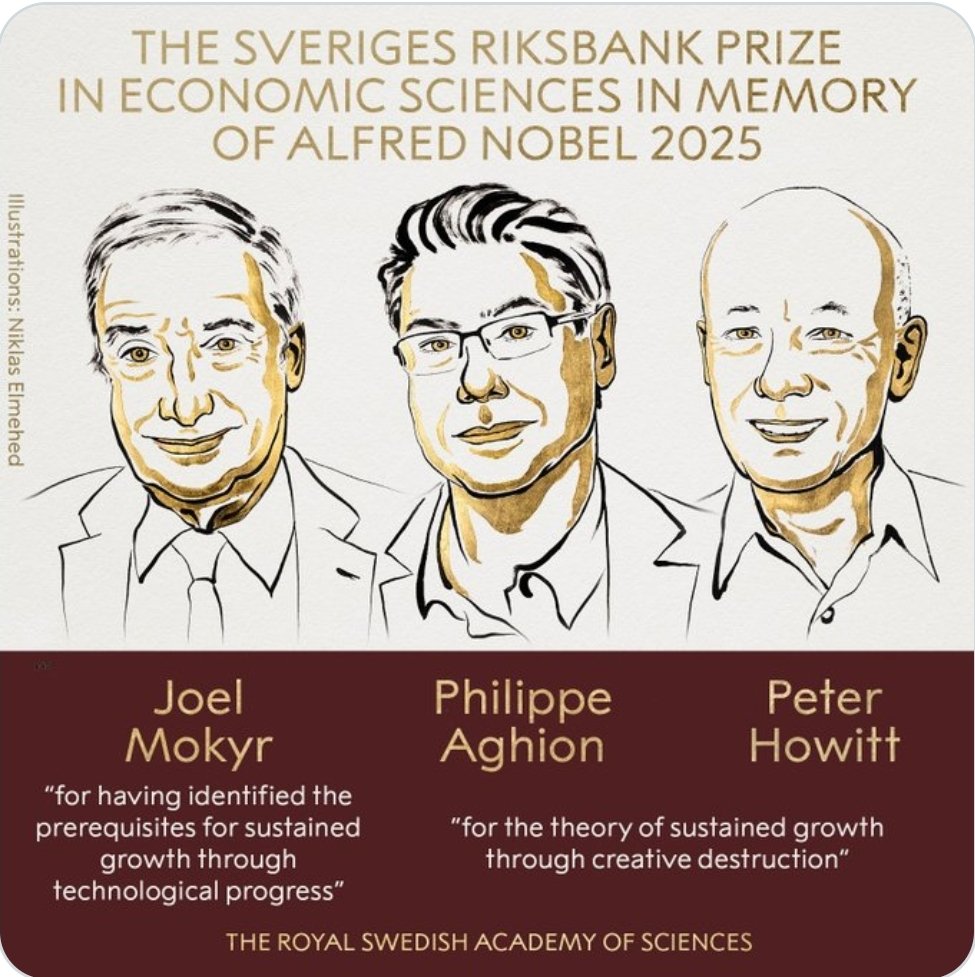
The Royal Swedish Academy of Sciences has decided to award the 2025 Sveriges Riksbank Prize in Economic Sciences in Memory of Alfred Nobel to Joel Mokyr, Philippe Aghion and Peter Howitt “for having explained innovation-driven economic growth” with one half to Mokyr “for having identified the prerequisites for sustained growth through technological progress” and the other half jointly to Aghion and Howitt “for the theory of sustained growth through creative destruction.” Source: The Nobel Prize on X.

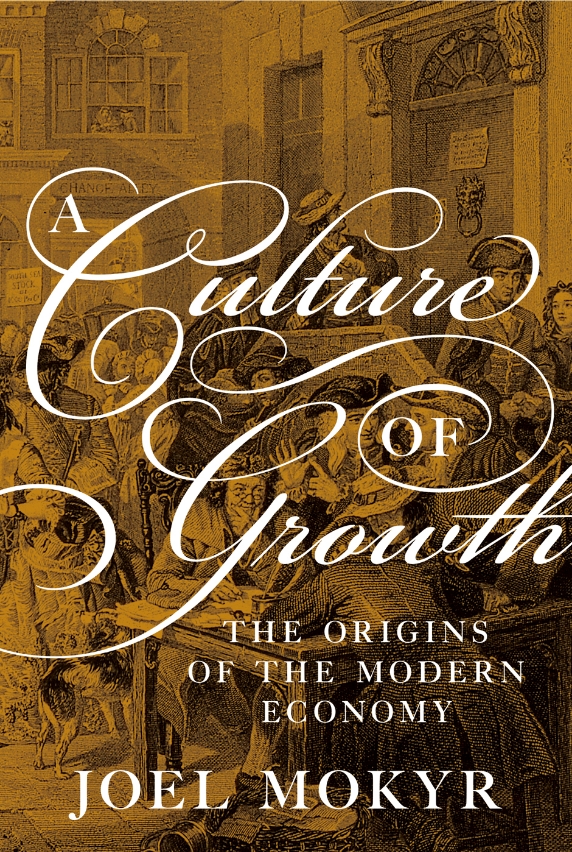
I like Prof Mokyr’s work. He’s a wonderful teacher. His talks are excellent and he has a wicked sence of humor. I particularly like his book, “A Culture of Growth: The Origins of the Modern Economy.

A wonderful read but you can get the main points in a 90 minute talk. Here it is: Continue reading “The Economics “Nobel” Prize”

Why America, the Superpower, Will Last

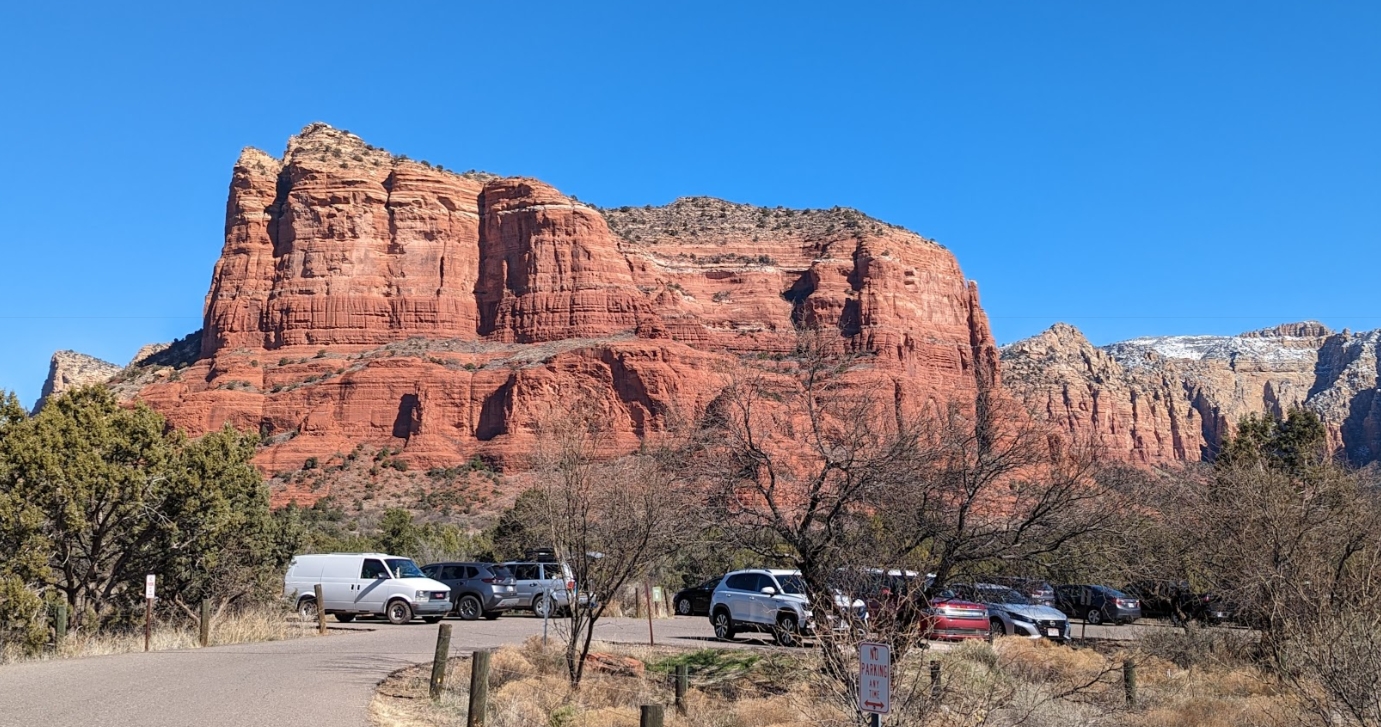
Red Rock, Sedona, AZ. Feb 2023.

The question of how the United States, which will celebrate its 250th anniversary of its founding on July 4th, 2026, became the most powerful superpower the world has ever known has been asked and answered by many. The answers vary. Economists stress some aspects; geologists, historians and sociologists other aspects. In the end, we have to integrate their multiple views. We have to continue to walk around that elephant to get a sense of what that beast is.

Geography has to have been a major factor. I recommend this video. The title “America Will Be the Last Superpower” is somewhat wrong. I believe that it should have been why America will last (at least for the foreseeable future) as a superpower. But here goes. Continue reading “Why America, the Superpower, Will Last”

Subho Bijoya Dashami

Ma Durga and her children — Ganesh, Lakshmi, Saraswati and Kartik. Click to embiggen.

Pujo ended today. Ma Durga’s visit to her maternal home is over and she’s gone back to her husband’s home. Bengali traditional iconography shows her with her children. In the picture above, from left to right, there’s Ganesh, Lakshmi, Ma Durga riding a lion in her incarnation as Mahisasurmardini (the slayer of the demon Mahisasur), Saraswati and Kartik. (Image from the puja pandal at PJC Bangalore.)

Mahisasur is a powerful asura (demon) depicted as a half-buffalo, half-human being born from the union of an asura king and a she-buffalo named Mahishi. He is known for his shape-shifting abilities, capable of transforming between human and buffalo forms. He gained immense power through severe penance, which led to a boon from Bramha Dev granting him invulnerability to being killed by any man or god. This boon had a critical loophole: he could only be slain by a woman.  Continue reading “Subho Bijoya Dashami”

Goodbye, Dr. Jane Goodall

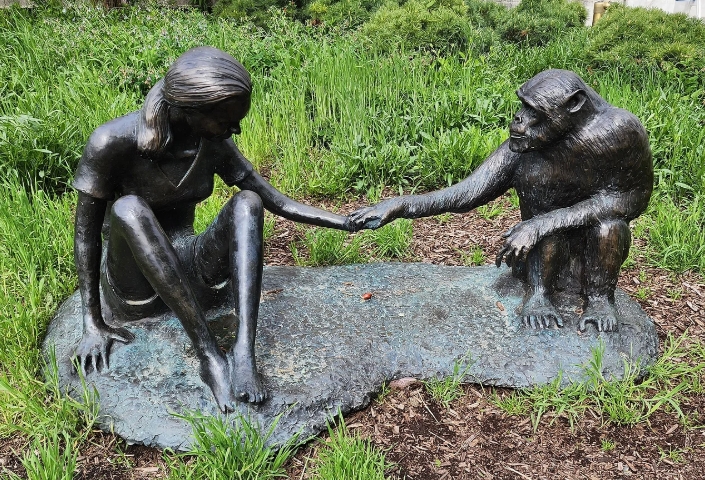
A sculpture of Jane Goodall and David Greybeard outside the Field Museum in Chicago (wiki)

Dame Jane Morris Goodall (3 April 1934 – 1 October 2025), was an English primatologist and anthropologist. She was considered the world’s foremost expert on chimpanzees, having studied the social and family interactions of wild chimpanzees for over 60 years. Goodall first went to Gombe Stream National Park in Tanzania to observe its chimpanzees in 1960. (Source: wiki.) She passed away yesterday, 1st Oct., in Los Angeles, CA.

Her work with the chimps at the Gombe National Park was phenomenal. I first came to know about her work through a talk she gave at the National Press Club sometime in the late 1990s. I heard the talk on my local public radio station KQED 88.5. (Those were the days when NPR had not generated to the woke nonsense station it has become now.) Continue reading “Goodbye, Dr. Jane Goodall”