

The word guru in the dharmic traditions—namely Sanatana, Buddha and Jaina—refers to someone who dispels the darkness of ignorance. Because ignorance is the primary barrier to enlightenment or moksha, the guru is supremely important.
Today is Guru Purnima. Hindus believe that on this day Bhagwan Shiva became the first guru (adi guru) when he transmitted the knowledge of yoga to the world. Also that sage Vyasa, the author of the Mahabharata, was born on this day.
For Buddhists, Guru Purnima commemorates the day when Gautama Buddha delivered his first sermon at the Deer Park in Sarnath, setting in motion the Wheel of Dharma. For Jains, it is the day when Mahavira, the 24th tirthankara accepted his first disciple. These two events are dated to around 2,500 years ago.
As today is Guru Purnima it is appropriate to express one’s gratitude and reverence to one’s spiritual and academic gurus by reciting the guru vandana. It’s one of the first Sanskrit mantra I learned.
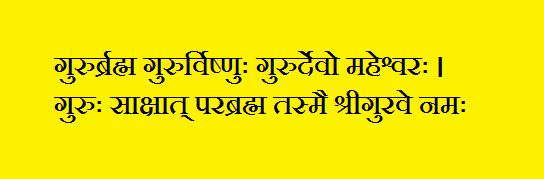
ॐ Guru Brahma, Guru Vishnu
Guru Devo Maheshwara
Guru Shakshat Parabramha
Tasmai Shri Guruvey Namaha ॐ
Rough translation: The guru is Bramha (one who creates); the guru is Vishnu (one who preserves creation); and the guru is the god Maheshwara (aka Shiva, one who completes the cycle creation by annihilation). The guru is the personification of the Ultimate Bramha. I salute the guru.
I have had many gurus who have guided me along my intellectual path. Many of my spiritual gurus have been from the dharmic traditions (therefore mostly, but not exclusively, Indian) and my academic gurus have been mostly (but not exclusively) dead white men. One day I should make a list of my gurus.
Sakshat pranam to all my gurus.
Guru vandana is included in the chorus of George Harrison’s song “My Sweet Lord”. Listen:
On the topic of Sanskrit mantra, here’s one that I learned rather late in life. The Gayatri mantra, a sacred and revered Rig Vedic mantra. It is addressed to Savitr, a solar deity. The Gayatri Mantra is considered the “mother of all mantras.” It is also associated with the concept of the Divine Mother, who protects her children and leads them toward self-realization.
“ॐ भूर्भुवः स्वः तत्सवितुर्वरेण्यं भर्गो देवस्य धीमहि धियो यो नः प्रचोदयात् “
“Om Bhur Bhuvah Svah, Tat Savitur Varenyam Bhargo Devasya Dheemahi Dhiyo Yo Nah Prachodayat“
The meaning of the mantra: “Om” represents the sound of the universe. “Bhur” refers to the physical world, “Bhuvaḥ” to the mental world, and “Svaḥ” to the celestial world. “Tat” means “That,” referring to something beyond. “Savitur” is another name for Savitri or Gayatri, and “Vareṇyaṃ” means the most excellent. “Bhargo” is radiance, “Devasya” is the divine, “Dhīmahi” means we meditate upon, “Dhiyo” refers to the intellect, “Yo” means which, “Naha” means our, and “Pracodayāt” means may enlighten.
Therefore —
“Om, the Lord is earth, the space in between, and the heavens. That Lord is the one who is the most worshipful. We meditate on that effulgent, all-knowledge Lord. May he set our intellects in the right”.
Another Sanskrit mantra I know is the shloka from the Isa Upanishad.

“Purna madah, purna midam Purnat purna mudachyate …”
That is the infinite; this is the infinite. When this infinite is taken from that infinite, that infinite alone remains.
Swami Sarvapriyanand explains it here.
I like Pandit Jasraj’s rendition of that shloka in a classical raga. Here’s an excerpt:
I will post the longer bit from which I took that bit from later.
The next Sanskrit mantra I know is the Om Asatoma mantra, which is derived from the Brhadaranyaka Upanishad. It is a request: lead me from the untrue to the true; from darkness to light; from death to immortality.
ॐ असतो मा सद्गमय ।
तमसो मा ज्योतिर्गमय ।
मृत्योर्मा अमृतं गमय ।
ॐ शान्तिः शान्तिः शान्तिः ॥
Credit: Ravi Shankar/George Harrison.
Om Asato Maa Sad-Gamaya
Tamaso Maa Jyotir-Gamaya
Mrtyor-Maa Amrtam Gamaya
Om Shaantih Shaantih Shaantih
Alright, time to listen to a couple of songs that have some connection to Hindu dharma. From the movie Matrix: Revolution. When I listen to this song — Navras — my neighbors hear it too 🙂
And I cannot end this Guru Purnima without listening to George Harrison’s My Sweet Lord (an excerpt from which I posted above.)
George considered Ravi Shankar to be one of his gurus. Sadly, he was gone too soon. His ashes were scattered in the Ganga since he was a Hindu.
That’s all for now. Be well, do good work and keep in touch.

 Atanu Dey : Life is a Random Draw
if 90pc of world population do not believe in yr assertions
who is right or wrong?
LikeLike
I am not in the business of sanctifying people’s beliefs. I am a seeker of truth. That’s ultimately an impossible quest but not without some limited success if one tries hard enough. The “truth” is limitless and can never be fully grasped. That’s what the dharmas teach. \
All that we can best hope for is an approximation to truth. That’s science. That’s tentative assertions of what the world may be about. But even limited truth is not decided by counting noses. Even science is not about consensus. Science is not “democratically” decided. Something may be true and yet very few people know it or if told, believe it.
Let’s take a trivial example. Imagine yourself around 2000 years ago. Imagine you believed in the assertion that the earth was a sphere around 8000 miles in diameter. Eratosthenes, the Greek polymath who lived around 276 BC to 194 BC calculated the earth’s circumference with remarkable accuracy. Your contemporaries even 1000 years after Eratosthenes — about 99 percent of them — believed that the earth was flat. Would you have been wrong merely because nearly all of your contemporaries thought you were wrong?
I thank you for your comment but to be honest, I am not sure I understand why you made that comment to my post.
LikeLike
“Truth” often is subjected to circumstances; 2 examples:
–“1000 years after Eratosthenes — about 99 percent of them — believed that the earth was flat”
Actually the (Earth’s) sphere is topologically homeomorphic to an infinite flat plane: Place the sphere on the flat plane, one can join the North pole with any point (except the North pole itself) with a straight line and that straight line can be extended to reach another point on the flat plane, ie, a one to one mapping between the sphere and the plane or the sphere (except the North pole)is topological homeomorphic to a flat plane.
— In In George Orwell’s ‘1984’: 2 + 2 must equal to 4, otherwise it’s a sign of tyranny; but a Holy Cow
has 2 toes per limb, so to a Sapient Bovine 2 + 2 = 10
LikeLike