
 Today, Feb 26th, is Maha Shivratri or “Great Night of Shiva”, the night when Shiva married Parvati. It has profound significance for Hindus.
Shiva is identified with Brahman, the supreme consciousness. The event marks the cosmic union of Shiva (consciousness) with Parvati who is Shakti (energy), representing harmony and balance in creation. We meditate on this ultimate reality to achieve self-realization and therefore liberation (Moksha) by overcoming ignorance.
Shiva is associated with the cycle of creation, preservation, and destruction. That is the transient nature of the world and the eternal nature of Brahman. That is represented by Shiva’s cosmic dance, the Tandava Nritya.
Untold number of legends are associated with Shiva. Here’s one. Shiva is known as Neelkanth — one with a blue throat. One time, the Devas (demi-gods) and the Asuras (demons) collaborated to extract Amrita (nectar of immortality) by churning Kshira Sagara, the cosmic ocean of milk (not to be confused with the Milky Way.) That event is known as Samudra Manthan.
Though eternal enemies, the devas and ashuras temporarily set aside their differences because neither group could do it by themselves. It symbolizes the balance and harmony needed to achieve great goals.
They used Mount Mandara as the churning rod. That massive mountain had to be supported to stop it from sinking. Kurma, the tortoise avatar of Vishnu, was the support. The churning rope was Vasuki, the serpent king. The asuras held Vasuki’s head and the devas his tail. Then they churned away.
Things don’t always go as expected. During the churning, Halahala, a deadly poison, emerged from the ocean. Shiva saved all living beings by swallowing the poison, which turned his throat blue, earning him the title Nilakantha.
The churning produced numerous treasures, including Kamadhenu (the cow of plenty), Lakshmi (the goddess of prosperity), Uchchaishravas (a divine horse), and finally Dhanvantari emerged with a jar of Amrita. What happened to the Amrita is another story.
My own name — Atanu — is derived from a Shiva story. Shiva, the great ascetic, meditates for eons. One time, Parvati wanted to marry Shiva but he was in meditation. She went to Kamadev — the god of love — and asked him to help.
Kamadev hatched a cunning plan. He took the form of a beautiful maiden and danced in front of the meditating Shiva. Getting disturbed made Shiva very angry. He opened his third eye, and annihilated Kamadev. Shiva, needless to say, is the destroyer.
Anyway, Shiva and Parvati got married, and thus we have the Maha Shivaratri, the cosmic union of Shiva and Parvati. But wait there’s more.
All procreation stopped because Kamadev was no more. The devas went to Bramha, the Creator, and asked him to plead with Shiva to bring back Kamadev. Bramha called up Shiva but Shiva said no can do because he doesn’t un-destroy what he destroys; it’s not what he does.
Thankfully, Vishnu and Shiva reached a compromise after a bit of back and forth: Shiva will allow Kamadev to exist but he will have no body. Kamadev will exist as a spirit but no body. So Kamdev is known as Atanu — one without a body.
(The careful reader would have noticed that I said Brahma went to Shiva, and later I said Vishnu and Shiva reached a compromise. That’s because they all three are the same. Funny.)
My friend Rajan Parrikar posted a beautiful piece on this blog: Shiva’s Cosmid Night – The Primal Pulse. A bit:
This annual revel is an ode to Shiva, the Supreme Yogi and Ascetic, Nataraja (King of Dance), Eternal Guru, and Transcendent Madman. He is Mahadeva, the Great God, who keeps company with mendicants, eccentrics, bums, and spectral wanderers – kindred spirits who haunt cremation grounds, where time dissolves into ash and the Lord sits absorbed in meditation, beyond space, beyond time, beyond thought.
No god in the Hindu pantheon commands the peculiar fascination that Shiva does. He is the distilled essence of paradox – at once the fierce ascetic and the divine householder, the annihilator and the supreme benefactor, the terrifying Rudra and the most tender of gods. He is stillness and tempest, void and abundance, the silence before creation and the force that unravels it. He is not merely worshipped; He is invoked in awe, in dread, in the hushed wonder of those who glimpse the infinite and recoil.
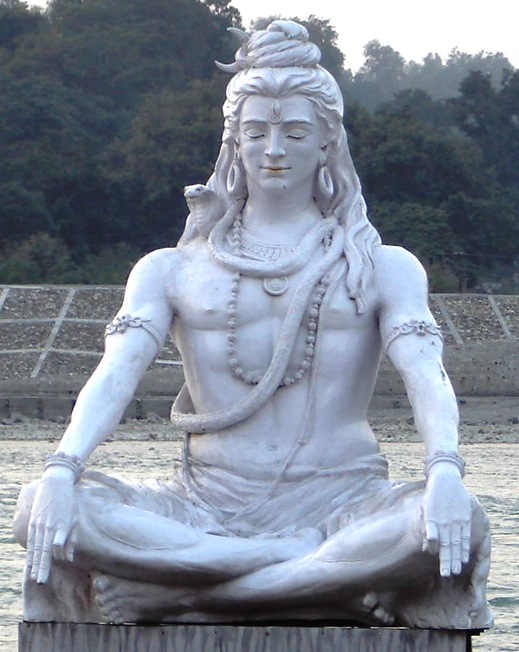
And Rajan explains —
Shiva’s very form is a constellation of potent symbols:
-
-
- The crescent moon – time, arrested and worn like an ornament.
- The serpent coiled at His throat – fear subdued, death mastered.
- The ashes on His body – the final truth of existence, embraced.
- The Ganga flowing from His locks – wisdom, descending from the heavens to the mortal realm.
-
He concludes: “But Shiva is not merely a god – He is a condition of being. To seek Him is to court dissolution, to strip away illusion. His is not the comfort of easy devotion but the event horizon of a black hole – beyond it, no return, only immersion in the infinite.
“Wild and unfathomable, terrifying and merciful, Shiva is the great cosmic enigma. Forever compelling, forever beyond reach.”
I have been a huge fan of Shiva as Nataraja dancing the cosmic dance of creation and destruction. Nataraja is perhaps the most profound metaphor for the evolution of the universe.
Carl Sagan, a great scientist and definitely the greatest science popularizer of the 20th century, described the Nataraja in episode 10 of his brilliant TV series “Cosmos.” Watch a few minutes here: Sagan on Hindu cosmology.
Read Tandava – Shiva’s Cosmic Dance — here on my blog. A bit:
The dance is an act of creation. It brings about a new situation and summons into the dancer a new and higher personality. It has a cosmogonic function, in that it rouses dormant energies which then may shape the world. On a universal scale, Shiva is the Cosmic Dancer; in his Dancing Manifestation (nritya-murti) he embodies in himself and simultaneously gives manifestation to Eternal Energy. The forces gathered and projected in his frantic, ever-enduring gyration, are the powers of the evolution, maintenance, and dissolution of the world. Nature and all its creatures are the effects of his eternal dance.
Ravana, the ten-headed king of Lanka who abducted Devi Sita, composed the Shiva Tandava Stotra, a hymn that celebrates Lord Shiva’s cosmic dance. Despite his portrayal as a demon king in epic narratives, Ravana was also a scholar, musician, and devoted follower of Shiva. His journey was one from pride to humility.
One time, Ravana attempted to lift Mount Kailash, Shiva’s abode, just to show how powerful he was. However, Shiva pressed his toe down on the mountain, trapping Ravana beneath it. Ravana realized that he was done. He repented and started composing the Shiva Tandava Stotra, a hymn expressing admiration of Shiva.
Now is a good time to listen to the stotra — sung by Uma Mohan. Tandava is a dance. Hence the beat.
We have the English translation of the Sanskrit lyrics at the end of this post. Stanza #6 says:
May he with the raging fire
In his forehead, who burnt the God of love,
May He who is forever being saluted by the king of devas . . .
The next song is not something to dance to but to listen with the lights turned low. It says, “Shivo’ham, Soham — I am Shiva, I am That.” The singer is Gaiea Sanskrit. She took the words from the Aṣṭāvakragītā.
The ultimate realization is that I am Shiva. I am That. I am that which the universe is.
Wait. We can’t end this one without “The Dance: by Uriah Heep: the last line does it for me–
You become the dancer
And we become the dance
The dancer dances
Have a wonderful Maha Shivaratri.
Shiv Tandav Stotra
Stanza 1
Jatatavigalajjala pravahapavitasthale
Galeavalambya lambitam bhujangatungamalikam
Damad damad damaddama ninadavadamarvayam
Chakara chandtandavam tanotu nah shivah shivam .. 1
From the forest of his matted lock, water flows and wets his neck,
On which hangs the greatest of snake-like a garland,
And his drum incessantly plays damat, damat, damat, damat,
And Shiva is engaged in the very vigorous manly dance,
To bless and shower, prosperity on all of us.
Stanza 2
Jatakatahasambhrama bhramanilimpanirjhari
Vilolavichivalara ivirajamanamurdhani
Dhagadhagadhagajjva lalalatapattapavake
Kishorachandrashekhare ratih pratikshanam mama .. 2
The celestial river agitatedly moved through his matted hair,
Which makes his head shine with those soft waves,
And his forehead shining like a brilliant fire-daga daga,
And the crescent of the moon which is an ornament to his head,
Makes my mind love him each and every second.
Stanza 3
Dharadharendrana ndinivilasabandhubandhura
Sphuradigantasantati pramodamanamanase
Krupakatakshadhorani nirudhadurdharapadi
Kvachidigambare manovinodametuvastuni .. 3
The consort of the ever-sportive daughter of the mountain,
Whose mind rejoices at her side long glances,
With the stream of merciful look which removes hardships,
Makes my mind take pleasure in him who wears the directions as apparel.
Stanza 4
Jatabhujangapingala sphuratphanamaniprabha
Kadambakunkumadrava praliptadigvadhumukhe
Madandhasindhurasphura tvagutariyamedure
Mano vinodamadbhutam bibhartu bhutabhartari .. 4
He, with the shining lustrous gem on the hood
Of the serpent entwining his matted locks,
He, who is with his bride whose face is decorated
By the melting of red saffron Kumkum,
And He who wears on his shoulder the hide
Of the elephant which was blind with ferociousness,
Makes my mind happy and contented,
In him who is the leader of Bhoothas*.
* can be taken to mean souls or mythical beings guarding Kailasa.
Stanza 5
Sahasralochanaprabhritya sheshalekhashekhara
Prasunadhulidhorani vidhusaranghripithabhuh
Bhujangarajamalaya nibaddhajatajutaka
Shriyai chiraya jayatam chakorabandhushekharah .. 5
May he whose foot stool is decorated
By the ever flowing flower dust.
Falling the bent head of Indra and other Gods,
And may He, whose matted locks are tied by the king of serpents,
And may he, whose head is decorated
By the crescent moon a friend of Chakora*
Shower prosperity forever on me.
* A mythical bird that lives by drinking moonlight.
Stanza 6
Lalatachatvarajvala dhanajnjayasphulingabha
Nipitapajnchasayakam namannilimpanayakam
Sudhamayukhalekhaya virajamanashekharam
Mahakapalisampade shirojatalamastunah .. 6
May he with the raging fire
In his forehead, who burnt the God of love,
May He who is forever being saluted by the king of devas,
And may he who has collected
The cool ambrosia-like crescent moon on his head,
And may he who wears the collection of skulls,
Bless us to create wealth for us.
Stanza 7
Karalabhalapattika dhagaddhagaddhagajjvala
Ddhanajnjaya hutikruta prachandapajnchasayake
Dharadharendranandini kuchagrachitrapatraka
Prakalpanaikashilpini trilochane ratirmama .. 7
May He in whose dreadful forehead, the fire burns “Dhahaga”, “Dhaga,”
May He who burnt the one with five arrows* as an offering to fire,
May He who is the only one who can write decorative lines,
On the tip of the breasts of the daughter of the mountain,
And May He with three eyes makes mind enjoy in him.
* The God of love
Stanza 8
Navinameghamandali niruddhadurdharasphurat
Kuhunishithinitamah prabandhabaddhakandharah
Nilimpanirjharidharastanotu kruttisindhurah
Kalanidhanabandhurah shriyam jagaddhurandharah .. 8
May He whose black neck is as dark
As several layers of new clouds,
Packed closely on the night of the new moon.
May He who wears the celestial river on his head,
May He who killed the Gajasura with an elephant head,
May He who is very handsome because of the crescent that he wears,
And May he who carries the entire burden of the world,
Bless us with all sorts of wealth.
Stanza 9
Praphullanilapan kajaprapajnchakalimaprabha
Valambikanthakandali ruchiprabaddhakandharam
Smarachchidam purachchhidam bhavachchidam makhachchidam
Gajachchidandhakachidam tamamtakachchidam bhaje .. 9
I salute him, who shines with a black neck
Similar to the well-opened blue lotus,
On which all the temples depend for prayer,
And him who destroyed God of love, the three cities,
The worldly problems and Yagnas destroyers,
And he who destroyed the elephant-faced Asura and also the God of death.
Stanza 10
Akharvagarvasarvamangala kalakadambamajnjari
Rasapravahamadhuri vijrumbhanamadhuvratam
Smarantakam purantakam bhavantakam makhantakam
Gajantakandhakantakam tamantakantakam bhaje .. 10
I salute him who is like the bee who drinks the sweetened honey,
That flows from the flower bunch of collection of arts of the Goddess,
And him who destroyed God of love, the three cities,
The worldly problems and Yagnas destroyers,
And he who destroyed the elephant-faced Asura and also the God of death.
Stanza 11
Jayatvadabhravibhrama bhramadbhujangamashvasa
Dvinirgamatkramasphurat karalabhalahavyavat
Dhimid dhimid dhimidhvanan mrudangatungamangala
Dhvanikramapravartita prachandatandavah shivah .. 11
Victory to the great Shiva, who has the fire burning in his forehead,
Which is increased by the breath of the snake wandering in the sky,
And to Him who dances to the changing tunes and fierce sound,
Of Dhimi, dhimmi, dhimmi coming out the auspicious drum.
Stanza 12
Drushadvichitratalpayor bhujangamauktikasrajor
Garishtharatnaloshthayoh suhrudvipakshapakshayoh
Trushnaravindachakshushoh prajamahimahendrayoh
Samapravrutikahsamam pravartayanmanahkada sadashivam bhaje .. 12
When will I be able to worship that eternal Shiva,
With a feeling of equanimity towards a snake and a garland,
Towards great gems and dirt or friends and enemies,
Or Towards a blade of grass and lotus-like eyes,
Or emperor and ordinary men.
Stanza 13
Kada nilimpanirjharinikujnjakotare vasanh
Vimuktadurmatih sada shirah sthamajnjalim vahanh
Vimuktalolalochano lalamabhalalagnakah
Shiveti mantramuchcharan sada sukhi bhavamyaham .. 13
When will I live a life of pleasure, meditating on Shiva,
Sitting near a hollow place near the celestial river Ganga,
Releasing all my bad thoughts and with hands clasped above my head,
After releasing all passion for the pretty women with shifting eyes?
Stanza 14
Idam hi nityamevamuktamuttamottamam stavam
Pathansmaranbruvannaro vishuddhimetisantatam
Hare gurau subhaktimashu yati nanyatha gatim
Vimohanam hi dehinam sushankarasya chintanam .. 14
This is greater than the great prayer if read,
Remembered, or recited daily by man,
Will make him pure, eternal,
And he would get devotion to Shiva leading him to salvation,
Remembering Lord Shiva is a sure method of removal of detachment.
Stanza 15
Pujavasanasamaye dashavaktragitam
Yah shambhupujanaparam pathati pradoshhe
Tasya sthiram rathagajendraturangayuktam
Lakshmim sadaiva sumukhim pradadati shambhuh .. 15
He who sings this song composed by the ten-headed one,
At the end of every worship or,
Reads it after worship of Shiva on the Pradosha day,
Will get the blessing of Lord Shiva, chariots, elephants and horses,
As well as the affectionate sight of the god of wealth.
Thus ends the prayer of the dancing Shiva.
–Composed by Ravana.

 Atanu Dey : Life is a Random Draw
Some people opine that Raag Malkosh (Malkauns) is for Shiv-thakur. Here is a rendition by Pt. Ajoy Chakrabarti.
https://youtu.be/UYdOQdYP99w?feature=shared
LikeLike