
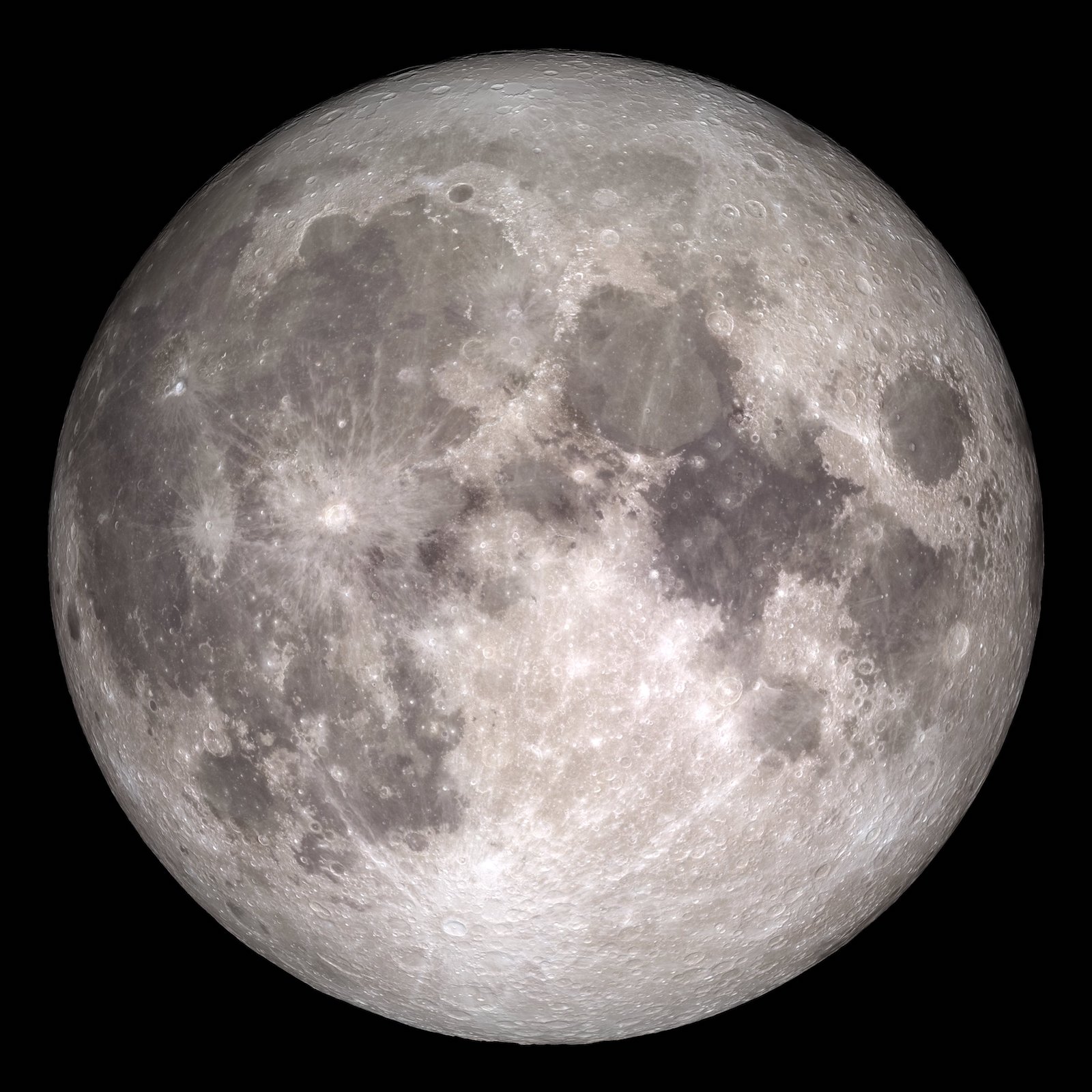
 Since time immemorial, we humans have looked up and wondered at the moon, earth’s only natural satellite. We continue to be captivated by the beauty of the moon and the 28-day cycle of waxing and waning. Not just that, the moon has played a crucial role in shaping our planet’s evolution and the development of life itself.
Modern scientific theories explain the origin of the moon and its impact on life on earth. Indeed the moon began with an impact, an interplanetary impact. The leading theory is the Giant Impact Hypothesis. According to that, about 4.5 billion years ago, a Mars-sized protoplanet called Theia collided with the earth. This massive impact ejected a vast amount of debris into space, consisting of material from both earth and the impactor. This debris coalesced due to mutual gravitational attraction over time, forming our moon. This explains several key observations, including the similarity between moon rocks and earth’s mantle composition, and why the moon is relatively large compared to earth.
The moon’s gravitational pull has profoundly influenced Earth’s development, most notably, through ocean tides. These daily tidal cycles shaped coastal ecosystems and may have played a crucial role in the emergence of life itself. The tidal zones created environments where early organic compounds could concentrate and interact, potentially catalyzing the chemical reactions necessary for life’s beginnings.
The moon also stabilizes Earth’s rotational axis, maintaining our planet’s tilt at roughly 23.5 degrees. This stability gives us reliable seasons and a relatively stable climate over geological timescales. Without the Moon, Earth’s axial tilt would wobble chaotically, causing extreme and unpredictable climate variations that could have made the evolution of complex life more challenging.
We probably would not be here if the earth didn’t have a moon.
Many organisms have evolved in response to lunar cycles. The most obvious examples are marine creatures whose breeding cycles synchronize with lunar phases. Many coastal species time their reproduction to coincide with spring tides, when the moon’s gravitational pull is strongest.
Even terrestrial organisms show lunar influences. Some nocturnal animals adjust their behavior based on moonlight levels, and there’s emerging evidence that some plants may respond to lunar cycles.
The moon is gradually retreating from the earth. Fun fact: you can fit all the other seven planets in the distance between the earth and the moon. Currently it is roughly 250,000 miles away but when it was formed, the moon was around a 10th of that distance from earth. It created enormous tides and dramatically influenced the earth’s environment.
The moon has been gradually moving away from earth at a rate of about 3.8 centimeters per year. This retreat is caused by tidal interactions. As the earth rotates faster than the moon orbits, the tidal bulge created by lunar gravity runs slightly ahead of the moon, creating a gravitational torque that gradually transfers earth’s rotational energy to the moon’s orbital motion. This process is slowing earth’s rotation, lengthening our days by about 2.3 milliseconds per century. Early in its life, a day on earth was only 12 hours long.
As seen from the earth, the moon appears to be the same size as the sun. That is so because though the sun’s radius is 400 times larger than the moon’s radius, the sun is 400 times further away than the moon. This fortunate fact makes total solar eclipses possible. But in a few million years, there will be no total solar eclipses — only partial and annular eclipses.
People noticed that the same side of the moon faced the earth; the far side never came into view from the earth. This is so because the moon is tidally locked with the earth: the moon’s rotational period on its axis is the same as its revolution around the earth.
The first time that humans got to see what the moon’s far side (the so-called “Dark side of the moon”) was in 1959. The Soviet Luna 3 spacecraft captured the first images in October 1959. No human had ever seen what the moon’s hidden side looked like throughout all of history until that moment.
Luna 3 took photographs on October 7th when it was about 65,000 kilometers away from the Moon’s surface. The photos were grainy by today’s standards, they revealed several major features of the lunar far side, including the fact that it looks quite different from the near side – it has fewer of the dark basaltic plains (maria) that create the pattern we see from earth. Scientists are still trying to figure out the answer to the question why the two sides are so different.
The Soviet team developed a complex automated film development and scanning system. The spacecraft took the pictures on conventional photographic film, automatically developed them, and then used a primitive fax-like system to scan and transmit the images back to Earth.
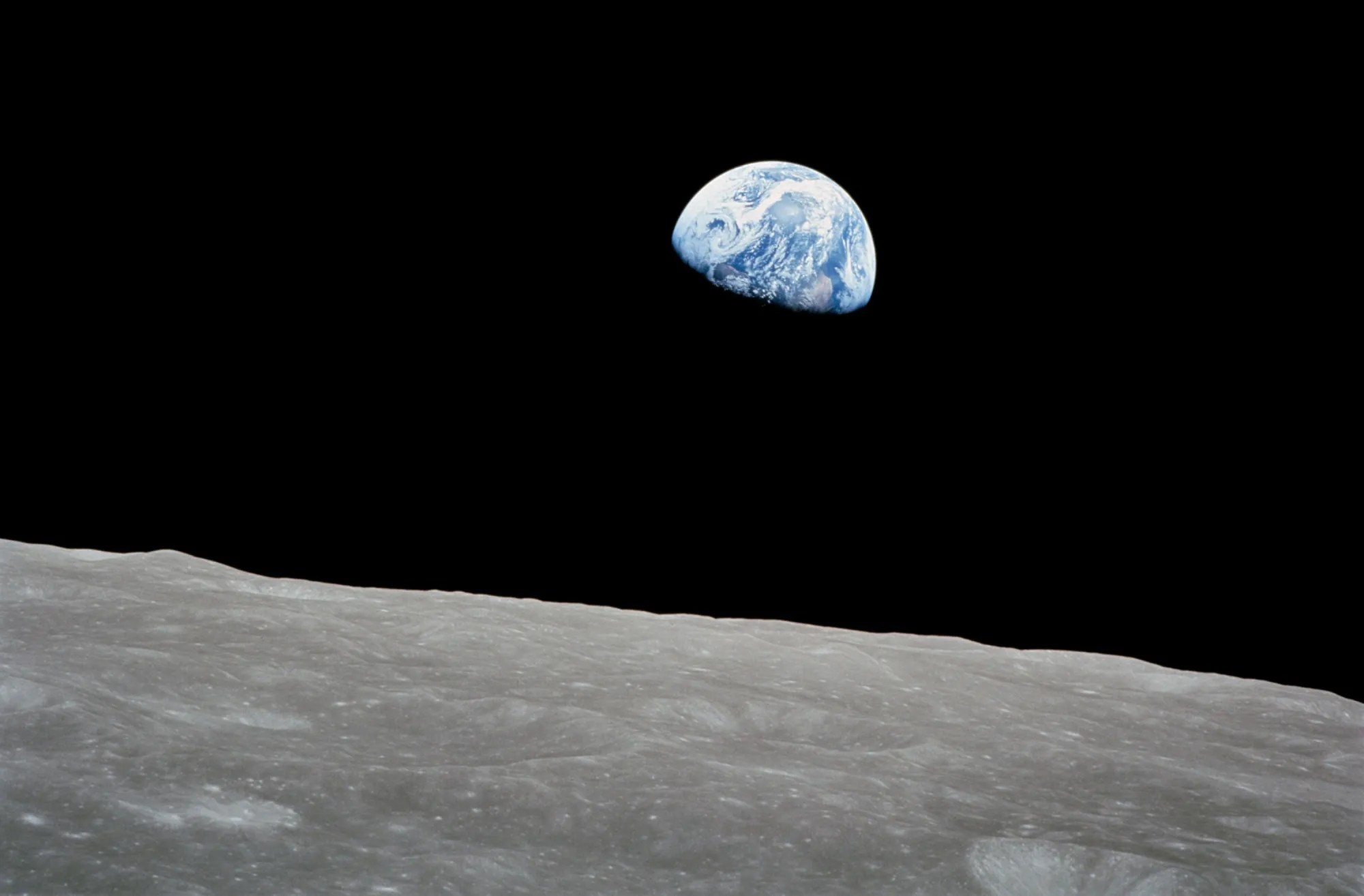
The first humans to see the moon from an orbit around it were three NASA astronauts: Frank Borman, Jim Lovell, and Bill Ander on Apollo 8 mission which launched on December 21, 1968. They were the first humans to see an Earthrise above its surface. On Dec 24th, they saw the far side of the moon.
 Since then, only 12 humans — all Americans — have ever walked on the moon. The first man on the moon was Neil Armstrong on July 21, 1969. (See One Giant Leap for Mankind.) The last man, Harrison Schmitt, did his moon walks between 11th and 14th December, 1972.
For the past nearly 52 years, no human has set foot on the moon. I am guessing that in the next 52 years, thousands of humans will have done so. I think people will routinely go for scientific work at first, and then for the thrills. I bet that going to the moon would be as unremarkable as crossing the Atlantic is today.
This meditation on the moon was inspired by an article I read recently. From a Million Miles Away, NASA Camera Shows the Moon Crossing Face of Earth.
 Quote:
A NASA camera aboard the Deep Space Climate Observatory (DSCOVR) satellite captured a unique view of the moon as it moved in front of the sunlit side of Earth last month. The series of test images shows the fully illuminated “dark side” of the moon that is never visible from Earth.
The images were captured by NASA’s Earth Polychromatic Imaging Camera (EPIC), a four megapixel CCD camera and telescope on the DSCOVR satellite orbiting 1 million miles from Earth.
Alright, time to listen to a few songs featuring the moon. First a Hindi song: Roj Akeli Aaye. Singer: Asha Bhosle. It’s a sad song: the moon as a lonely lady looking for a child.
Next up: Sting. Moon over Bourbon Street.
And a Spanish song:Hijo de la Luna (Son of the Moon.)
It’s a very sad song. It’s also very beautiful. The moon grants a lonely gypsy woman her wish to find her a gypsy husband. In return, the moon asks that she give it their first born. When the child is born, it is white like the moon– not brown like the parents. The husband thinks his wife has been unfaithful. He kills her and abandons the child on the mountain. The moon takes care of the child. When the child is happy, there is a full moon. And if the child cries the moon wanes to make a crib for it.
That’s it for now. Be well, do good work and keep in touch.

 Atanu Dey : Life is a Random Draw
We were having a Ganesh-Chaturthi-celebration in our apartment complex. As a part of that, there was a science exhibition by residents explaining concepts, and showing off models. That was around my 40th Birthday. I realized at ~40 that I did not know why we see the moon phases. I thought I knew, but I realized (on that day) that what I thought I knew was actually the reason for the solar eclipse, not the moon’s phases.
I truly understood finally, why a lunar eclipse can only happen on a Purnima.
I truly understood finally, why a solar eclipse can only happen on an Amavasya.
And many more.
Thanks to that little girl in 2nd grade and her model exhibit.
(PS: I realized nobody in my social circle knew why moon phases happen. Most of them did not care. A few who did care committed the same mistake as mine. The reason those select few knew, explained eclipse. Not moon phases)
LikeLike