
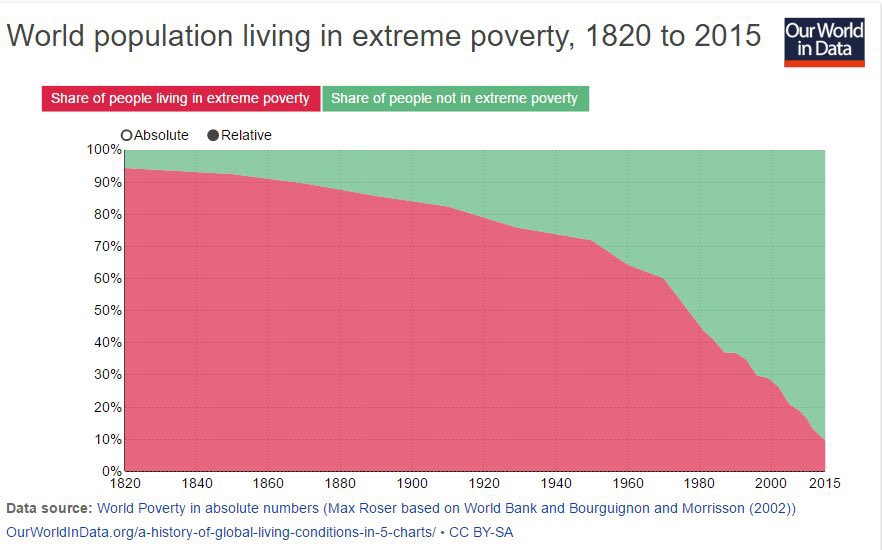
 The graphic above is amazing. Not too long ago, a mere eight generations or 200 years, over 90 percent of all people lived in extreme poverty. That of course means that nearly all humans that have ever lived before that lived in unimaginable poverty. None of the ancestors of the billions living today enjoyed any wealth. Even the wealthiest of the past were poor compared to the average person today.
Why and how this transformation happened is a fascinating question that occupies most of my attention. This is how I understand the matter.
Now I will continue from part 1 of this series.
I am an anarcho-capitalist in the tradition of the American economist Murray Rothbard, an important exponent of the Austrian School of economics, who coined that term in the 1950s.
Anarcho-capitalism is rooted in classical liberalism, individualist anarchism, and the Austrian school of economics. We believe in a minimal state. A minimal state is one which only protects citizens from external harm (a military), provides internal security (police), protects private property, and enforces contracts and resolves disputes (courts.)
Here’s a bit on anarcho-capitalism from the wiki:
Anarcho-capitalism is an anti-statist, libertarian political philosophy and economic theory that seeks to abolish centralized states in favor of stateless societies with systems of private property enforced by private agencies, based on concepts such as the non-aggression principle, free markets and self-ownership. In the absence of statute, anarcho-capitalists hold that society tends to contractually self-regulate and civilize through participation in the free market, which they describe as a voluntary society involving the voluntary exchange of goods and services.
We further believe private companies can provide better policing and legal services than the state, and that competitive markets will ensure high-quality and cost-effective services. (See David D. Friedman‘s writings for more on this.) We hold on to libertarian principles such as self-ownership and nonaggression.
I use the term “the state” and “the government” interchangeably.
The state is necessary but for limited purposes only. Historically, the state (or something like it) has been involved in all sorts of things. That was due to a primitive understanding of how a good society could be created without the threat of violence. Now that we have an advanced understanding of how to get things done — which is a good definition of “technology” — we can organize society without the threat and use of violence.
The state is characterized by violence. Look with even a little bit of care at what the state does, and you will see the barrel of a gun pointed at someone. It claims the legal monopoly on the use of violence. That fact, more than anything else, should make us wary of the state in whatever it does and should resist with all our might any enlargement of the state.
Ah but the roads! And education! And taking care of people’s health! And helping the poor and the “under-privileged”!
Who will do those things if the state doesn’t? You libertarian anarcho-capitalists are too stupid to realize that civilization will collapse without the state providing for its maintenance.
Au contraire, mon cher ami.
The state does not — can not — create wealth. Wealth is created by people. The state consumes wealth that people create, and usually the state destroys wealth or at best uses wealth inefficiently.
Let’s unpack that carefully. People have to create wealth because wealth does not exist in nature. Nature provides stuff, the raw material out of which people create wealth through effortful action. Wealth does not fall unbidden from the skies like rain. People have to expend effort to transform stuff into wealth.
The motivation that people have for expending effort is that they foresee that they will get to enjoy wealth. But if that is blocked, if people anticipate that the wealth they create will be confiscated by the state or by bandits (the state is properly seen as a stationary bandit — see this blog post), then they will not expend effort and less wealth will be produced.
The opposite of the creation of wealth is the creation or the continuation of poverty. It’s karma. Unavoidable. It’s a law of the universe we inhabit.
Roads, did you say? Sure, roads are often built by the state. Meaning, the state extracts wealth from the people (generally labeled taxes) and uses part of that to build roads and other public infrastructure. Therefore state.
Not so fast. People build roads and people pay for those roads to be built. So what’s the function of the state in this?
Economists have a term for this: collective action.
We, as individuals, don’t have the ability to finance and build roads individually. Let’s say I use $100 worth of road services a year but I need to use 1000 km of roads a year, the cost of building of which would be $100,000,000 (hundred million$). Unfortunately my name is not Elon Musk, who can dig up some spare pocket change and put down $100M.
So we collectively solve that problem. We get our closest 100,000 friends and neighbors to chip in $100 each. That gets us $10M. Still short of the $100M. But wait! This road will last 10 years. So we each pay $100 a year for 10 years.
So we are good: we borrow and repay the debt over the life of the road. (The details of financing and debt servicing is left as an exercise for the serious reader. Others just sweep the details under the rug.)
Thus there is a possible role for the state: it can solve certain collective action problems. More about how effectively and efficiently the state solves the collective action problem in a bit.
For now the claim is that it does a terrible job solving problems, and does a great job of creating problems. Furthermore, due to advances in technology, some things that required the state in the past are better done by the private sector.
We individuals create wealth, individually and collectively. A farmer tending his small farm does it individually; a worker in a factory employing thousands of people does it collectively. Both the farmer and the factory worker are motivated to work hard to provide for themselves and their families.
The factory collective action problem is solved by entrepreneurs. The entrepreneur gets resources together, produces something after a while, brings his product to the market, and possibly makes a profit if people buy his stuff. If he doesn’t make a profit, he exits stage left and is heard no more, a poor player that didn’t make it. (Literate readers will see what I did there.)
Here’s an important point. Wealth is something that is valued. Valued by whom? By people. If people don’t value something, it is not wealth. Effort is necessary for creating wealth but just expending effort does not create wealth. Only if effort results in something that someone values will it be said to be wealth.
This is where neoclassical economics differs from classical economics. The classical economists’ model was “the labor theory of value.” Neoclassical economists realized that that was wrong, and developed the “subjective theory of value” which accurately describes the nature and causes of value and wealth.
It is useful to briefly examine what profit is. To many people, profit is a dirty word. The belief is that for-profit corporations are evil personified. But the truth is exactly the opposite: all good things flow from profit-seeking people and firms. In India, profit is celebrated in the dharmic invocation “Subh Labh.”
If I buy ingredients X, Y and Z at a cost of C, do the work of combining them to produce good G, and get revenue R by selling G in the market, then the difference between R and C is my profit P. My revenue R is a measure of how much the customer values my product. If R exceeds cost C, then that is the profit — which is a very good estimate of how much additional value I have created. If the cost was greater than the revenue, then the loss (C – R) is a good estimate of the value I destroyed.
Private sector firms generally make a profit over the medium and long terms. If they don’t, they go out of business. Public sector firms incur losses. They don’t go out of business; the state continues to extract taxes at the point of a gun and shovels wealth into public sector enterprises to be destroyed.
To see the truth of that, the empirical evidence is undeniable. No public sector enterprise has ever made a profit. They don’t create wealth; they destroy wealth. That’s a broad generalization and therefore subject to refutation if one can point to contrary evidence. Suppose someone says, “Of 500 public sector enterprises, we find x% > 10 have NOT incurred losses over the medium and short terms,” then my claim is refuted.
In the next bit, I will explain why the state fails to produce wealth and why it succeeds in producing misery when it strays outside its limited mandate as demanded by libertarians like me. That will be the analytical argument to explain the empirical observation why the state fails.
And now, a nice song to end this one. I’ve been listening to this song for over a dozen years. Enjoy!

 Atanu Dey : Life is a Random Draw
I want to understand money printing mechanism by first principles.
Let us assume there are 3 people on an isolated-island making One fish basket, One coconut cutter, One fire-stove each per year.
They put a price of 10, 40 and 50 IIC (Isolated Island Currency) respectively on basket, cutter and stove.
They have a god who can only produce currency notes when all 3 ask together. So they ask their god to give them 100 IIC currency notes (I am ignoring the denominations).
Next year, they again make a bakset, cutter and a stove. Shall they ask for more currency-notes? Or now one currency note doubles in real value?
LikeLike
Assume that the previous year’s basket/cutter/stove are still in perfectly usable situation. That ‘wealth’ is still there on top of which the new set of basket/cutter/stove got added.
LikeLike