
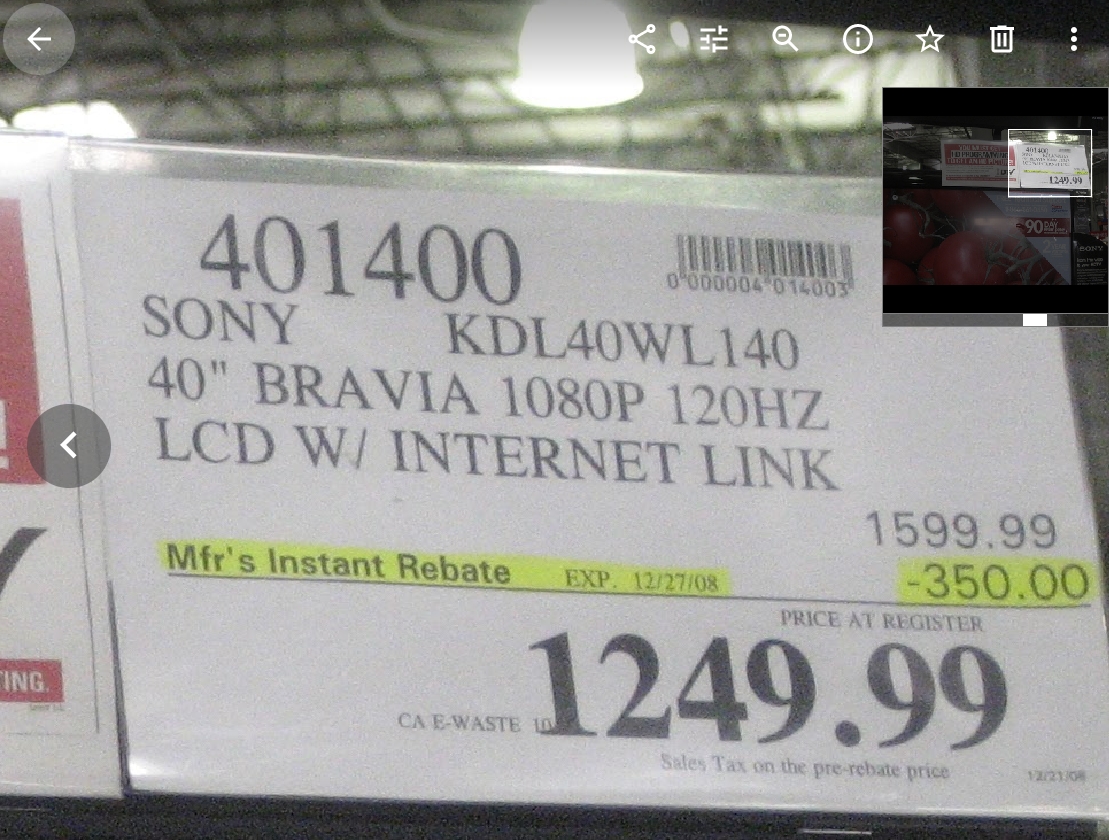
I recently came across a picture I’d taken years ago: price tag of a Sony 40″ 1080p LCD TV with “internet link” at Costco. The price of $1250 (after a $350 rebate) was valid till Dec 2008.
Fifteen years ago, people actually paid a princely sum for that tiny (by contemporary standards) TV. Back then, we would scan Fry’s Electronics superstore Sunday ads in the San Jose Mercury News for deals. Those were the days before Amazon. Fry’s is dead and gone now. But back in the day, Fry’s was the big deal in town. Best Buys ate their lunch. The king of kings from one time end up as ruins in the sands of time. But I digress.
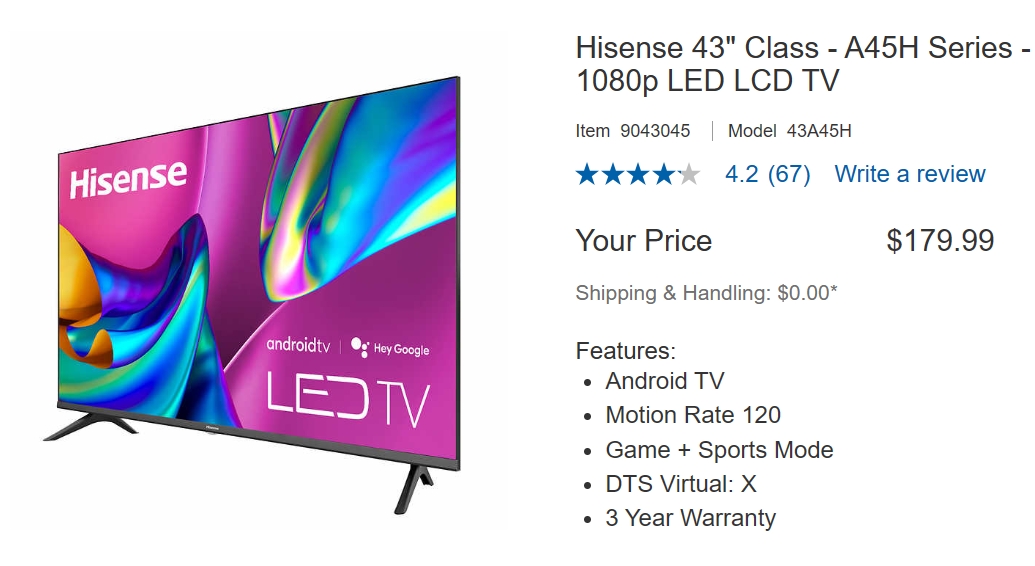
How much do we pay for TVs today? I checked the Costco.com website. Here are two screen captures. First, a Hisense 43″ LED TV. Price: $180.
And then this LG 75″ 4K TV. Price $650.
 We have to keep in mind that all prices are relative. Prices of things need to be compared to prices of other things, and to changes of prices over time for the same or similar things, to get a sense of how relatively expensive or cheap things are.
TV prices have fallen precipitously over the years. I bought my first TV nearly 40 years ago. It was a Toshiba 22″ CRT TV. Most people don’t even know what “CRT” means, never having seen a “cathode ray tube” ever.
That CRT TV’s resolution was a measly 480p, not even 720p. I paid over $400 for it — or around 10% of my entry-level monthly salary. Now you can get a TV four times as large (a 40″ screen) and three times the resolution for a day’s entry-level salary. That’s cheap.
Let me belabor the point that electronics have become extremely cheap. You can buy four times as much TV (75″ as compared to 40″), and a phenomenally higher quality TV (4K resolution as opposed to 1080p) for much fewer nominal dollars ($650 for that LG) than you could 15 years ago. TVs are, by some estimates, around 90% cheaper today relative to 20 years ago.
Prices are relative and they change. That’s one of the salient features of the modern world. It wasn’t like that before. People used to pay pretty much the same for things as their parents and grandparents did. We should appreciate that feature of our modern world.
Here’s a helpful graphic of relative price changes in the US since 2000 of a broad set of consumer goods and services.

In short, TV have become dirt cheap. Prices of cell phone services have halved; new cars have become relatively more expensive; housing prices have more than doubled; health care and education have shot through the roof. Prices change. And they change dramatically at time.
Here we have to take note of changes in quality. New cars are about 25% more expensive now to be sure but the new cars of 2020 are quite a different beast from the cars of 2000. The new cars have more electronics in them than the Apollo 11 spacecraft that landed men on the moon did. You may not believe it but around 20 years ago, you had to crank up car windows and there were — horror of horrors — no remote controlled car keys: you had stick in a key to lock and unlock cars.
You may ask: what accounts for those changes and why should you care? I was coming to that.
Prices are closely related to costs. If the cost of production of some good or service falls, then the price also falls in competitive markets. TV prices have fallen because costs have fallen and the market for TV (and other electronics) is extremely competitive.
Cost of production of electronic items fall because of advances in technology. There’s the famous “Moore’s law” — per unit of computing power drops because you can pack more transistors into the same space as before more cheaply. But that’s just part of the story. Costs fall because of two other factors that is not limited to electronics.
One is called “scale economies.” The larger the total amount of production, the lower is the average cost of production. If it costs $2 billion to design a chip or discover a new drug and get it FDA approved, and you produce only one chip or one pill, then the cost per unit is $2 billion; if you produce 2 billion chips or pills, then the average cost falls close to $1.
The other factor that reduces costs is the effect we call “learning by doing.” This introduces time into the production of stuff. You don’t produce all the output all at once; you produce them sequentially, over time.  Take the Boeing 747 (my favorite airliner). A total of 1,573 of those were produced between 1968 and 2023. The 100th 747 was easier and cheaper to produce then the 10th because they learned how to build them as they produced more of them. By the time Boeing produced the 1000th 747, they were very good at it.

Talking of planes, here’s a fun fact. The Cessna 172 Skyhawk holds the record for the largest number produced. Over 44,000 of those have been produced, starting in 1955. They still produce them. I have flown in a 172 a few times.
Back to our main story. So prices change and because of technological advances, they usually fall. But since technological advances in various domains proceed at different speeds, the relative prices change. Manufacturing sees a lot of technological advances, but services do not. Therefore the relative prices of manufactured goods fall and services rise.
As the economy gets more advanced due to technology, the secular trend is a fall in prices, with one important exception. As noted before, what matters is not the nominal prices but the relative prices. The operative word is relative. If the relative prices of goods fall, it means that relative prices of labor must rise.
Let’s explore that. Advanced industrialized countries like the US are rich. People can afford all sorts of stuff. Meaning they earn a lot. Which means that their labor is expensive relative to goods. Labor is expensive and stuff is cheap in the US. The average hourly wage is around $25. That would be the cost of running a washing machine for an entire year for a family of four. In effect, one hour’s labor is all that is needed to do 200 loads of laundry. In a poor country, it would require 600 hours of labor.
I have noticed that in India, most households don’t use dishwashers; they have a maid do the dishes. Doing dishes by hand is quite costly in terms of time and water. But labor is cheap in India because labor productivity is low. Only with higher labor productivity can the situation improve. How to increase labor productivity? Remove the government from education and make markets free.
I love to spend time in store, not to buy stuff but to check out the prices. Prices are one of my deepest obsessions. That is why I love price theory. Prices make the world go around. They convey information. They are like magic. They are hardly ever under anyone’s control in a free market. In free markets, prices emerge from the free interactions of people engaged in the ordinary business of making a living.


Reminded me of this-
“Value does not exist outside the consciousness of men” – Menger
LikeLike
True cost of a TV: https://www.youtube.com/shorts/hh0EIf4h6RA
LikeLike
Sorry but the guy makes little sense. The cost of anything, in the way that economists mean by the word “cost”, is the opportunity cost. Therefore it is wrong to say that the TV bought for $450 (nominal cost) actually costs $12,000. It most certainly doesn’t cost that.
LikeLike