Driving

Driving

Recently I had a very brief week-long career as a driver. I signed up as a Lyft driver in Austin, TX. It took me a couple of hours on the web to do so, and I became a driver for hire.

There were several reasons why I did that. Foremost reason was that I was curious to know how it feels to do a low-status service job. All jobs I had done before have also been service jobs but they were cognitively demanding, high status jobs such as teaching college courses in reputed universities or product marketing at a multinational corporation in the Silicon Valley. In contrast to that kind of service work, a taxi driver’s job though it requires skill is not intellectually challenging or high status. Continue reading “Driving”

Book Titles

Back in the day when I read fiction, I liked to know (and I still do) the sources of the titles. For example, Ernest Hemingway took the title for his novel “For Whom the Bell Tolls” from John Dunne’s 1623 “Meditations XVII.” That meditation is my favorite. Here’s that part:

“No man is an island, entire of itself; every man is a piece of the continent, a part of the main. … any man’s death diminishes me, because I am involved in mankind, and therefore never send to know for whom the bell tolls; it tolls for thee.”

We are all part of the same living tree of life. I recommend reading the whole bit.

Hemingway took the title “A Farewell to Arms” for his 1929 novel from a poem by George Peele. Economist Gregory Clark tipped his hat to Peele and used the homophony in ‘arms’ and ‘alms’ to title his 2007 book, “A Farewell to Alms”, with the subtitle “A Brief Economic History of the World.” I included that book in the reading list for a course on economic development I had taught some years ago. Continue reading “Book Titles”

Diversity

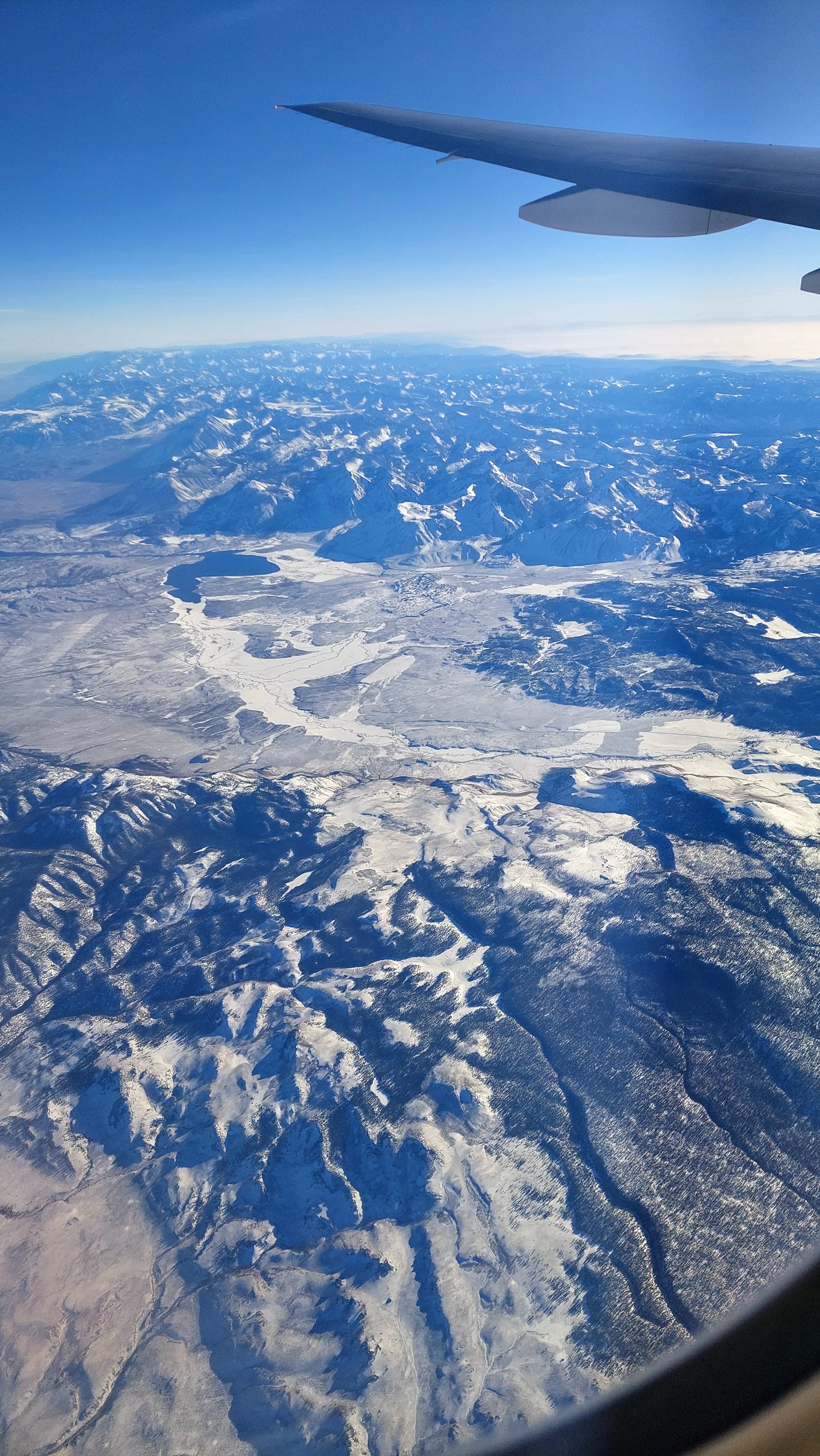
Over the Sierra Nevada in California. Click to embiggen.

Humans, I tell you dear fellow human, are unique. Here’s a quick reminder on our zoological classification.

At the most specific classification — the species level at the bottom of the zoological taxonomic tree — we are homo sapiens, the modern humans. One level up from our species is the genus. We are in the genus homo. We are the only species in that genus.

Go up one level, we belong to the family hominidea. Our family includes chimpanzees, gorillas, and orangutans — the other great apes. We can detect the family resemblance. Apes have large brains and are bipedal.

Apes like us belong to the order primates. Besides us humans, the primate order includes apes, monkeys, and lemurs — animals that have a large brain, and they use their hands to manipulate objects. There are over 500 species of primates in the world. Continue reading “Diversity”

Experts

Thanks to Akshay for his comment. From it, I learned something important (see the end of this post.) I love pushback because then I get off my lazy ass and actually write a post.

Both Carl Sagan and Freeman Dyson are excellent exemplars of people who are both well-informed and well-meaning. I would add that they were not just highly intelligent but were also exceedingly wise. However they differed in their assessment of how critical the climate change issue was. This is not surprising because the matter is one on which reasonable people could disagree. It is important to note their divergent opinions and explain it. Continue reading “Experts”

California

Solace St, San Jose, CA. (Click to embiggen)

Having lived most of my adult life in the San Francisco Bay area, I naturally think of it as home. I’ve been a citizen of California for decades.

I have made life-long friends here, worked here, gone to graduate school here, taught at various universities here, owned a home here, vacationed in the many national parks here. In short, I am a Californian. Therefore seeing what’s happening to it is distressing, to say the least.

Why the decline and fall of California? Questions about complex phenomena that begin with “why” are “over-determined” (as economists are fond of saying.) There are multiple causal factors, none of which are individually sufficient but various different combinations of them could be responsible. These factors could be economic, technological, social, cultural or historical. Analysis of complex phenomena is never entirely settled. In other words, it’s not rocket science; it’s social science. Continue reading “California”

Learn Before We Act

On Fridays once in a while I engage with a few teenagers and a couple of my adult friends. We discuss matters of mutual interest. Lately it’s been about climate change and global warming.

I am persuaded that the young are being systematically misled by a committed group of interested parties that have an agenda to profit from misdirection and misinformation.

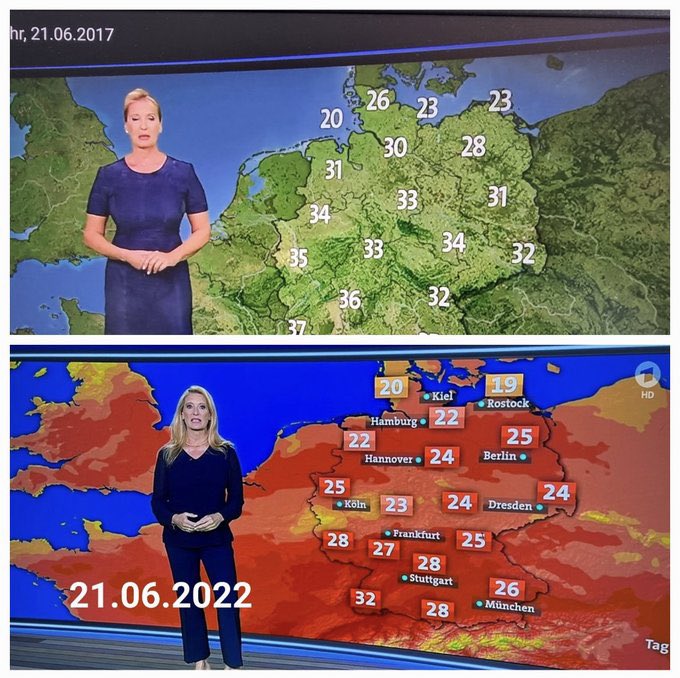
The image of a TV meteorological report at the top of this post exemplifies my point about misdirection.The top part is colored green and the bottom part red. They are five years apart. The impression conveyed is that the world is melting due to high temperatures but if you care to notice, you’d see that the temperatures reported are pretty much the same.

This has to be resisted. In the following, I present a bit of what I recently wrote to the group of teenagers I engage with on Fridays. Here it is, for the record. Continue reading “Learn Before We Act”

Across the Universe

NGC 1300 (Click to embiggen)

Images of broken light which dance before me like a million eyes
They call me on and on across the universe …

Words magically conjure images in our minds, especially if they are not reportage but instead are attempted expressions of the ineffable. That is why I like certain songs not just for their musical quality but those with lyrics that evoke mystery and longing.

The words quoted above are from the song “Across the Universe” by the Beatles. They evoke images in my mind that are like the image (at the top of this post) of the barred spiral galaxy discovered by John Herschel in 1835, NGC 1300. It is about 110,000 light-years across and 61 million light-years away. We are unlikely to visit it anytime ever. Continue reading “Across the Universe”

Coronation

Today was the coronation of King Charles III of the UK. Pretty big day for some people — around 130 million of them who have him as the head of 15 countries, including Canada, Australia, New Zealand, Papua New Guinea, Jamaica, etc.

But we’d have to admit not all of them are his loyal subjects. Celtic fans at the Scottish Cup Semi-finals at Hampden Park last week sent a clear message to his royal highness (note the lack of capitalization). They were not pledging their loyalty. Instead they told him what to do with his coronation. Continue reading “Coronation”

Convergence

I concluded the post on well-being with: “The trend of increasing wealth, income and consumption is undeniable. The question is what is the trend in inequality? And what of well-being? While the level of well-being is undoubtedly rising around the world, is it also becoming more unequal?”

The world is unequal in terms of wealth and income for certain. Empirical evidence shows that inequality in wealth and income is increasing monotonically. Since wealth and income are positively correlated with consumption, and are also causally linked, one can conclude that inequality of consumption must be growing as well. It is.

That much is clear. Now let’s talk about well-being. What is it? It’s a feeling of being well. It’s about having our needs — physiological, psychological, emotional — satisfied. These needs are met through consumption. We consume water to meet the physiological need to satisfy thirst, for instance. We need stuff to meet our needs; stuff that may be in short supply relative to demand. Continue reading “Convergence”

Magic

I love anything that evokes a sense of childlike wonder in me. Magic does that to me.

I have loved magic shows ever since I was little. My father would take us to P. C. Sorcar’s magic “INDRAJAL” shows, which generally showed up in Nagpur every couple of years.[1]

Unfortunately, I did not get to watch any live magic shows since my childhood. Fortunately, these days I can watch the best of them on the internet. Granted that it’s not the same as a live performance but in some senses it is better — you get a much more intimate view of the show. Continue reading “Magic”