
I have been promoting that idea — that the solution to rural development lies in urban planning — for a few years. The RISC model (Rural Infrastructure & Services Commons) is about planting the seeds of in situ urbanization in rural India. Glad to see that the idea that urbanization is essential for development and growth is gaining momentum. One of these centuries, the government of India may even wake up. Although by then, I will be with yesterday’s seven thousand year.
Continue reading “BBC Program on Cities and Rural Development.”
Electoral Reforms
Although I had planned to, I will not be attending the “5th National Conference on Electoral and Political Reforms” of the Association for Democratic Reforms (ADR). It’s happening in Mumbai, and I alas, am in Pune. My colleague Rajesh Jain is going there to be on a panel on “The role of business and Government.” Rajesh mentions on his blog the context of the event.
Since 2002, the major impacts of these campaigns have been on criminalization of politics, and transparency in candidate and political party assets. Leaders of both the BJP and the Indian National Congress have made public statements that they would not field candidates with criminal records even if they were likely to win in the coming Lok Sabha elections . . .
Interesting, isn’t it? I added the emphasis above because it is worth noting. That phrase is a recognition of the fact that criminals routinely contest and win elections. Let me understand that a bit more. That criminals contest elections is a choice that the criminals make. The laws of the land, for whatever they are worth, permit criminals to contest elections. That they win elections is the more remarkable fact. Contesting the elections is within the control of the criminals; winning elections is not. People — the much celebrated wise Indian voters — are the ones who vote criminals into power.
They at ADR could conference the whole day long till the cows come home, but I am afraid that the fault, dear Brutus, lies not with the criminals but with the people who vote for them.
If in your generally free and fair elections, you elect criminals as your political leaders, you might be a third world country. (Or in the case of the US, you might be aspiring to become a third world country.)
Defending Free Speech
Item: Chyetanya Kunte wrote a blog post “Shoddy Journalism” on Nov 27th, 2008. I cannot give you a link because he has since removed it from his blog (although you may be able to read it on google cache). He posted an apology to NDTV and Barkha Dutt on Jan 26th:
I hereby repudiate and withdraw my post dated November 27, 2008 titled “Shoddy Journalism” and, more specifically, the following allegations / statements made in the post titled “Shoddy Journalism” namely:
* a lack of ethics, responsibility and professionalism by Ms. Dutt and NDTV Limited;
* that Ms. Dutt and NDTV’s reporting at the scene of the Mumbai attacks during November 2008, resulted in jeopardizing the safety and lives of civilians and / or security personnel caught up in and / or involved in defending against the attacks in Mumbai in November 2008;
* that Ms. Dutt was responsible for the death of Indian Servicemen during the Kargil Conflict.
Endorsing the BJP
Governance matters because how a society functions is clearly determined by how it chooses to govern itself. I have my doubts about democracy as a good form for organizing society — smacks of majority rule — but it’s better than many of the available alternatives. Democracy is, in my opinion, a first-best solution applied haphazardly in a second-best world. But given the world we have rather than the world we would like to have, democracy is the best we can do for now. So when it comes to choosing between the least unpalatable of a wide number of unappetizing options in a second-best world, I have chosen to support the BJP in the upcoming Indian elections.
Continue reading “Endorsing the BJP”
Death to Juice
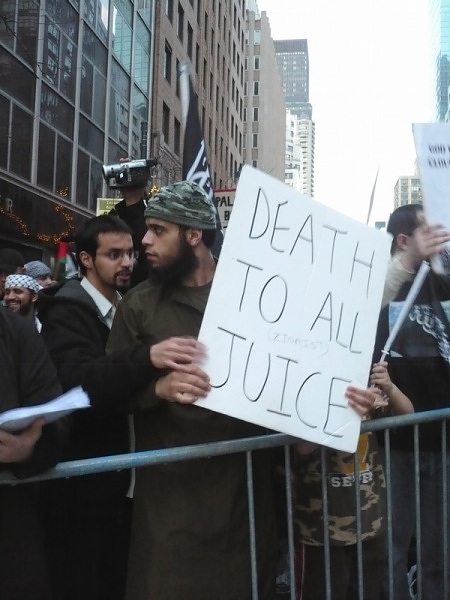
“Death to the (Zionist) Juice” urges the demonstrator in London. Why? Because it’s written in the holy book.
Continue reading “Death to Juice”
SDM
From a review of the movie Slumdog Millionaire by Dennis Lim in Slate:
A slippery and self-conscious concoction, Slumdog has it both ways. It makes a show of being anchored in a real-world social context, then asks to be read as a fantasy. It ladles on brutality only to dispel it with frivolity. The film’s evasiveness is especially dismaying when compared with the purpose and clarity of urban-poverty fables like Luis Bunuel’s Los Olvidados, set among Mexico City street kids, or Charles Burnett’s Killer of Sheep, set in inner-city Los Angeles. It’s hard to fault Slumdog for what it is not and never tries to be. But what it is—a simulation of “the real India,” which it hasn’t bothered to populate with real people—is dissonant to the point of incoherence.
What’s up, OLPC?
At the intersection of high-tech gadgets and public spending on education in poor countries lies XO, the machine from the One Laptop Per Child (OLPC) project led by Nicholas Negroponte. I have been a critic of the program right from the start. I have argued before that the idea of providing one laptop per child is well and good if money were no object. Unfortunately, in resource-strapped economies such as India, the opportunity cost of providing school children with laptops is prohibitive.
Continue reading “What’s up, OLPC?”
Hubble’s Universe is Beautiful
“HUBBLESITE . . . Out of the ordinary, out of this world” has pictures. I could spend days checking them out and indeed I have. I am sharing a small collection from there: “Astronomers Select Top Ten Most Amazing Pictures Taken by Hubble Space Telescope in Last 16 Years.”
Here are the pictures. The text associated with them is from Nov 2006 article by Michael Hanlon of the Daily Mail.

The Sombrero Galaxy – 28 million light years from Earth – was voted best picture taken by the Hubble telescope. The dimensions of the galaxy, officially called M104, are as spectacular as its appearance. It has 800 billion suns and is 50,000 light years across.
Continue reading “Hubble’s Universe is Beautiful”
Not the News
I get to watch TV news only occasionally, mostly at airports, hotels and while visiting friends. Today at my friend’s place in Delhi, I woke up to TV news. It was wall-to-wall coverage of Dr Manmohan Singh’s heart surgery and the gunning down of two Pakistani terrorists just outside Delhi.
On the 24-hour news channels, the presenters have to keep talking non-stop about whatever is the breaking news. Naturally, it is humanly not possible to say something meaningful about any event without some time to think about it. So the need to keep talking incessantly about an event which can only be described in a few words results in verbal diarrhea. There is so little content in the story being told that the TV screen has to be filled with all sorts of other items: there are two or three lines of scrolling texts relating to different issues, some totally meaningless video occupying part of the screen, another part of the screen given to some advertisement, etc.
Continue reading “Not the News”
Jan 23rd: Subhas Chandra Bose’s Birthday
Netaji Bose was born on this day in 1897. When and where he died is a mystery. The airbrushing of his image from the consciousness of Indians bears testimony to M K Gandhi’s success in crushing his opponents. Gandhi appointed Nehru as his successor and the rest is, as they say, history.
Gandhi cast a very long shadow on India. Mao is supposed to have replied, when asked about his opinion of the French revolution, “It is too early to tell.” The official line in India — and therefore the line parroted by the vast majority of ‘educated’ Indians — is that Gandhi was a prime factor in India gaining political independence. I think it is too early to tell whether Gandhi was good for India or not. But give it a few more decades and I am confident that Gandhi’s image will undergo a radical transformation. Satyam eva, as the old Sanskrit saying (which is India’s motto) goes, jayatey. Truth alone prevails. Eventually.
Update: Thanks to all those who pointed out that the title of the post was incorrect. I have changed the “Jan 13th” to “Jan 23rd.”
Thanks to rahushar for correcting my incorrect transcription of “satyam eva jayate.”
 Atanu Dey : Life is a Random Draw