
 This is a story of fire and ice. Well, not exactly ice but a close cousin — snow. I was hoping that we’d get a huge big snow storm in Chicago, IL but all we got yesterday, Friday, was a minor snow fall of a few inches only. Continue reading “Fire and Ice”
Category: Uncategorized
Happy Winter Solstice
 Today – December 21, 2024 – marks the winter solstice in the northern hemisphere. It was precisely at 1:21 a.m. Pacific time (9:21 a.m. UTC — Coordinated Universal Time.) It’s the day when the North Pole is tilted farthest from the Sun, resulting in the shortest day and longest night of the year. In the southern hemisphere, today marks the summer solstice, their longest day of the year.
From an astronomical perspective, during the winter solstice, the Sun reaches its southernmost point in the sky (from our northern hemisphere viewpoint) and appears to stand still momentarily before beginning its gradual northward journey again. The word “solstice” itself comes from the Latin “solstitium,” meaning “sun standing still.” Continue reading “Happy Winter Solstice”
The West is in Decline
 “Hard times create strong men. Strong men create good times. Good times create weak men. And, weak men create hard times.” ― G. Michael Hopf
The decline of the West is evident. In some sense, this is an inescapable result of its own successes in science and technology. The scientific method — and the resulting technologies that that produced — resulted in the incredible increase in material wealth. That immense material wealth, unmoored from an appropriate philosophy that would have provided meaning and purpose to life, has produced a generation that is actively engaged in destroying the foundations of wealth and prosperity it enjoys but has not produced.
But there is hope. The foundation that the West was built on was strong and served to create prosperity. However that philosophical foundation was only adequate for a civilization that was engaged in escaping poverty and managed to do so remarkably well. But that philosophical foundation is no longer suited to a prosperous world. Continue reading “The West is in Decline”
Institutions, not People

In my tribe, I’m particularly fond of two people: Milton Friedman (1912 – 2006) and James M. Buchanan (1919 – 2013). Both were associated with the University of Chicago. Both were awarded the Nobel Memorial Prize in economics: Friedman in 1976 and Buchanan in 1986.
About Friedman, the wiki states: Continue reading “Institutions, not People”
Technological Predictions
 Two of the greatest science fiction writers of the 20th century were Isaac Asimov (1920 – 1992) and Arthur C. Clarke (1917 – 2008). Their works have enduring value. Based on a short story by Clarke, Stanley Kubrick’s 1968 movie “2001: A Space Odyssey” is among the best in its genre. Watch it if you can. Don’t say, “I’m sorry Atanu, I’m afraid I can’t do that.”
Asimov and Clarke, besides being great science fiction writers, were particularly fascinating in their technological predictions. They combined rigorous scientific knowledge with imaginative extrapolation. Their vision of the future could be said to be prophetic even but there’s a distinction between prophesy and prediction.
The methodology behind predictions can usually be explained and scrutinized. Predictions rely on observable, measurable phenomena and logical inference, while prophecies typically rely on claimed supernatural, spiritual, or intuitive knowledge that can’t be empirically verified in the same way. Continue reading “Technological Predictions”
Our Moon
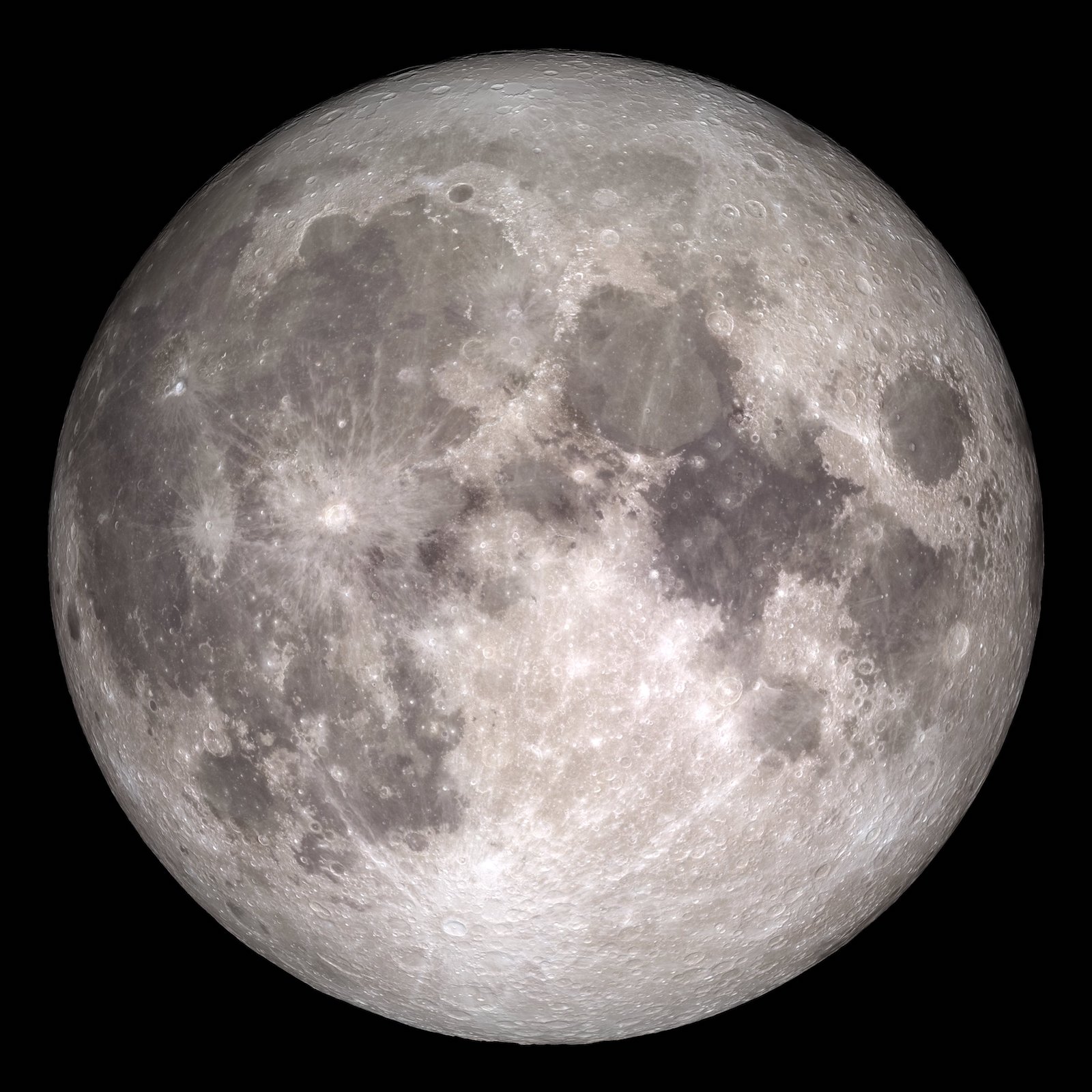 Since time immemorial, we humans have looked up and wondered at the moon, earth’s only natural satellite. We continue to be captivated by the beauty of the moon and the 28-day cycle of waxing and waning. Not just that, the moon has played a crucial role in shaping our planet’s evolution and the development of life itself.
Modern scientific theories explain the origin of the moon and its impact on life on earth. Indeed the moon began with an impact, an interplanetary impact. The leading theory is the Giant Impact Hypothesis. According to that, about 4.5 billion years ago, a Mars-sized protoplanet called Theia collided with the earth. This massive impact ejected a vast amount of debris into space, consisting of material from both earth and the impactor. This debris coalesced due to mutual gravitational attraction over time, forming our moon. This explains several key observations, including the similarity between moon rocks and earth’s mantle composition, and why the moon is relatively large compared to earth. Continue reading “Our Moon”
Krugman Retiring from NYTimes
 All things must pass. Paul Krugman is going to retire from being a NY Times columnist after 25 years. Some people claim that being a columnist helped him get the 2008 Nobel Memorial prize in the economic sciences.
I can’t say anything about his NYT columns. I am not a subscriber. I did catch glimpses of his political position, though. He was totally sold out to the Democratic party. Over the years, he’s infamously made a bunch of poor predictions. I was surprised at his mistakes considering that he was a first-rate economist.
I say “was” because he appeared to have forgotten the economics lessons that he learned and taught to a couple of generations of students — including yours truly. Continue reading “Krugman Retiring from NYTimes”
Why I’m a Hindu – Part 5
 I’m happy to learn about my dharma — the Sanatan dharma — from all manner of sources: teachers, books, talks, videos and friends.
The dharma is vast and inexhaustible. No point in attempting to understand it to any significant degree. One cannot drink all the waters of all the rivers and lakes of the world. Don’t even try. Take a drink as and when thirsty, and get on with other things.
I like Dr Nick Sutton’s talks on Hinduism. He is at the Oxford Centre for Hindu Studies. I’m not sure but I believe he is a practicing Hindu. Be that as it may, he sure enjoys his scholarship. Continue reading “Why I’m a Hindu – Part 5”
Big Government Rocks – Part 2
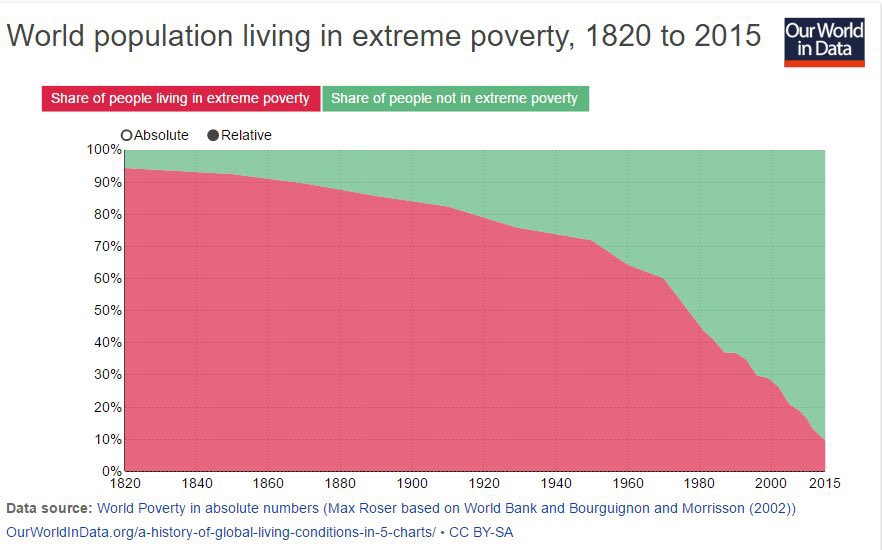 The graphic above is amazing. Not too long ago, a mere eight generations or 200 years, over 90 percent of all people lived in extreme poverty. That of course means that nearly all humans that have ever lived before that lived in unimaginable poverty. None of the ancestors of the billions living today enjoyed any wealth. Even the wealthiest of the past were poor compared to the average person today.
Why and how this transformation happened is a fascinating question that occupies most of my attention. This is how I understand the matter.
Now I will continue from part 1 of this series. Continue reading “Big Government Rocks – Part 2”
Big Government Rocks – Part 1
 The proposition that big government gets things done — and the corollary that the bigger the government the better it gets — is one of those propositions that sound better the less one thinks about it. But it falls apart under even the slightest load of analytical and empirical examination. Best not to think too deeply about it if one wants to maintain that misconception.
In a recent post (Javier Milei at the UN) I had heaped praise on Argentina’s Javier Milei for cutting his government. Argentina’s economy was in shambles because of insane socialist (but I repeat myself) policies. I won’t go into the details of the absolute disastrous path that Argentina was accelerating on; you can look it up at your leisure. Milei upon assuming office began to put on the brakes and with some luck, will put his nation on the road to recovery. Continue reading “Big Government Rocks – Part 1”
 Atanu Dey : Life is a Random Draw