
In what is to follow, I will focus on what is a core concern of this blog: education and related matters. One thing is certain in a world of uncertainty: the system will change. So I would like to ponder the direction and magnitude of the change. It is also certain that the change will be technology based and in a sense will be technology driven. I will take some lessons from books and the web. One book that I have spent some time with recently is “The Race between Education and Technology” by Goldin and Katz. I would also like to touch upon the the future of universities. My point of departure is that technology will have a disruptive influence on them.
Continue reading “On the future of education and technology”
Category: Education
Pragati April 2009: Ideas for the honeymoon
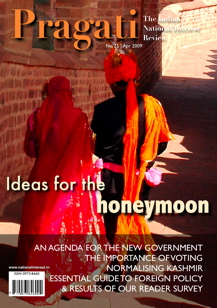
This month’s Pragati is about “What the new government should do in its first 100 days.” I have a piece in there about the structural changes required in education. What else is new, you’d ask. Below the fold are the editorial comments for the issue. Please read and distribute.
Continue reading “Pragati April 2009: Ideas for the honeymoon”
It’s education, stupid
Nicholas Kristof in an op-ed in the New York Times asks:
Quick, what’s the source of America’s greatness?
Is it a tradition of market-friendly capitalism? The diligence of its people? The cornucopia of natural resources? Great presidents?
No, a fair amount of evidence suggests that the crucial factor is our school system — which, for most of our history, was the best in the world but has foundered over the last few decades.
As I wrote in 2001, “The most devastating impact of our dismal educational system is that we are condemning ourselves to a future of exceedingly low economic development. If there is one thing that growth and developmental economists have learnt, it is this: education is the most important factor in economic growth. Education has more impact on economic growth than natural resources, foreign investment, exports, imports, whatever. Neglect education and you may as well hang yourself and save yourself the pain of a slow miserable death.” [Link.]
Do the movers and shakers of the Indian state understand that fundamental point? Apparently not because precious little is being done about it. Instead of sending silly probes to the moon, the nation should be dedicated to figuring out what to do about the education system. Anyway, barely educated people cannot be reasonably expected to fully comprehend the value of education.
India’s Colleges are Suffering
One of the persistent themes of this blog is the dismal failure of the education system. There is a direct relationship between the excellence of the educational system — human skills — and the broad performance of the economy. So even without knowing much about an economy, if you find the economy in dire straits, you can as a reasonable hypothesis maintain that the educational system may be dysfunctional.
Continue reading “India’s Colleges are Suffering”
On IITs, PanIIT, and the Funding of 50 New IITs
PanIIT 2008
It’s coming up to that time of the year again when a very large group of completely self-absorbed people with very inflated egos gather to congratulate themselves on how astonishingly amazing they are and how they are the almighty’s gift to humanity, if not the entire creation.

The PanIIT 2008 site declares: “IIT Alumni 2008 Global Conference is being held at IIT Madras, from 19th to 21st December. With 3000 alumni participants from around the globe, a galaxy of eminent speakers, and selected sponsors who are leaders in their industry, the 2008 Global Conference will be the most impressive ever. The focus this year is to inspire IITians to innovate and transform India.” [Emphasis added.]
The Bright and the Beautiful
Really very impressive. Especially the globe and galaxy bits, and the eminent speakers. Shilpa Shetty and Hema Malini are eminent speakers. Not impressed, are you? Well, then consider this. Not only will Prof Amartya Sen be there, but the “Nobel Laureate has rescheduled his busy schedule to make time for us”.
Now are you impressed? Do you have any idea what it means when a NL flies in to attend even though it means major disruption of his other engagements? What on earth could be more important than the annual PanIIT circus?
Now that I am done with expressing my disgust with the organization and its c-j antics, it is time to move on to more substantial and important matters. It has to do with gratitude, credit constraints, education, fairness, development, and India.
Continue reading “On IITs, PanIIT, and the Funding of 50 New IITs”
A couple of education related TED videos
Richard Baraniuk: Goodbye, textbooks; hello, open-source learning. (Filmed Feb 2006)
http://static.videoegg.com/ted/flash/loader.swf
Jonathan Drori: Why we don’t understand as much as we think we do. (Filmed Feb 2007)
http://static.videoegg.com/ted2/flash/loader.swf
[Thanks to Manish Dharod for the links.}
Certification, not degrees
An opinion piece in the Wall Street Journal (Aug 13th) by Charles Murray, “For Most People, College is a Waste of Time” has many points that I agree with. (Hat tip: R S Malapati.)
For a while I have been convinced that it is better to separate teaching from testing and evaluation. See this post “De-linking Teaching and Testing” (Feb 2005) where I wrote: Continue reading “Certification, not degrees”
Free Educational Content
A new world
That the world has changed radically in just this generation is nowhere more evident than in matters that have something to do with information and communications technology. The evidence is all around us — including this fact that I am writing this on a laptop somewhere in India and anyone with a connected computer anywhere in the world can read it. It is hard to overestimate the profound changes. Perhaps because the changes are so overwhelming that we consider them normal and so unremarkable. However, understanding the consequences of that change is going to be important in how successful we are in meeting the evolving challenges and indeed making the most of it. Here I will argue that education — the process and its objectives — has to change dramatically in this new world.
Continue reading “Free Educational Content”
UC Berkeley gets a bronze
It’s heart-breaking but what is one to do. UC Berkeley, in a ranking of world universities conducted by a Chinese university published the ranked list of top 500 universities, doesn’t get the gold. (Thanks Ashish Asgekar for the link.)
UC Berkeley, my alma mater, I regret to say shows up behind Harvard, and — horror of all horrors — behind a junior university which shall not be named here. The only consolation for me is that the university that my nemesis attended — Cornell — shows up way down the list at rank 12.
It is a matter of some pride and considerable astonishment that two Indian universities make the list of the top 500: IISc and IIT-Kgp figure in the 303-401 space. I say astonishment because I am constantly amazed that given that the Indian government has done all it can to destroy education in India, even in this ranking by a Chinese university, two Indian universities are mentioned. But I am sure that given what the government is doing to cripple the IITs, they will be also-rans in the rankings race soon enough. After that, I suppose the government can set its sight on the IISc and kill it in short order.
Profiting from Education
My contribution to the August issue of Pragati. I am reproducing the piece here below the fold, for the record. Regulars to this blog pretty much know my position on what needs to be done on education. Still you may find something of use.
Continue reading “Profiting from Education”
 Atanu Dey : Life is a Random Draw