
 Thanksgiving is quintessentially American and my most favorite of western holiday traditions. In a way, Thanksgiving is a more important holiday to Americans than even Christmas. It is historically significant because the modern version began here. I love it because it is centered around gratitude. Continue reading “Thanksgiving”
Author: Atanu Dey
Economist.
Prices
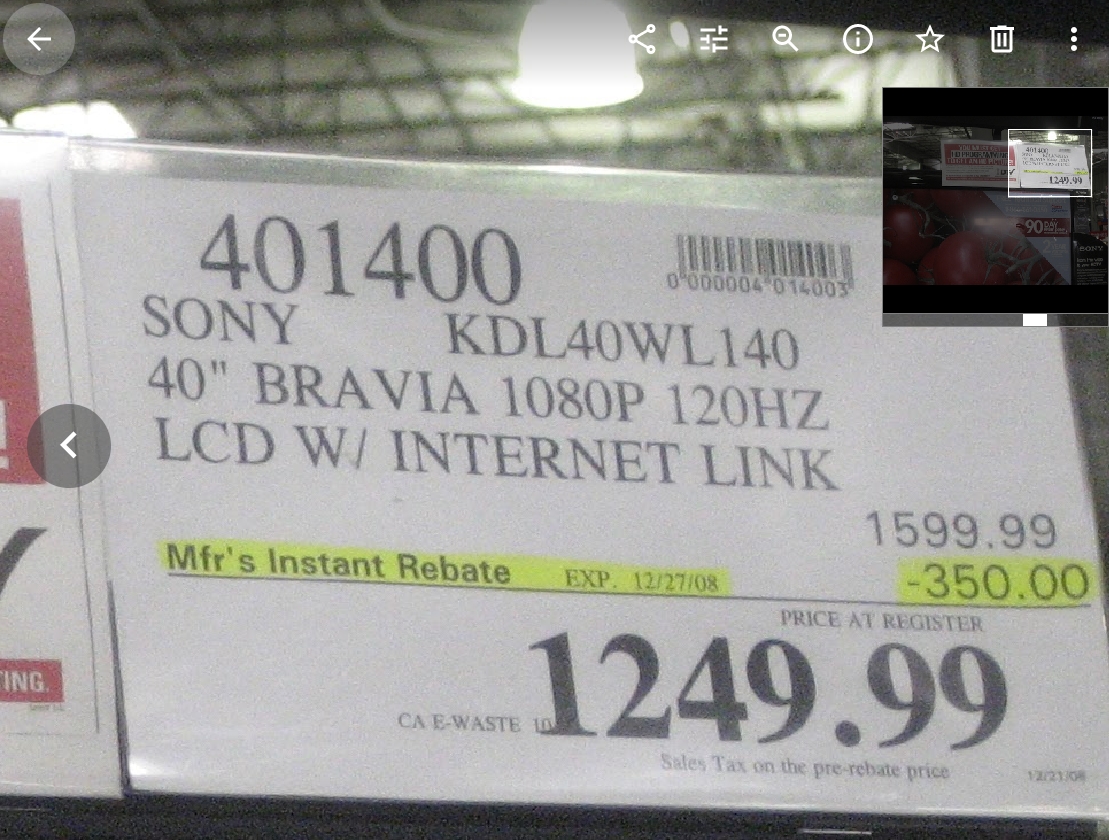
I recently came across a picture I’d taken years ago: price tag of a Sony 40″ 1080p LCD TV with “internet link” at Costco. The price of $1250 (after a $350 rebate) was valid till Dec 2008.
Fifteen years ago, people actually paid a princely sum for that tiny (by contemporary standards) TV. Back then, we would scan Fry’s Electronics superstore Sunday ads in the San Jose Mercury News for deals. Those were the days before Amazon. Fry’s is dead and gone now. But back in the day, Fry’s was the big deal in town. Best Buys ate their lunch. The king of kings from one time end up as ruins in the sands of time. But I digress.
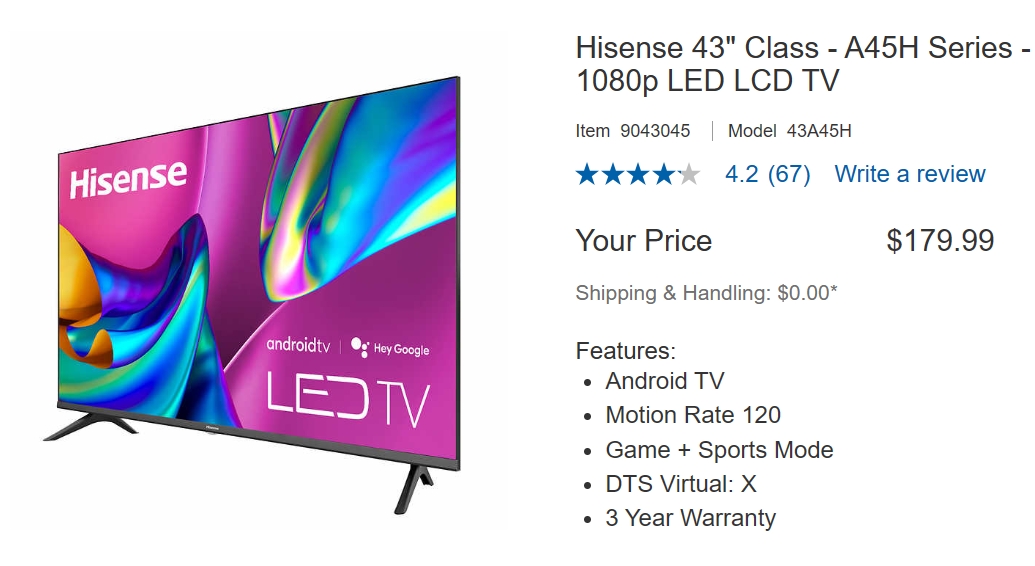
How much do we pay for TVs today? I checked the Costco.com website. Here are two screen captures. First, a Hisense 43″ LED TV. Price: $180.
Dhanteras
 Happy Dhanteras. Economists are fundamentally concerned with human flourishing. Therefore it is appropriate that as an Indian-born economist, I focus on an Indian festival that celebrates wealth. Dhanteras.
Happy Dhanteras to all. May you and yours have Lakshmi Ma’s blessings. For what the Dhanteras festival is, see this and this.
Shubho Bijoya

Shubho Bijoya greetings to all. Today is what we Bengalis call Bijoy Doshumi, the final day of our most important festival, Durga Pujo or simply Pujo.
I’m in Bangalore as a guest at my friend K’s home. The above image is from a Durga puja we visited yesterday evening. It depicts Ma Durga and her four children — from left to right, her son Ganesha, her daughter Lakshmi, herself, her other daughter Saraswati, and her other son Kartik.
As a child I learned this story from my mother and grandmother. Every year Durga, who is married to Shiva, comes to visit her parental abode with her four children. Everyone celebrates her visit and she is worshiped, and on the final day of Bijoy Dashumi, she goes back. Continue reading “Shubho Bijoya”
Reagan’s Last Speech
Ronald Reagan, the 40th president of the United States (1981 – 1989) was a hard act to follow. His last speech as the POTUS is emblematic of who he was. With all his faults and mistakes, he was a true American hero.
As a side note, I think Vivek Ramaswamy is the kind of American that Ronald was talking about — the children of immigrants who lead the country of their birth.
Puzzles
 We humans are puzzle solvers. We get a certain joy out of solving puzzles. Richard Feynman spoke about “the joy of finding things out.” We are not Nobel Prize-winning geniuses like Feynman but still we do like solving puzzles.
Given that we differ in our preferences, we choose different puzzles we attempt to solve. Charles Darwin wanted to know what was the mechanism that drove biological evolution; Adam Smith wondered about the nature and causes of the wealth of nations; Newton wanted to figure out (among lots of other things) what the nature of light was; Einstein wanted to know what it would be like if one moved at the speed of light, etc. Continue reading “Puzzles”
Freedom

I am convinced that freedom is an acquired taste, somewhat like dietary preferences. People brought up in a vegetarian households are likely to prefer vegetarian food. People brought up free tend to prefer freedom, and those brought up under command structures, prefer that. Muslims apparently prefer the stifling, humanity-denying strictures of Islam that non-Muslims generally find horrifying. Continue reading “Freedom”
Across the Universe
 It’s time to muse about music. The words muse and music are related, as one can guess from the spelling. The big dictionary says that Muse refers to “any of the nine sister goddesses in Greek mythology presiding over song and poetry and the arts and sciences.” That suits me since who wouldn’t be in favor of songs, poetry and science, I ask you.
In my formative years, I was exposed to a healthy dose of music and poetry in various languages. English and Hindi language poetry predominated as did English and Hindi language songs. I took special delight in the songs of The Moody Blues and The Beatles. Their songs particularly resonated with me because those two bands were heavily influenced by Indian philosophy. I’m still crazy about them after all these years. (Did you get the reference to another band in that last bit?[1]) Continue reading “Across the Universe”
Atheist Preachers
 In my list of favorite Christian preachers who turned atheist is Seth Andrews. Preachers have to have the gift of the gab since that’s the tool of their trade; Seth has that in spades. He is a delight to listen to — like listening to a virtuoso violinist. Years of preaching the Good Book does make one into a maestro in that business. A sample video coming up.
Another favorite is Dan Barker. He preached for 19 years. He was no ordinary preacher; he was the kind of preacher that you’d not want to sit next to on a bus (Richard Dawkins’ description of Dan in the preface to Dan’s book Godless.) He has even appeared on Oprah, talking about his de-conversion. A sample video of him in an Oxford Union debate will be up next. One of the people on the opposing side was Peter Hitchens, a devote Christian. That’s ironic considering that his brother, the late great Christopher Hitchens, was the world’s most celebrated atheist. Continue reading “Atheist Preachers”
Last time
 I’ve refrained from posting because I heed George Eliot’s caution that “Blessed is the man, who having nothing to say, abstains from giving wordy evidence of the fact.” I have nothing to say.
Although in conversation I am never at a loss for words, it is not easy for me to write something meaningful without a prompt. I feel that if I write something unprovoked, it had better be worth reading. This is not one of those instances. This time I write just to see if I can still write. You’ve been cautioned.
***
I had the worst flight of my life a couple of days ago. The flight time was nearly 18 hours, non-stop from SFO to BLR. Of the hundreds of international flights (most of them between the US and India) and hundreds of domestic flights I have taken, I would rate this one as the worst I have endured. For the record, Finnair, which I took between Dallas TX and Mumbai the previous visit to India in November 2022, was the second worst. Continue reading “Last time”
 Atanu Dey : Life is a Random Draw