
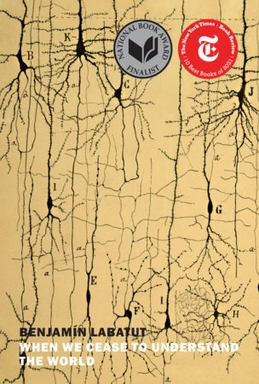
 “When We Cease to Understand the World” is a historical fiction work by Chilean author Benjamín Labatut. It explores the human drive to comprehend the universe, the costs of intellectual obsession, and the ethical dilemmas inherent in scientific progress.
The book was originally published in Spanish in 2020 and in English in 2021. It blends historical fact with fiction, presenting the lives of scientists and mathematicians whose groundbreaking discoveries reshaped human understanding but also carried profound ethical and existential consequences.
It is composed of five interlinked essay-style chapters, each focusing on a different historical figure or scientific concept. Labatut employs a poetic style that combines concision, cruelty, and dark humor to illustrate the human and philosophical dimensions of scientific discovery. The narrative oscillates between historical events and imaginative reconstructions, creating a hybrid of fiction and nonfiction that emphasizes the personal costs of genius.
Themes
-
- The Limits of Knowledge: Labatut examines how even the most brilliant minds confront the inscrutability of the universe, highlighting the tension between human understanding and the unknown.
- Sacrifice and Obsession: Scientists in the book, such as Werner Heisenberg, Erwin Schrödinger, Fritz Haber, Alexander Grothendieck, and Shinichi Mochizuki, often prioritize discovery over personal relationships, leading to isolation, madness, or moral dilemmas.
- Destruction and Ethical Consequences: The narrative explores how scientific advancements, from chemical warfare to quantum mechanics, can have catastrophic consequences, illustrating the duality of human progress.
- Existential Reflection: Through the lives of these figures, the book meditates on the philosophical and existential implications of confronting the unknown, portraying knowledge as both illuminating and terrifying.
Focus
-
- Prussian Blue: Explores Fritz Haber’s development of chemical weapons and fertilizers, highlighting the moral ambiguities of scientific innovation.
- Schwarzschild’s Singularity: Focuses on Karl Schwarzschild’s work in astrophysics and the existential weight of understanding singularities in space-time.
- The Heart of the Heart: Examines the isolation and radical approaches of mathematicians like Mochizuki and Grothendieck, emphasizing the personal and societal consequences of intellectual pursuit.
- Quantum Physics and the Copenhagen Interpretation: Chronicles the debates between Schrödinger, Heisenberg, and others, illustrating the tension between theory, observation, and philosophical interpretation.
- The Night Gardener: A contemporary, reflective narrative that ties together the book’s themes of mortality, human ambition, and the fragility of understanding.
The book has been widely acclaimed, appearing on The New York Times’ 10 Best Books of 2021. Critics have praised it for its stylistic brilliance and intellectual depth.
I have enjoyed the audio version of the book immensely. This book review was composed by an AI model and edited by me.
Since the book was originally in Spanish, let’s listen to a bit of flamenco. I have been fond of flamenco ever since I first heard it decades ago. I was tickled to learn that it has links to Rajasthan. The Encyclopedia Brittanica says that it is —
. . . a form of song, dance, and instrumental (mostly guitar) music commonly associated with the Andalusian Roma (Gypsies) of southern Spain. (There, the Roma people are called Gitanos.) The roots of flamenco, though somewhat mysterious, seem to lie in the Roma migration from Rajasthan (in northwest India) to Spain between the 9th and 14th centuries. These migrants brought with them musical instruments, such as tambourines, bells, and wooden castanets, and an extensive repertoire of songs and dances. In Spain they encountered the rich cultures of the Sephardic Jews and the Moors. Their centuries-long cultural intermingling produced the unique art form known as flamenco.

 Atanu Dey : Life is a Random Draw