
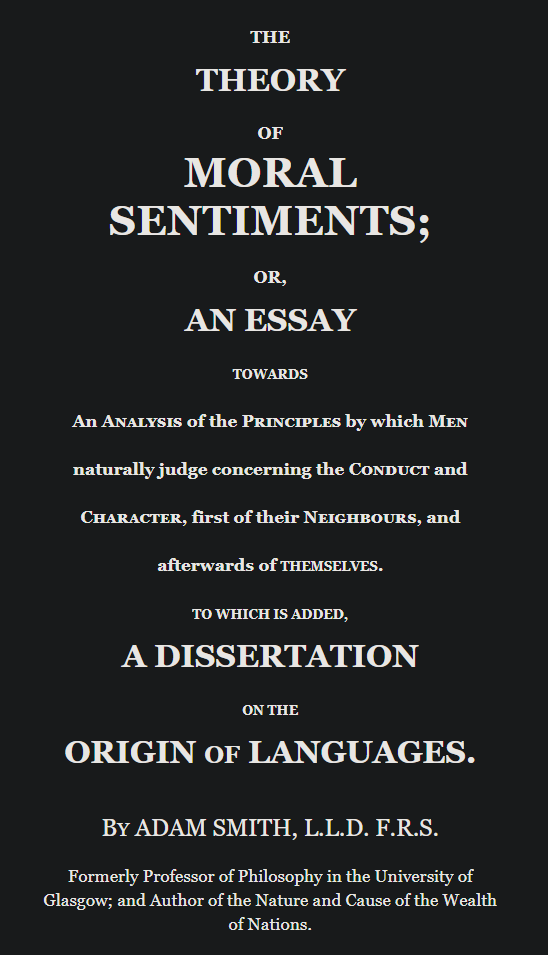
 Two hundred and fifty years ago, in 1776, two events occurred in the world that had a momentous impact on the subsequent development of the modern world. They were separated by the Atlantic Ocean: one happened on an island on the east and the other on a continent on the west that it had colonized where an act of treason took place.
The first event was the publication of a book titled An Inquiry into the Nature and Causes of the Wealth of Nations by Adam Smith in two volumes on 9 March 1776 in London, England. (It’s March 10th, 2026, as I write this.) It can justifiably be regarded as the start of the formalization of the modern discipline that we call economics today.
The second event happened later that year on the 4th of July 1776 in the colonial city of Philadelphia in Pennsylvania, one of the 13 British colonies. It was the Declaration of Independence that announced the separation of the 13 North American British colonies from Great Britain.
It is hard to overestimate the impact of those two seemingly disparate events. One was the publication of a book by a Scottish philosopher, born in 1723 in Kirkcaldy, Scotland, and the other an act of rebellion by a bunch of traitors which eventually to a very large extent created the modern world we live in. What could possibly be common to both?
I would argue that the element common to both events was that both were the product of philosophy, and more specifically they both were about human freedom and human flourishing.
Adam Smith (1723 — 1790) was a prominent figure of the Scottish Enlightenment. About Smith, ScottishPhilosophy.org informs us that —
Smith became Professor of Logic at the University of Glasgow in 1751 and soon after Professor of Moral Philosophy, a position he held until 1764. His lectures on moral philosophy formed the foundation of his first major work, The Theory of Moral Sentiments (1759), which explored ethics, human behavior, and the principles of sympathy and moral judgment. This work established him as a leading thinker in moral philosophy and social theory.
It’s important to note that Adam Smith was not what we call an economist today primarily because there was no such discipline then we call economics today. He was a moral philosopher. His first book’s first paragraph is —
How selfish soever man may be supposed, there are evidently some principles in his nature, which interest him in the fortune of others, and render their happiness necessary to him, though he derives nothing from it, except the pleasure of seeing it. Of this kind is pity or compassion, the emotion which we feel for the misery of others, when we either see it, or are made to conceive it in a very lively manner. That we often derive sorrow from the sorrow of others, is a matter of fact too obvious to require any instances to prove it; for this sentiment, like all the other original passions of human nature, is by no means confined to the virtuous and humane, though they perhaps may feel it with the most exquisite sensibility. The greatest ruffian, the most hardened violator of the laws of society, is not altogether without it.
We — except for psychopaths and sociopaths — are not without concern for others. We care about others, not just for ourselves. In modern economic parlance, we say that our utility functions have the utility of others as an argument; that human preferences are interdependent or other-regarding, not purely selfish; that people’s well-being depends directly on what happens to other people.
Mathematically, this means their utility function Uᵢ includes the utility of others as direct inputs (arguments):
Uᵢ = Uᵢ(xᵢ, xⱼ, …) where xⱼ affects i because i cares about j.
Very few people, including economists, have read Adam Smith’s two books. He certainly initiated our discipline but we don’t have to read him except perhaps for bragging rights. There are three reasons. First, Smith is not easy to read. Modern prose is a lot easier to read. Second, economists have learned a lot more about how the world works than Smith did. Besides, the modern world is a lot different from Smith’s times even though the principles remain the same.
Finally, Smith got a lot of things wrong that later thinkers such as the neoclassicals, and particularly the Austrians, fixed. Smith was mistaken about the labor theory of value, for example. Also, the classical economists could not figure out the solution to the “water diamond” paradox which the Austrians solved with their “marginal revolution.”
I will put off for now how the two events of 1776 are related. For now, let’s delve into the question whether Adam Smith was the “Founding father of Capitalism?”
Short answer: no, he was not. The word “capitalism” was invented about 100 years after Smith’s Wealth of Nations. During Smith’s time, the subject was part of moral philosophy and later it was called political economy and only much later economics.
For now, let Gene Epstein of the Soho Forum argue that Smith was not the father of economics.
Be well, do good work, and keep in touch.

 Atanu Dey : Life is a Random Draw