
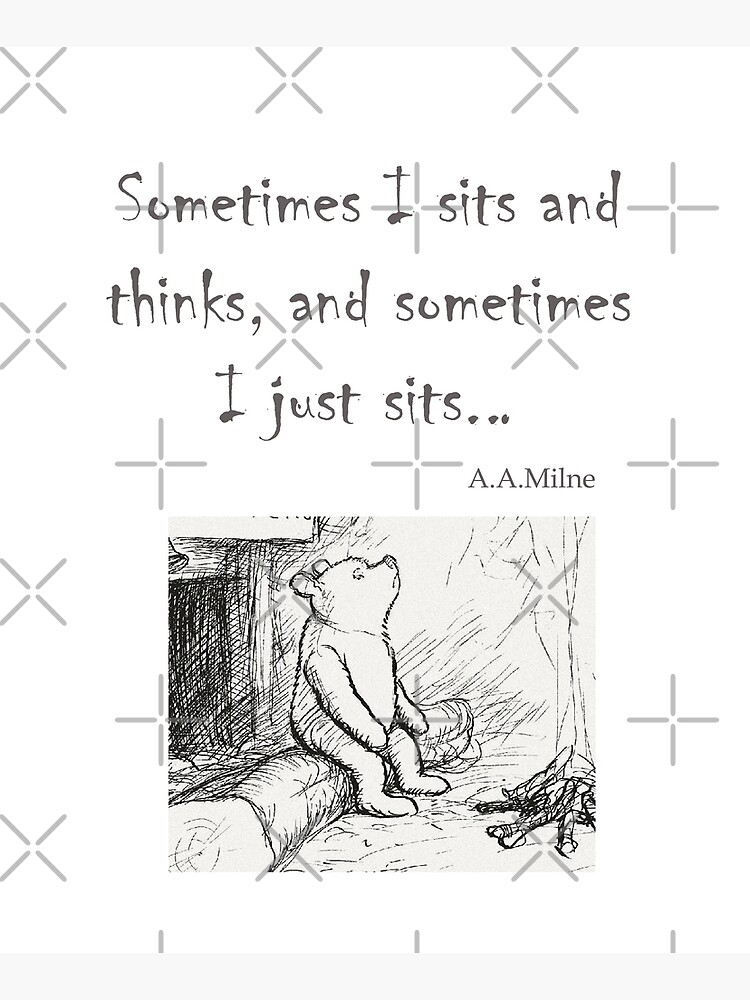
 I recently came across a quote on the web that “many of the best investors in the world are really good at doing nothing for long periods of time.”
Doing nothing for long periods of time comes naturally to me. I am definitely not a lazy thinker but when it comes to doing, I am content to avoid any action until it becomes unavoidable. Laziness is an art form.
I have always been in favor of idleness. See my post from January 2019, In Praise of Idleness, which begins —
It makes good sense for the slave master to persuade his slaves that idleness is a sin and he’s doing god’s work when he flogs the slaves to work harder. The harder the slaves work, the more the master can take for himself. But of course the real motive has to be concealed and clothed in moral raiment.
“Work hard, you b*tches, and stop complaining.” That’s what Mohandas Gandhi meant but put it so very piously by saying, “Purity of mind and idleness are incompatible.” See what I mean?
The American historian and philosopher Will Durant (1885 – 1981) held that “One of the lessons of history is that nothing is often a good thing to do and always a clever thing to say.” I religiously adhere to the first bit but frequently fail at the second bit. I am not clever enough to keep my mouth shut.
Back to that quote about the best investors. I have a couple of friends who are professional investors in the market. I have never bought a single share. I neither have the knowledge nor the guts. One might think that economists will demonstrate their commitment to markets by investing in them. John Maynard Keynes habitually did and made quite a fortune. But I’m no Keynes.
Keynes’ investing core principle was a careful selection of a few investments based on cheapness relative to intrinsic value, and holding them through volatility.
Paul Samuelson, who literally wrote the book on undergraduate economics and the first American Nobel laureate in economics (1970), was a key figure in modern portfolio theory. He advocated for simple, low-effort, long-term investing. He wrote that investing should be “more like watching paint dry or watching grass grow”— boring and steady, not exciting. For excitement he advised taking money to Las Vegas. He advised against trying to beat the market because he argued that few people can reliably outperform the market.
Economists, in general, are not known for their success in the stock market, unlike say Warren Buffett and Charlie Munger. They mastered the art of “doing nothing” for extended periods. They emphasized patience and resisting constant action over impulsive trading.
I found a few quotes that capture Buffett’s core philosophy: great investing often involves disciplined inaction, avoiding unnecessary trades, and letting high-quality holdings compound over long periods rather than chasing constant movement.
-
-
- “The stock market is a device for transferring money from the impatient to the patient.”
- “Wall Street makes its money on activity, you make your money on inactivity.”
- “The stock market is designed to transfer money from the active to the patient.”
- “Successful investing takes time, discipline, and patience. No matter how great the talent or effort, some things just take time.”
- “You do things when the opportunities come along. If I get an idea next week, I’ll do something. If not, I won’t do a damn thing.”
- “The trick in investing is just to sit there and watch pitch after pitch go by and wait for the one right in your sweet spot.”
- “We don’t get paid for activity, just for being right. As to how long we’ll wait, we’ll wait indefinitely.”
-
Charlie Munger summarized his strategy (crudely, as he was wont to do) as “sit on your ass investing.” He said that there were “huge mathematical advantages to doing nothing.”
Alright back to me. (I’ve noticed that it’s always about me.)
The quote at the top of this piece — “Sometimes I sits and thinks, and sometimes I just sits” — resonates with my preference for contemplation and idleness. It is associated with A. A. Milne, the author of Winnie the Pooh. Quote Investigator traces it to the Boston Record of February 1905.
The original version was spoken by an anonymous old fisherman who replied to a bond salesman about how he spent his evenings: “Oh, sometimes I sit and think, and sometimes I just sit”.
That’s how I spend my whole day, not just the evenings.
I’ve been busy doing nothing for weeks. Now I need to get some things that have been on my mind on this blog. So watch out.
Now it’s time for some music. Golden Brown by The Stranglers.
Be well, do good work, and keep in touch.

 Atanu Dey : Life is a Random Draw