
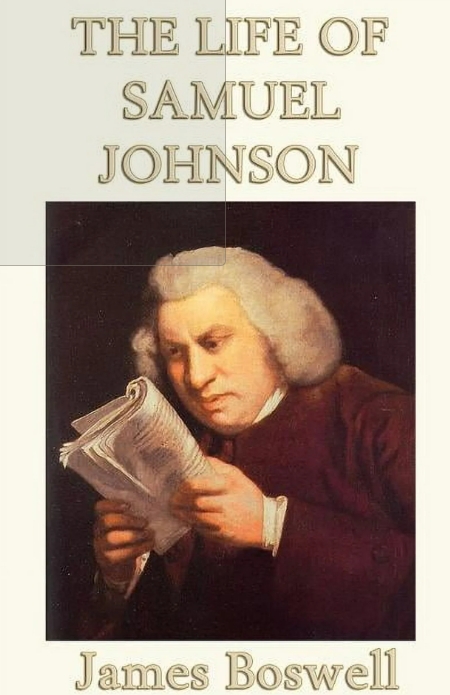
 Decades ago when I was in high school, I came across a Samuel Johnson quote: “Knowledge is of two kinds. We know a subject ourselves, or we know where we can find information upon it.”
It struck a chord with me. That prompted me to read James Boswell’s “Life of Samuel Johnson.”
An interesting bit of trivia. The credit for the first major dictionary of the English language goes to Samuel Johnson, also known as the great lexicographer. His “A Dictionary of the English Language” published in 1755 became the dominant English dictionary for over a century and is considered the first truly authoritative, comprehensive English dictionary.
Today I was reminded of that book during a conversation with a friend. The context was what Trump was doing. I quoted Johnson. “Patriotism is the last refuge of a scoundrel.” Johnson’s view was that pretended patriotism is often used as a cover for self-interest and deceit. He was critical of people who claimed to be patriots while acting in ways that undermined true national interest.
Given our time limitations, it is impossible for us to read more than an infinitesimally small portion of the vast collection of great literature. Fortunately, we have AI agents. They can summarize and surface the best bits. Expert users of AI agents learn where to find information on any subject of interest.
I gave Copilot a simple prompt: “Provide me detailed summary of The Life of Samuel Johnson.” Within seconds, I got a response. Here is an edited version. Begin quote.
A Detailed Summary of Boswell’s Life of Johnson
A detailed summary of The Life of Samuel Johnson is a bit like summarizing a cathedral — it’s not just the structure but the atmosphere that matters — but here’s a full, coherent account of what Boswell actually built and why it remains singular.
Published in 1791, The Life of Samuel Johnson is James Boswell’s monumental biography of his friend, the lexicographer, critic, poet, conversationalist, and moralist Samuel Johnson (1709–1784). It is widely regarded as the greatest biography in the English language — not because of its chronology, but because of its vividness. Boswell turns Johnson into a living presence.
The book blends eyewitness reporting, diary entries, letters, travel anecdotes, verbatim conversations, and Boswell’s own commentary. The result is less a “life” in the conventional sense and more a portrait of a mind in motion.
Boswell recounts Johnson’s difficult childhood: chronic illness, poverty, depression, and a fierce intellectual appetite.
Johnson’s brief time at Oxford is marked by brilliance but cut short by lack of funds. He drifts into school mastering, then into hack writing in Birmingham and later London.
Boswell emphasizes Johnson’s early struggles with melancholy, his lifelong fear of insanity, and his moral seriousness, already fully formed.
London and the Making of a Man of Letters
Johnson arrives in London nearly penniless and begins the long grind of literary labor: writing for magazines, translating, producing political pamphlets, and eventually composing The Dictionary of the English Language (1755).
Boswell highlights Johnson’s astonishing work ethic, hatred of pretension, and his belief that literature should serve moral ends.
A major portion of the book is simply Johnson talking — and Boswell listening. Boswell records Johnson’s wit, his thunderous moral pronouncements, his prejudices, his tenderness, and his ability to dominate any room. These conversations are the heart of the biography. They reveal Johnson’s mind more vividly than any formal essay.
Boswell devotes significant space to their shared travels, especially the 1773 journey to the Hebrides. These chapters show Johnson to be curious, open‑minded, occasionally irritable, and unexpectedly adventurous. The travel narrative also deepens their friendship — Boswell’s vanity and Johnson’s gruff affection play off each other beautifully.
Johnson’s Moral and Intellectual Character
Boswell presents Johnson as a devout Anglican, a defender of established institutions, a fierce opponent of slavery, a critic of luxury, and a man who believed deeply in duty, charity, and self‑discipline.
Yet Boswell also shows Johnson’s vulnerabilities: crippling melancholy, obsessive rituals, fear of death, and lifelong struggles with idleness.
This duality — strength and fragility — is central to the portrait.
Boswell records Johnson’s prayers, letters, and reflections on mortality with great tenderness. Johnson dies in 1784, surrounded by friends, after a final period of intense religious devotion.
Boswell’s genius lies in capturing conversation as literature, revealing character through small details, and refusing to hide his own foibles.
Boswell’s Life remains unmatched because it offers the most vivid portrait of a great mind ever written, a model of biographical intimacy, and a study of friendship between two very different men. It is both a historical document and a work of art.
End quote.
I cannot end this post without a few quotes from Boswell’s book.
-
- “Knowledge is of two kinds. We know a subject ourselves, or we know where we can find information upon it.”
- “The true, strong, and sound mind is the mind that can embrace equally great things and small.”
- “A man is seldom more innocently employed than when he is making money.”
- “He who makes a beast of himself gets rid of the pain of being a man.”
- “Patriotism is the last refuge of a scoundrel.”
(Boswell notes that Johnson meant false patriotism, not genuine love of country.) - “A decent provision for the poor is the true test of civilization.”
- “Integrity without knowledge is weak and useless, and knowledge without integrity is dangerous and dreadful.”
- “No man but a blockhead ever wrote except for money.”
- “The only end of writing is to enable the readers better to enjoy life, or better to endure it.”
- “We are all prompted by the same motives, all deceived by the same fallacies, all animated by hope, obstructed by danger, entangled by desire, and seduced by pleasure.”
- “Almost every man wastes part of his life in attempts to display qualities which he does not possess.”
- “A man has no more right to say an uncivil thing than to act one.”
- “To cultivate kindness is a valuable part of the business of life.”
- “The mind is enlarged by knowledge, but it is not ennobled unless by virtue.”
- “Self-confidence is the first requisite to great undertakings.”
- “A man should keep his friendships in constant repair.”
- “Life affords no higher pleasure than that of surmounting difficulties.”
- “We are not to judge of the feelings of others by what we should feel in their place.”
- “He is not only dull himself, but the cause of dullness in others.”
- “That man has a great deal of brass, but no gold.”
- “Sir, your manuscript is both good and original; but the part that is good is not original, and the part that is original is not good.”
- “Sir, he reasons from premises which he does not understand to conclusions which do not follow.”
Time for music. Enjoy.
Be well, do good work, and keep in touch.

 Atanu Dey : Life is a Random Draw
“No man but a blockhead ever wrote except for money.” Got lost in the double negatives here.
If I write a blog, without getting any money for it, am I a blockhead?
LikeLike
Venerable GROK:
https://x.com/i/grok/share/2fa1f60d21304e9d97d47c5dbded2f78
LikeLike