
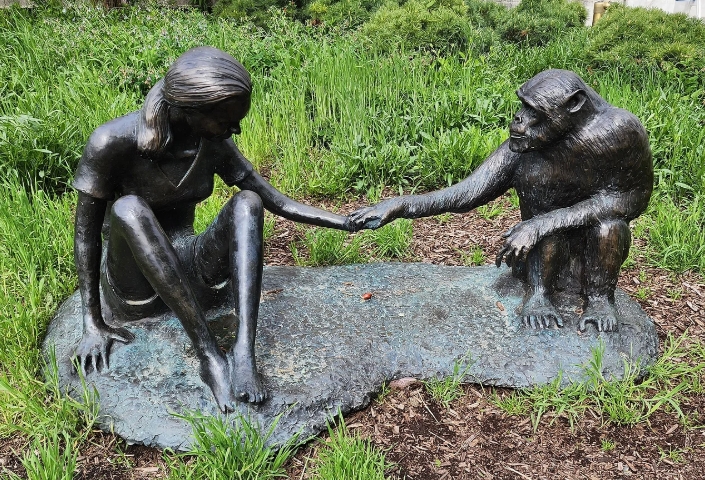
Dame Jane Morris Goodall (3 April 1934 – 1 October 2025), was an English primatologist and anthropologist. She was considered the world’s foremost expert on chimpanzees, having studied the social and family interactions of wild chimpanzees for over 60 years. Goodall first went to Gombe Stream National Park in Tanzania to observe its chimpanzees in 1960. (Source: wiki.) She passed away yesterday, 1st Oct., in Los Angeles, CA.
Her work with the chimps at the Gombe National Park was phenomenal. I first came to know about her work through a talk she gave at the National Press Club sometime in the late 1990s. I heard the talk on my local public radio station KQED 88.5. (Those were the days when NPR had not generated to the woke nonsense station it has become now.)
One can tell that she had a heart of gold. She loved all creatures great and small, as evidenced from the work she did on non-human primates for all her adult life. However, she was seriously mistaken about how to save the non-human world. She apparently thought that there are too many humans. Instead of billions of humans (currently 8+ billion), there ought to be around 500 million.
Here she is at the WEF.
Too many otherwise good people suffer from the mistaken belief that to save the planet most humans ought to vacate it. Another of that bunch is the BBC documentary maker Sir David Attenborough (99 years old, born 1926.) He believes that global warming and climate change will doom the planet. The wiki says,
Attenborough’s programmes have often included references to the impact of human society on the natural world. The last episode of The Living Planet, for example, focuses almost entirely on humans’ destruction of the environment and ways that it could be stopped or reversed.
The great English (another!) physicist Stephen Hawkins (1942 – 2018) in a 1995 TV show famously dismissed the human race as just “chemical scum on a moderate size planet, orbiting round a very average star in the outer suburb of one among a billion galaxies.”
So what’s wrong with these people?
The fear, anxiety and dread of human over-population is understandable among those who have not thought-through the matter rigorously. I know since I used to be one of them. I had read The Population Bomb (1968) and The Population Explosion (1990) by the Stanford biologist Prof. Paul Ehrlich (born 1932) and sincerely believed that India’s problem was due to over-population.
What cured me of that dreadful misconception was a careful study of economics. And of course the 1981 book The Ultimate Resource by Prof. Julian Simon (1932 – 1988) who was Prof Ehrlich’s nemesis. Simon argued that us humans were the ultimate resource. We weren’t just chemical scum.
Fortunately, Goodall is wrong about what the optimal number of humans is. While it is true that humans often have a negative effect on the world, somewhat paradoxically the solution is more humans, and not fewer. A world of 500 years ago with only 500 million people was a world unimaginably worse than the world of today with its 8+ billion people.
This is not common sense. Common sense says fewer is better. But uncommon sense says the more the merrier.
Fare thee well, Dr Goodall, and may you rest in peace.

 Atanu Dey : Life is a Random Draw