
 One of the joys of being an economist is that I get to meet (nearly always virtually) great minds, of the past and the present. Among those whom I admire immensely are the legendary ancients like David Hume, Adam Smith, David Ricardo, and the 20th century greats like Ludwig von Mises, Friedrich Hayek, James Buchanan, Milton Friedman, Thomas Sowell.
Sowell is unique in many ways. Unlike the others I just mentioned, he’s not a dead white man; he’s alive and black. Also, Sowell is not primarily an economics theorist and has not made (as far as I can tell) any fundamental theoretical contributions to economics. However, he’s one of the best social commentators and explainers of basic economics. His work enable lay persons to understand how the world works. He has made—and continues to make—the world understandable to millions of people.
Let’s begin with a brief bio of Dr Sowell.
Born in June 1930 in North Carolina, Thomas Sowell grew up in New York city. He excelled academically in school but had to drop out at 17 due to financial hardship and family difficulties. He served in the U.S. Marine Corps during the Korean War. After discharge, he used the G.I. Bill to attend college, graduating magna cum laude in economics from Harvard University in 1958. He earned a master’s degree in economics from Columbia University in 1959 and a PhD in economics from the University of Chicago in 1968, studying under economists George Stigler and Milton Friedman.
Sowell held professorships at Cornell University, Brandeis University, Amherst College, and the University of California, Los Angeles (UCLA). He became a senior fellow at the Hoover Institution at Stanford University in 1980.
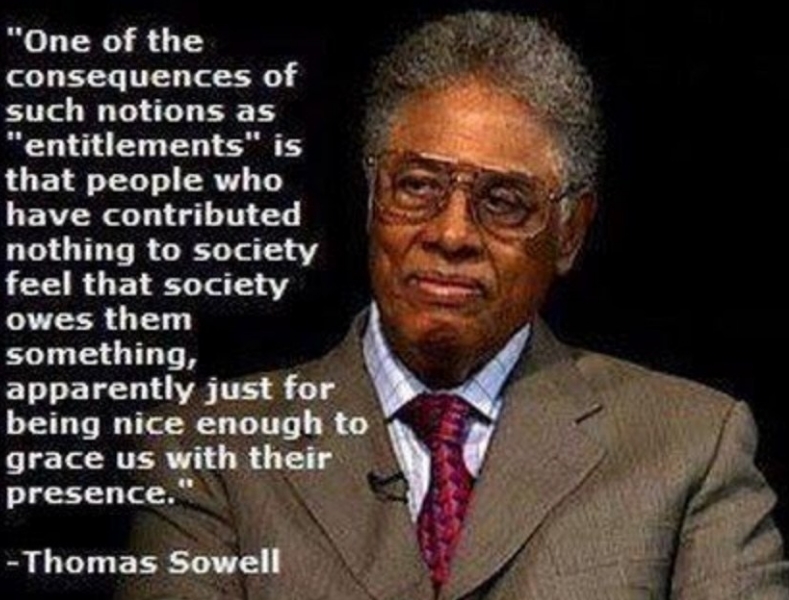 He is the author of over 45 books and a nationally syndicated newspaper columnist, known for his views on economics, race, education, and public policy. His work emphasizes free-market economics and critiques government intervention, arguing that well-intentioned policies can perpetuate poverty. He received the National Humanities Medal in 2002.
He should have been awarded the US presidential medal of freedom long ago. However, his handicap is that he’s not a leftist and he speaks the brutal truth that make too many people—particularly blacks—uncomfortable. It’s hard to get popular if one is too honest and says it like one sees it.
These days it is trivially easy to listen to Sowell. He frequently appears on Peter Robinson’s Uncommon Knowledge interviews from the Hoover Institution. Robinson is one of the best interviewers. However, those are hour-long discussions. I present three much briefer auto recordings to give you a sense of what Sowell is about. It’s time worth spending. They are guaranteed to make you smarter—or your money back. Listen.
Sowell on Why Blacks Are Poor and Whites Are Rich.
Sowell on the Black Victimhood Culture.
Sowell on Why the Poor Stay Poor.
And finally, a long-form interview of Sowell by Peter Robinson at the Hoover Institution, titled Facts Against Rhetoric, Capitalism, Culture and Yes, the Tariffs.
I wish that more people would read and listen to Thomas Sowell. Alright. Be well, do good work and keep in touch.

 Atanu Dey : Life is a Random Draw