

Carl Jung (1875 – 1961) wrote, “Never do human beings speculate more, or have more opinions, than about things which they do not understand.” He must have been invoking his inner Alexander Pope (1688 – 1744) who in his poem “An Essay on Criticism” cautioned —
A little learning is a dangerous thing;
Drink deep, or taste not the Pierian spring:
There shallow draughts intoxicate the brain,
And drinking largely sobers us again.
Either drink deep, or don’t drink at all. My motto also.
Superficial understanding does lead to unjustified confidence. With deeper understanding we realize the limits of our knowledge. We are not omniscient. That’s not an amazing claim. Our understanding is severely limited because we are limited beings, and therefore ignorant of nearly everything. That must teach us epistemic humility but all too often experts don’t learn that lesson.
There’s a second-order problem that is an unavoidable consequence of the fundamental first-order ignorance: we don’t know what we are ignorant about. That ignorance allows us to hold confident opinions on matters we are not equipped to comprehend.
Geoffrey Hinton is rightly celebrated at the “Godfather of AI” these days. His opinion on the development of AI and its potential is probably correct and definitely worth paying attention to. Now that he has been awarded a Nobel Prize in physics for his work on AI, we must take him all the more seriously. But should we take him seriously on matters that are affected by, but not directly related to, AI? I don’t think so.
TITLE: ‘Godfather of AI’ predicts it will take over the world
Around 8:20, Hinton says, “I am worried that there’s going to be massive job losses and that would be good if the increase in productivity made us all better off. Big increases in productivity ought to be good for people but in our society they make the rich richer and the poor poorer.”
Dr Hinton, Nobel prize worth smart and intelligent, gets this wrong. True, that an increase in inequality could mean that the rich get richer and the poor poorer. But that is not necessarily so, has never been so, and is unlikely to be so.
The average level of prosperity has been monotonically increasing around the world for over two hundred years. And with it, inequality has also been rising. Despite that, the poor haven’t become poorer — ever. This matter is empirically true. Check the data.
The rich do get richer. But the poor don’t become poorer.
The next step is to explain why, despite increasing inequality, there’s no deepening of poverty. That analytical bit is a bit more tricky but the logic is robust. Wealth has to be produced. Productivity refers to the efficiency of wealth production. With technological advances, productivity increases. Most stuff gets produced, and more gets consumed. In free markets, everyone’s consumption increases, not just of those at the top of the heap.
Will there be job losses? That’s been the perennial worry that keeps well-meaning people up at night. Fortunately, though technology has been making jobs obsolete for hundreds of years, unemployment has never been a persistent problem in free market economies.
It’s like a leaky bucket. It has enough holes in it to empty out the bucket quickly — except there’s a pipe that keeps filling the bucket up as it empties. Technology empties out the bucket and simultaneously keeps it topping it up. It’s in a dynamic equilibrium.
Let’s consider US employment figures in the period 1890 to 2024. (I very cleverly chose the US and that period. It was clever of me because the figure was handy. But you can do this exercise for other countries and periods if you wish.)
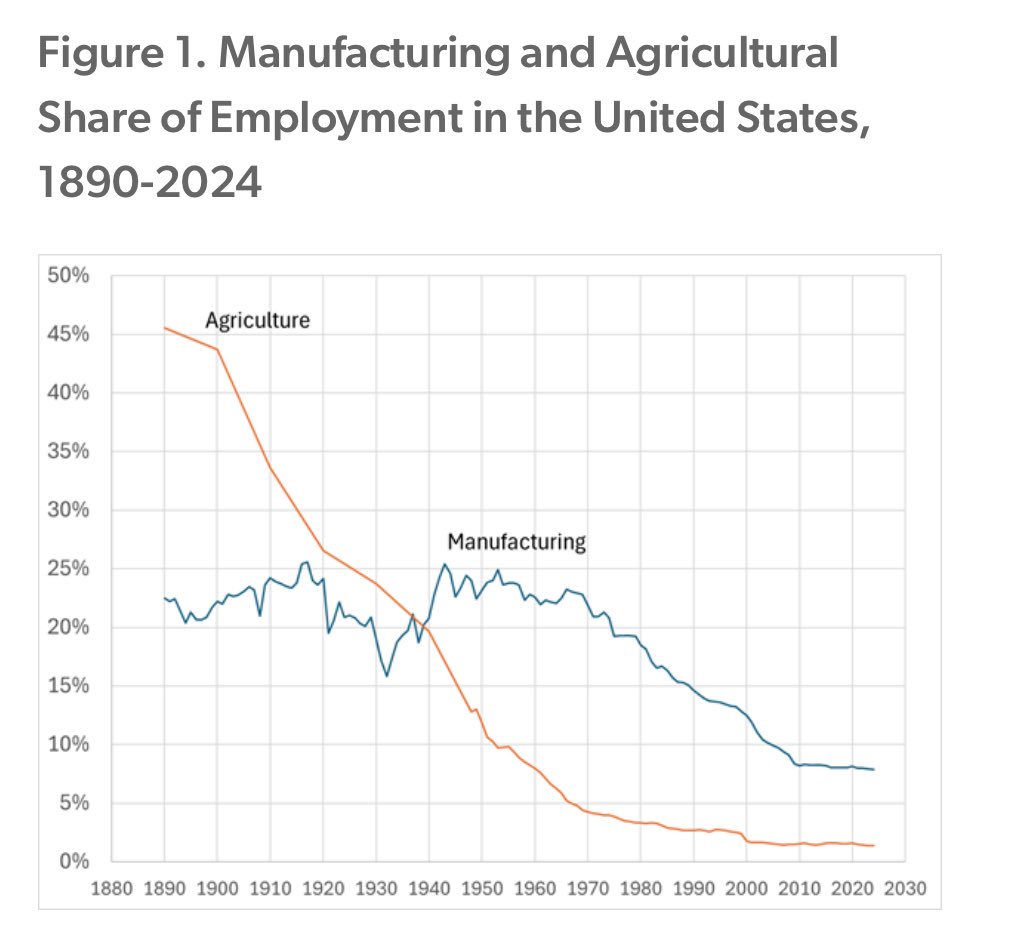
OK, manufacturing had 23% and agriculture had 46% share of US employment in 1890. That means the remaining 31% of US jobs were in other occupations such as mining, construction, services (teaching, research, cleaning, medicine, hospitality, etc.) Then 50 years later in 1940, manufacturing jobs declined a bit to 20% and agricultural jobs fell dramatically to 20%. So now non-ag and non-manf jobs were 60% of US employment. Manufacturing employment was at its peak (25% of the jobs) around 1942.
But that was nothing. By 2024, agriculture jobs had declined to less than 2%. The people who would have been in agriculture, ended up in manufacturing, and in services. Jobs are lost because of technology, and jobs that did not exist any time in the past get created because of technology.
In 2024, manufacturing and agriculture account for less than 10% of US employment. Around half the US labor force is engaged in jobs that did not exist 70 years ago. Such as? Everything related to computers.
Dr Hinton is much smarter than I am for certain. But I know a bit more economics history and theory than he does. Therefore I am a lot more optimistic about jobs, and I am not at all worried about the increase in inequality.
AI and robots will take up more and more jobs that used to require people. Once upon a time, the US employed around one million (1,000,000) telephone operators. Advances in telephone technology ended those. Therefore telephone services became cheaper. Therefore instead of people having to have a “party-line” they could have a private phones at home.
About a hundred years ago, only the rich could afford to travel out of town in comfort. Now the rich can travel across the world in first class comfort. The poor can afford economy class.
No matter how hard one tries, it will be impossible to argue that the poor are getting poorer. Anyone who claims that — Nobel winner or not — is either ignorant or lying.
Alright, time for some music. What would it be? Ah yes, The Second Waltz by the Russian composer Dmitri Shostakovich (1906 -1975).
I don’t much care for the video. I like to listen to the pure music and not be distracted with all that waltzing around.
Talking of waltz, here’s a bonus song. Leonard Cohen.
The entire poem is wonderful. Here are my favorite lines:
And I’ll dance with you in Vienna
I’ll be wearing a river’s disguise
The hyacinth wild on my shoulder
My mouth on the dew of your thighs
And I’ll bury my soul in a scrapbook
With the photographs there, and the moss
And I’ll yield to the flood of your beauty
My cheap violin and my cross
And you’ll carry me down on your dancing
To the pools that you lift on your wrist
Be well, do good work, and keep in touch.

 Atanu Dey : Life is a Random Draw