

For people to be able to ask important questions, they have to have the capacity to seek, find and comprehend the answers themselves. That is, the answers are almost but not quite within their reach. The Zen proverb — when the student is ready, the teacher appears — is a version of that.
A corollary to that is the fact that one cannot learn something from a book that is not implicitly almost known already. To have a chance to gather even the low-hanging fruits, you have to be close to the tree; if you are far enough away from the tree, you can’t even see what fruits it bears.
The less one’s knowledge of a subject, the less aware one is of one’s ignorance. It’s almost paradoxical that the more you know, the more your knowledge of your ignorance grows. Ignorance of one’s ignorance is meta-ignorance. Knowledge of one’s ignorance is meta-knowledge.
I got to know about quantum physics sometime after my undergraduate days. Before that, I did not know what that beast was. Now I know about quantum mechanics, and what’s more, I know that I am as incapable of understanding QM as a chimpanzee is incapable of understanding calculus.
Not everyone has the same cognitive capacity; some are extraordinarily gifted. One can, provided one puts in the effort, learn a lot of stuff but in the end, one reaches one’s natural limits. No amount of feeding a dwarf will result in a giant.
I sometimes despair that I don’t know as much as some others I know of. Given the easy access these days to the works of intellectual giants, it’s a depressing realization that I don’t measure up. But then another thought brings me some consolation.
While it is true that there is inequality in cognitive capacity and the amount of knowledge, that’s only half the story. When it comes to what is potentially knowable, we are all equal. It’s as if I have only 10 units of knowledge, which is small compared to, say, an awesomely intelligent person who has 1000 units. But what if — and I suspect that this is true — what is knowable is unbounded, far exceeding hundreds of trillions of units of knowledge? From the vantage point of the infinite, there’s no difference between my 10 units and another’s 1000 units. They both round down to zero.
I developed a geometrical analogy to the relationship between knowledge and ignorance: the Koch snowflake. It is based on the Koch curve, first described by Swedish mathematician Helge von Koch in 1904 as an example of a non-differentiable curve.
The Koch curve is a fractal curve that can be constructed by recursively adding smaller equilateral triangles to each side of an initial straight line segment, resulting in a continuous curve that does not have a tangent at any of its points.
The Koch snowflake is a shape with an infinite perimeter and a finite area. It is formed by applying the Koch curve construction to each side of an equilateral triangle recursively. Here are the first few iterations:
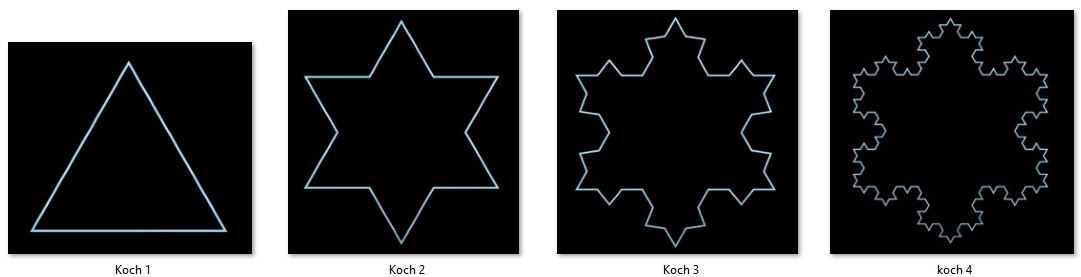
The above image is from a video tutorial on the Koch curve, which I append at the end of this post.
I use the Koch snowflake to represent knowledge and ignorance. The area within the Koch snowflake is analogous to knowledge. The area of the curve is clearly bounded. The area increases with each iteration but the marginal increase keeps diminishing. However the perimeter of the snowflake keeps increasing and is unbounded. The perimeter is analogous to ignorance. The perimeter grows without bound as the area increases.
Humanity’s collective knowledge will continue to grow. We are at the initial stages of the construction of the snowflake. The journey will be fascinating. As our knowledge grows, the frontier of our ignorance will grow rapidly and without bound.
For your listening pleasure, here’s the Prajnaparamita Hridya Sutra (Perfection of Wisdom Heart Sutra) aka the Heart Sutra sung by Imee Ooi. The mantra in Sanskrit:
Gate, gate, para gate, para sum gate, Bodhi svaha!
Gone, gone, gone beyond, gone completely beyond. Enlightened mind, so be it.
Be well, do good work and listen to the Heart Sutra!

 Atanu Dey : Life is a Random Draw
We’re all ignorant to various extent because we can’t know it all.
There’s a psychological dimension: Stupidity or severe form of ignorance is the unwillingness to admit one’s ignorance.
One form of smartness is A.I. : ‘Artificial Ignorance’ ..It referes to
1) Play Dumb or hide one’s strength due to certain circumstances
2) Political ploy or demagoguery to gather support for certain political aims..eg:
https://indianexpress.com/article/india/subramanian-swamy-bill-seeks-death-penalty-for-cow-slaughter-4584486/
Please tell me how ignorant I’m.
LikeLike