Economic Growth and Degrowth

Growth is a feature of the natural world. All sorts of processes at various scales — from the molecular to the galactic — lead to growth. Plants and animals grow through their life cycles, as do stars and galaxies. The opposite process of degrowth is also part of the natural world. Growth invariably leads to dissolution and death. Nothing lasts forever. Whatever has a beginning has an end. Creation and destruction are inextricably linked. Shiva, as Nataraja, ceaselessly dances the universe into existence and also dances it out of existence.[1]

Though growth and its opposite continue, overall growth wins over degrowth. The universe and its various subsystems grow with the passage of time.

Narrowing our focus to the processes that are involved in the evolution of life on earth, we see the same cyclical story: birth, growth, dissolution and death followed by renewal. All these processes are by definition dynamic and therefore have the potential to be creative. Continue reading “Economic Growth and Degrowth”

Benjamín Labatut – When We Cease to Understand the World

There are many wonders of the modern world. Which matters most to us depends on our individual preferences. To me, the easy access to the written word is a miracle that was not available even a generation ago.

Sure there were books in the past but access was costly in terms of time and money. Today, most of us have broadband internet connections. That means not only text but vast quantities of quality audio, video, text and graphics are at our fingertips, on our computers and smartphones.

What’s more, the marginal cost of all that awesome stuff is near zero. There’s more material being added every hour than one can consume in an entire lifetime. Time and attention is the scarce resource, not material. Continue reading “Benjamín Labatut – When We Cease to Understand the World”

Why I’m a Hindu – Part 4

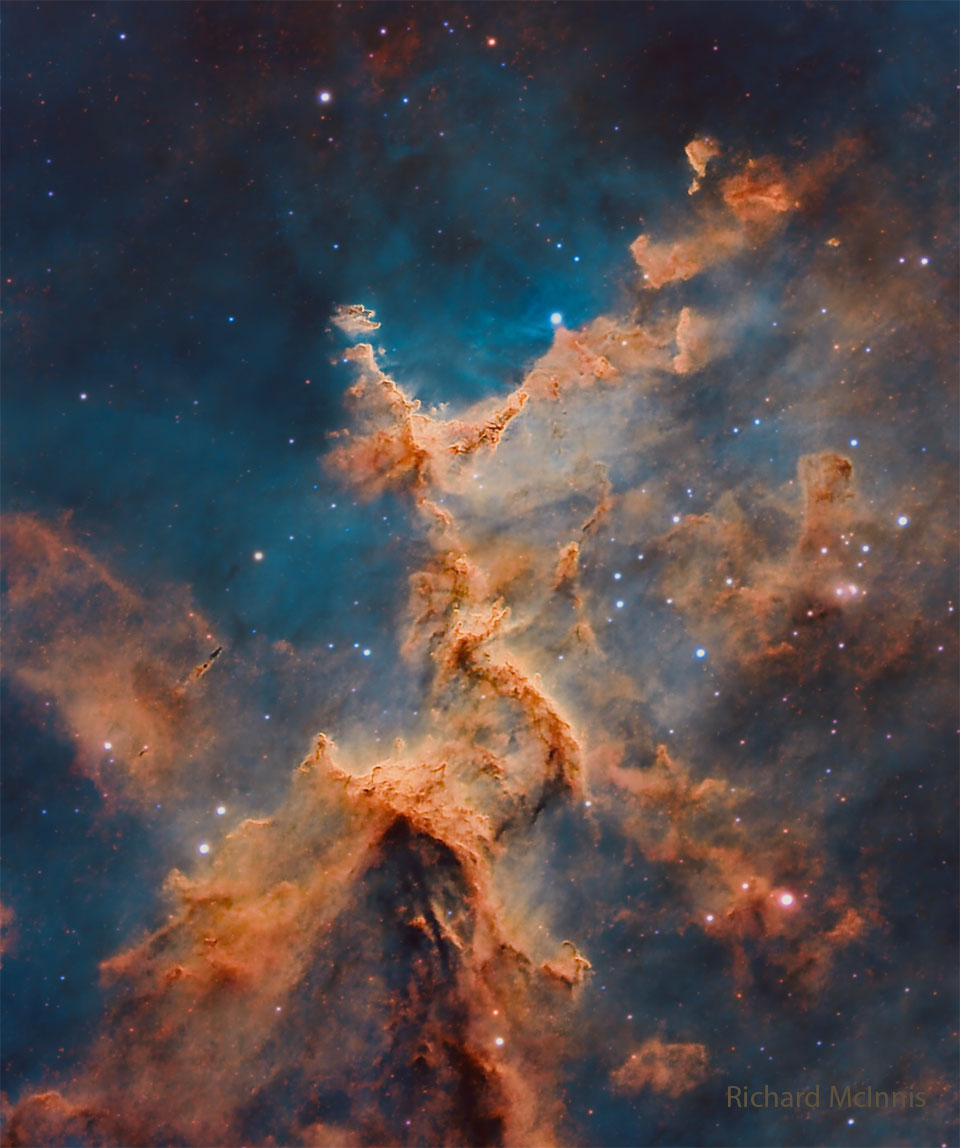
Melotte 15 in the Heart Nebula. (Click to go to Nasa.gov source.)

In the first bit I distinguished between religions and the dharmas, and argued that Hinduism (and the related traditions of Buddhism and Jainism) is not a religion. Furthermore, religions have a concept of god (and strictly only one god) but dharmas have no related concept of god, neither one nor many. Thus Dharmas are godless, and therefore by the strict definition of the term, the dharmas are atheistic.

As I’m an atheist — a person who does not believe in god — I am godless and therefore irreligious. I assume that much was clear by now if you’ve been following my posts.

In this series (see Part 1, Part 2 and Part 3), I am exploring why I’m a Hindu, and intellectually and morally justifying my choice of my dharmic identity. Continue reading “Why I’m a Hindu – Part 4”

India and Mars

Mars. Image from NASA/JPL (Click to embiggen)

That’s a very strange title for a post. Unimaginative and uninformative. But it may be appropriate. Mars is quite popular these days — what with all those rovers on Mars (Mars is 100% inhabited by rovers) and then there’s Elon Musk and his Starship project to build a colony on Mars. I support his goal to make humanity a multiplanetary species.

I was randomly looking through this blog and found a set of articles I had done in November 2013. I present them here for the benefit those who have missed reading them. Continue reading “India and Mars”

Johan Norberg on China

The Swedish economist Johan Norberg is a Senior Fellow at the Cato Institute. He is a passionate advocate of capitalism. In his 2023 book The Capitalist Manifesto: Why the Global Free Market Will Save the World he argues for free markets and freedom.

Among his 20 books are In Defense of Global Capitalism, Progress: Ten Reasons to Look Forward to the Future, and Open: The Story of Human Progress. Those two books were recognized as the 2016 and 2020 book of the year, respectively, by The Economist . Continue reading “Johan Norberg on China”

9/11: 23 Years Ago

Fountain in the footprint of the WTC North Tower (May 2019) Click to embiggen. Atanu Dey

Twenty-three years ago on September 11th, a great big catastrophe hit the world. The US suffered a direct hit that was bad enough in terms of death and destruction. But the reaction by the US military-industrial complex was orders of magnitude more devastating to the world. Trillions of dollars worth of arms and ammunition was unleashed on millions of innocent civilians while protecting the guilty.

A few days later on Sept 17th, 2001, I wrote a piece on my UC Berkeley blog (which is no longer online.) I reproduced that piece on this blog: The Looking Glass War.

Continue reading “9/11: 23 Years Ago”

Civil War Inevitable: Musk

M31 The Andromeda Galaxy (Click to see full size)

I am generally not impressed by the many hugely popular media celebrities on YouTube and on social media. Many of them are, IMNSHO, overexposed midwits and in some cases they are positively harmful because their millions of followers don’t have the cognitive capacity to distinguish chalk from cheese.

I could be accused of being elitist and correctly so for observing that the masses are stupid. The wise and the intelligent have never been in the majority.

All opinions are not equally valid or justified. People (present company not exempted) are more often wrong than right. The saving grace is that most of us don’t have the enormous reach that celebrities have, and therefore our ability to mislead is severely limited. Continue reading “Civil War Inevitable: Musk”

Wealth, Income, Consumption & Utility – Part 2

TL;DR. The world is getting increasing unequal in wealth, income and consumption. That’s great. I prefer to live in an increasingly unequal world than in a world of equality because an unequal world is a better world than a world characterized by equality.

But let me stress that a world with more inequality is preferable to a world with less inequality is an empirical fact, not a necessary logical fact. Here’s why.

Our present world is unimaginably wealthier than the world was any time of the past, as I claimed in the first part of this essay. I believe the future will be even more unimaginably wealthier than the present. The causal factors that led to the present explosion of wealth will continue to not only operate in the future but will intensify. Continue reading “Wealth, Income, Consumption & Utility – Part 2”

Ganesh Chaturthi

It’s Ganesh Chaturthi season again. Therefore it is time for the annual post. Of the 330 million devas of the Hindu dharma, Ganesha is my favorite for a variety of reasons, chief among them being that my interests closely mirror his.

He likes food; he likes reading and writing; he loves music; likes traveling; he is lazy and is easily bribed, and so on. Ganesha is always depicted with food. After the sage Vyasa composed the Mahabharata, he dictated the massive 100,000 verses to Ganesha as the scribe. Continue reading “Ganesh Chaturthi”

Wealth, Income, Consumption & Utility – Part 1

Thomas Hobbes (born 1588 CE) had a dismal view of humans living “in a state of nature.” In his famous book Leviathan (published 1651 CE) he characterized human life as “solitary, poor, nasty, brutish and short.” From all the evidence we have it appears that he was, to a first approximation, absolutely correct about the human condition.

Human beings — species homo sapience — have been around for approximately 300,000 years. Taking a generation to be 25 years, we have had 12,000 generations of human beings prior to our own. An estimated 100 billion of us have ever lived, including the present 8 billion. Continue reading “Wealth, Income, Consumption & Utility – Part 1”