
 My dear friends F and D in India have two teenage sons. The older one is an undergrad in a reputed art college in Paris, and the younger one, in high school in India, is aiming to become a professional drummer. I mention this as a contrast to the career choices open to me when I was a teenager in Nagpur so many decades ago.
Born in a middle-class family in a tier-two city in India, I was limited to studying either engineering or medicine. Since I could not stomach the sight of blood or any pain and suffering, I chose engineering. Becoming an artist or a musician was inconceivable. Economist? I didn’t even know such a discipline existed.
But times have changed. In the last half century or so, career options have exploded, and not just those related to computer technology and the internet. Jobs exist in every field today, surely in hardware and software, that one could not have imagined a generation ago.
I’m amazed that “Youtube creator” or a “pod caster” is a paying occupation these days. Thousands of people make a very good living posting videos on every conceivable topic. People value the content and voluntarily pay for it. Also thousands make a killing creating pr0n videos on the web. I wouldn’t know that first hand of course but I have it on good authority from a friend of a friend that it’s a thing.
The change in the structure and nature of occupations has been a constant in the last few centuries. At one time, the majority of the population was engaged in agriculture and related activities. Most of our ancestors in the last ten millennia have been involved in producing food. The increase in agricultural productivity in developed economies released labor that was absorbed first in manufacturing and then into services.
Manufacturing jobs are hard but not as hard as agricultural jobs. And services jobs are not a cake walk either but they are not as hard as manufacturing jobs. I’d rather drive a bus or do Amazon deliveries than work in a steel mill. Working in an auto assembly line in Detroit is better than picking cotton in Louisiana.
Thankfully, employment in the agriculture and manufacturing sectors is declining and soon will shrink to almost nothing. Artificial intelligence-powered machines will do the dirty work, leaving people to do creative work. Alright, maybe not creative work but work that they choose freely and therefore enjoy doing.
Which brings me to why I titled this post “Happiness.” Bertrand Russell held that the good life is the happy life. He clarified that he didn’t mean that if you’re good then you’d be happy but rather that if you are happy then you’d be good.
Do what makes you happy, and you’d be good at it.
If you’re happy drumming, you’d likely be good at it. And if you are good at something, that will be sufficient to make a good living. Most of the time. No guarantees but most of the time it will work out.
The world is getting better in that the variety of occupations is increasing. You could still choose to be, as in the past, a farmer or perhaps a “tinker, tailor, soldier, spy” but now you can also choose to be a web designer, software engineer, advertising specialist, interior decorator, yoga instructor, quantum physicist, heart surgeon, financial advisor, or engage in a million other specialized occupations.
The story inexorably follows from specialization and the division of labor. It’s what Adam Smith pointed out in his “The Wealth of Nations” in 1776. Smithian growth is about the expansion of the scale and scope of the market. Larger markets means more suppliers and more consumers. That in turn entails more specialization. Doctors are not just doctors but now you can have doctors who specialize in pediatric medicine and others who specialize in geriatric medicine. Not just physicists but those who focus on condensed matter physics and others on relativistic physics; some are theoreticians and others experimentalists.
Smithian growth is one kind of growth. It is limited by the extent of the market. It is simply due to more people producing and consuming stuff. ln the modern world, following the industrial revolution of the mid-1700s, the world saw another kind — Schumpeterian economic growth. This growth is not the result of division of labor and specialization; it results from product and process innovation.
Schumpetarian growth led to the phenomenal increase in the variety of occupations, and therefore contributed significantly to the increase in human flourishing and happiness.
In the year 1800, you might have had the talent to be a great VLSI (very large scale integrated) circuit designer but you’d be totally out of luck because there was no need for your skills. Then you were forced to choose between being a farmer or a factory worker. You could have been happier designing VLSI circuits but no such occupation was open to you until recent times.
Having an occupation that is suited to our individual preferences and talents contributes to our happiness. Civilization advances to the degree that people have the freedom and the opportunity to do what they prefer to do. That increases our standard of living in all its dimensions — health, longevity, the enjoyment of art, freedom from want, etc.
A final word. What is the one factor that is necessary (though not sufficient) for both Smithian and Schumpeterian growth? Simple answer: the number of people on earth. More people, more growth, more flourishing.
I will explore that point in another post soon. (Follow up post: Humans.)
Happy New Year 2024.

 Atanu Dey : Life is a Random Draw
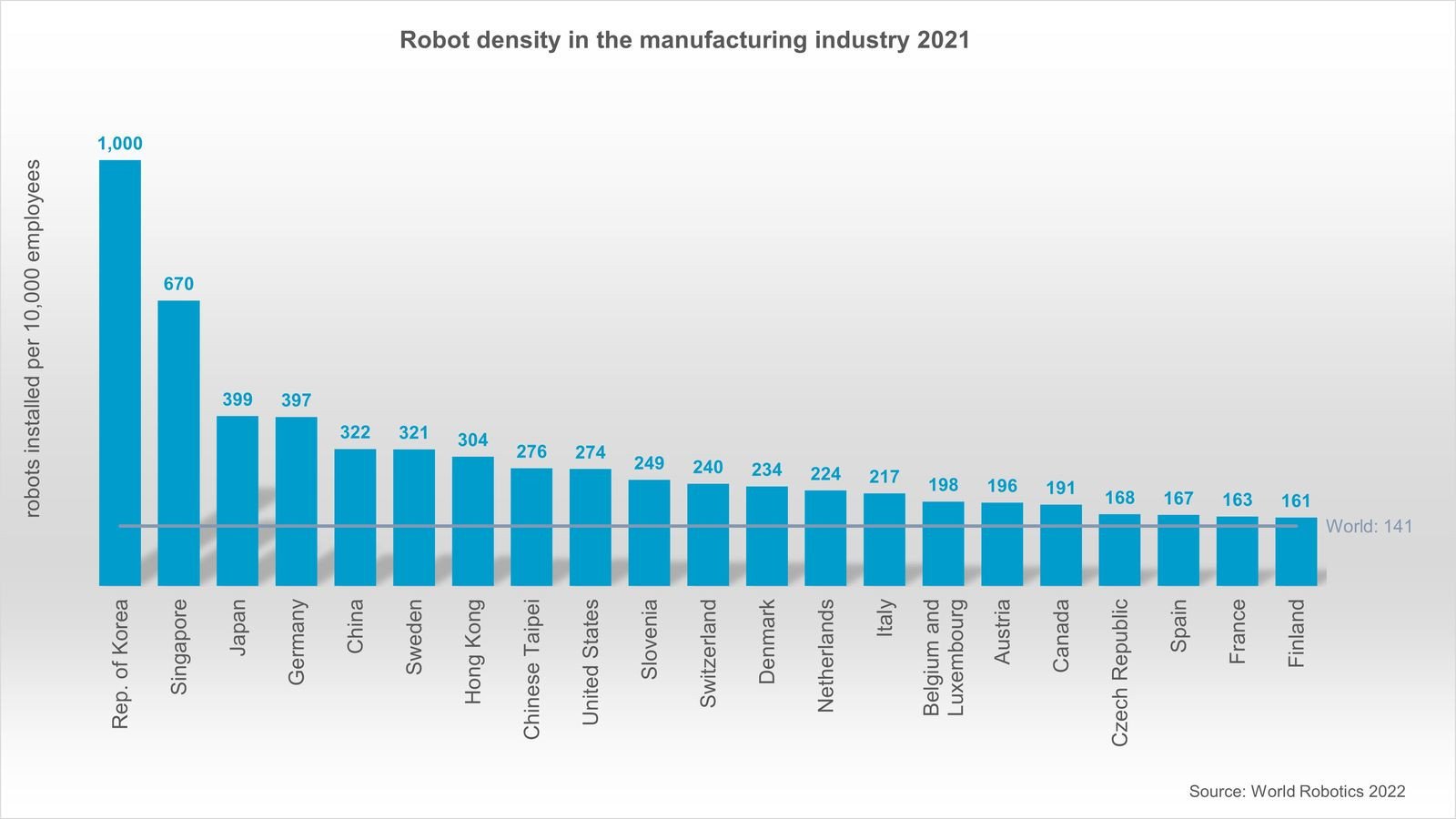
https://roboticsimulationservices.com/maintenance-and-repair-of-industrial-robots-what-you-should-know/
“….Initially, the overall cost of an industrial robot (including systems engineering costs) is approximately $250,000. Furthermore, robots will also have operations and maintenance costs which we calculate at approximately $10,000 annually.
Typically, in the first 3-4 years the cost of industrial robot maintenance will be around $500 per year regarding preventive maintenance like lubrication and upgrading batteries. In the 5th year, the preventative maintenance will cost around $5,000 primarily for replacing wear items like internal wire harnesses.
In the next 6-8 years, there would be another 500 dollars spent on preventative maintenance. Still, this time it’s mostly to do with greasing any moving parts and replacing the lithium-ion batteries, which should last up to about 8 or 10 years, depending on usage. …”
To the managers, the only(or main)concern is cost. According to the article above, it costs about $350,000 to run a Silicon based bots for 10 years and it can run non-stop except 1-2 hours of maintenance/day or it can replace 4 Carbon based bots. $350,000/480 =$729 monthly wage+benefits cost is the line. Exceeding it means ‘Silicon based bots’are more economical than ‘Carbon based bots’.
Of course there’s a big difference:’Carbon based bots’ can form trade unions and complain while ‘Silicon based bots’ are still not smart enough for that.
https://fashinza.com/manufacturing/industry-news/pros-and-cons-of-manufacturing-in-india-bangladesh-china-and-vietnam-a-comparative-study/
LikeLike
The most aspiration among american teens today is “youtuber”. Some people are using this statistics to claim that this is “decline” or American society. I find this to be exact opposite. Most teenagers had no idea how to become nasa astronauts, their aspiration was purely based on the limited publicity that media gave to 1-2 astronauts. In some sense an average person has higher probability of working in hollywood as actor than working in ISS.
Youtuber on other hand is actually lot more reasonable occupation. There are more successful youtubers than astronauts or hollywood stars. In addition to that youtubers add immense value to society at different levels. They education and enagage millions all around the world.
The fact that american youngsters can aspire to be youtubers is a great sign that they have lot more opportunities available to them where they see themselves getting happy making that choice.
LikeLike