

Image description: A dense spherical cluster of stars. The stars merge into a bright core in the center, and spread out to the edges gradually, giving way to an empty, dark background. Most of the stars are small points of light. A few stars with cross-shaped diffraction spikes appear larger, and stand out in front.
The New General Catalogue of Nebulae and Clusters of Stars (abbreviated NGC) is an astronomical catalogue of deep-sky objects. The image above (click on image to embiggen) is the globular cluster NGC 6652. A bit more about that from the European Space Agency:
The glittering, glitzy contents of the globular cluster NGC 6652 sparkle in this star-studded image from the NASA/ESA Hubble Space Telescope. The core of the cluster is suffused with the pale blue light of countless stars, and a handful of particularly bright foreground stars are adorned with criss-crossing diffraction spikes. NGC 6652 lies in our own Milky Way galaxy in the constellation Sagittarius, just under 30 000 light-years from Earth and only 6500 light-years from the Galactic centre.
Globular clusters are stable, tightly gravitationally bound clusters containing anywhere between tens of thousands and millions of stars. The intense gravitational attraction between the closely packed stars in globular clusters is what gives these star-studded objects their regular, spherical shape.
We take images like this for granted and are blasé about it. But take a few minutes to marvel at what we have here. Unaided we can see at most a few thousand stars on a clear moonless night sky away from light pollution. But thanks to the advances in science, technology and engineering made by untold numbers of people, we average folks get to see what no living being ever saw before until about a century ago — images of millions of stars and galaxies that are billions of light years away captured by telescopes in space such as the Hubble and the James Webb.
Not just that, now we get to see high resolution images of galaxies billions of light yeas away on high definition big screens in the comfort of our homes. And some of us may even be seeing this on a handheld device that no generation before the present had.
***
I stared at NGC 6652. I said to myself, “the stars are so many there, they seem to overlap.”[1]
I have this peculiar habit of staring at pictures like the above. It’s a form of meditation for me. Here I am, an insignificant entity in a vast cosmos. I am contemplating that vastness of space and time. Billions upon billions of stars and galaxies throughout space spanning billions of light years and time that stretches for billions of years.
And yet, as Vedanta says, “tat tvam asi” — That you are. I am that vastness. I am SAT CHIT ANANDA. I am existence, I am consciousness, I am bliss.
Space measured in light years! It leaves you breathless. (Note to Joan Baez: Light year is a measure of distance, not time, OK? [2])
***
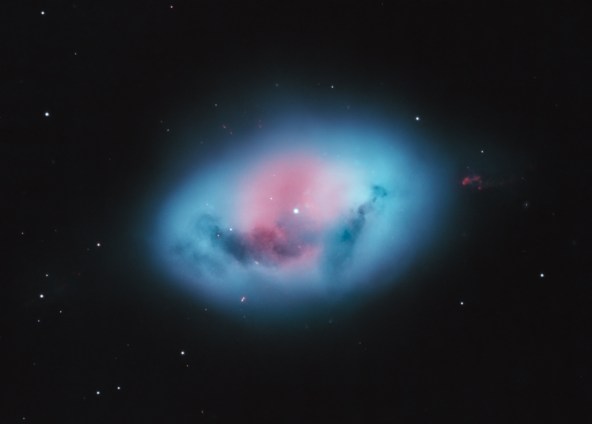
One fantastic source of astronomical pictures is the aptly named “Astronomy Picture of the Day” or APOD. Yesterday’s picture was the Robin’s Egg nebular [3]:
That’s it for now. Be well, do good work and
NOTES:
[1] The album “In My Tribe” by 10,000 Maniacs is a top favorite. I know all the songs by heart. A few lines from the song “The Painted Desert”–
The Painted Desert can wait till summer.
We’ve played this game of just imagine long enough.
Wait till summer?
When I’m sure the rains have ended, the blooms have gone,
Everyone killed by the morning frost.
Is a cactus blooming there in every roadside stand
Where the big deal is cowboy gear sewn in Japan?
The Painted Desert can wait till summer.
We’ve played this game of just imagine long enough.
Wait till summer?
When I’m sure the rains have ended and the blooms have gone,
Everyone killed by the morning frost.
Is a cactus blooming there upon the Northern rim
Or in the ruins of the Hopi mesa dens?
You met a new friend in the Canyon, or so you wrote.
On a blanket in the cooling sand you and your friend agreed that
The stars were so many there they seemed to overlap.
[2] Joan Baez wrote a song titled “Diamonds and Rust” (1975) about her boyfriend Bob Dylan. A very pretty song with a lovely guitar track and nice lyrics. She is good at ballads. Anyway, at one point she sings, “. . . a couple of light years ago . . .” Sorry, sweetie, the word “light” doesn’t belong there.
But the song is lovely. Listen.
[3] Description of the Robin’s Egg nebula:
This pretty nebula lies some 1,500 light-years away, its shape and color in this telescopic view reminiscent of a robin’s egg. The cosmic cloud spans about 3 light-years, nestled securely within the boundaries of the southern constellation Fornax. Recognized as a planetary nebula, egg-shaped NGC 1360 doesn’t represent a beginning though. Instead it corresponds to a brief and final phase in the evolution of an aging star. In fact, visible at the center of the nebula, the central star of NGC 1360 is known to be a binary star system likely consisting of two evolved white dwarf stars, less massive but much hotter than the Sun. Their intense and otherwise invisible ultraviolet radiation has stripped away electrons from the atoms in their mutually surrounding gaseous shroud. The predominant blue-green hue of NGC 1360 seen here is the strong emission produced as electrons recombine with doubly ionized oxygen atoms.

 Atanu Dey : Life is a Random Draw