
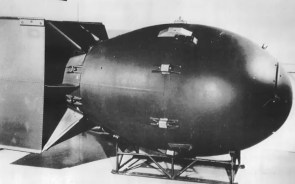
The atomic bomb and the Trinity Test is much in the news due to the release of the movie Oppenheimer last week on July 21st. I hope to watch the movie one of these days on an IMAX GT screen. There are a few in the US (sadly none in India.)
The popular press bombards us with sensational headlines (what else is new?) without really helping comprehension. Oftentimes, it ends up misinforming the public about important issues. A glaring example of that is “climate change.” Fortunately for us the social media, never celebrated as bastions guarding the public interest, has exceptionally great explainers who advance the public understanding of important matters.
The movie motivated a lot of excellent YouTube channels to explore the science, technology, engineering and history related to the project.
Here’s an example. Curious Droid begins with the question, “Who invented the atomic bomb?” The answer of course is that no particular individual did; it was a collective effort. Dozens of theoreticians figured out different parts of the abstract scientific atomic theory, dozens of experimental physicists and chemists figured out the technology, hundreds did the engineering that created the final product which Sting called “Oppenheimer’s deadly toy” in his song “Russians.” Let’s watch:
(Aside: In the video, around 1:04 timestamp, Curious Droid incorrectly says that the Trinity Test was on July 9th, 1945, when in fact it was on July 16th.)
I learned a lot of interesting stuff. The first use of the phrase “atomic bomb” was in a 1913 novel The World Set Free by H. G. Wells. Curious Droid says, “Leó Szilárd, one of the key figures in the development of the bomb and who conceived the idea of the neutron chain reaction which is key to a nuclear explosion, read Wells’s book in 1932 before he came up with the idea in 1933 and filed for patents for it in 1934, coincidence, maybe, maybe not.”
Did you know that Einstein who laid important parts of the theoretical foundation on which the bomb was built did not have the security clearance to be part of the Manhattan Project? That was because he was sympathetic to socialism. (See this post of mine: Einstein the Physics Giant and the Economics Dwarf.)
***
I have always marveled at the fact that how recent some of the great scientific discoveries are. Consider the neutron. It feels as if the basic structure of the atom has been known for ages. But that isn’t so.
The neutron was discovered in 1932 by the English physicist James Chadwick. Still, since the time of Ernest Rutherford, it has been known that the atomic mass number A of nuclei is a bit more than twice the atomic number Z for most atoms. Essentially, all the mass of the atom is concentrated in the relatively tiny nucleus. Rutherford’s model for the atom in 1911 claims that atoms have their mass and positive charge concentrated in a very small nucleus. [Source: nuclear-power.com]
All the great scientific and technological advances have been made in the last two centuries. Compared to what is known today, humanity was basically ignorant about the nature of the material world for nearly all its tenure. If we have 100 units of technology today, our ancestors had close to zero; and compared to our 100 units, our descendants will have billions of units. There are no conceivable limits to knowledge.
Knowledge keeps on advancing. The process, as the physicist David Deutsch keeps repeating, is simple: conjecture, criticism and testing alternatives. The first bit is pure guesswork. Nearly all guesses are wrong and are rejected. However, a few cannot be rejected and those are tentatively accepted, and then when something better emerges, they are replaced.
Philosopher Karl Popper taught that scientific theories can only be proven to be wrong, and never proven to be right. The distinction is important.
“Science is the belief in the ignorance of experts,” said Richard Feynman. Experts do make errors not because they are stupid (we all are to varying degrees) but because they too have limited knowledge although not as severe as non-experts.
Robert Millikan in 1928 declared that “There is no likelihood man can ever tap the power of the atom. The glib supposition of utilizing atomic energy when our coal has run out is a completely unscientific utopian dream.”
Ernest Rutherford in 1933 said, “Anyone who expects a source of power from the transformation of these atoms is talking moonshine.”
Albert Einstein too in 1933 said, “There is not the slightest indication that nuclear energy will ever be obtainable. It would mean that the atom would have to be shattered at will.” Einstein was no dummy. After all, he figured out that matter (atoms) and energy are equivalent as expressed in the equation E=mc**2.
Experts make mistakes. Not as frequently as we non-experts do but their mistakes have larger consequences than our mistakes.
***
Aside from conveying particular facts, Curious Droid’s video illustrates the general nature of the scientific enterprise. It is collaborative, it is incremental, it is unpredictable, and — this will stick in the craws of many — so far it has been largely an European white male-centric enterprise.
Yesterday I was chatting with my friend A and we were remarking about the famous picture of the Fifth Solvay Conference on Physics of Oct 1927 held in Brussels. Here’s the picture:
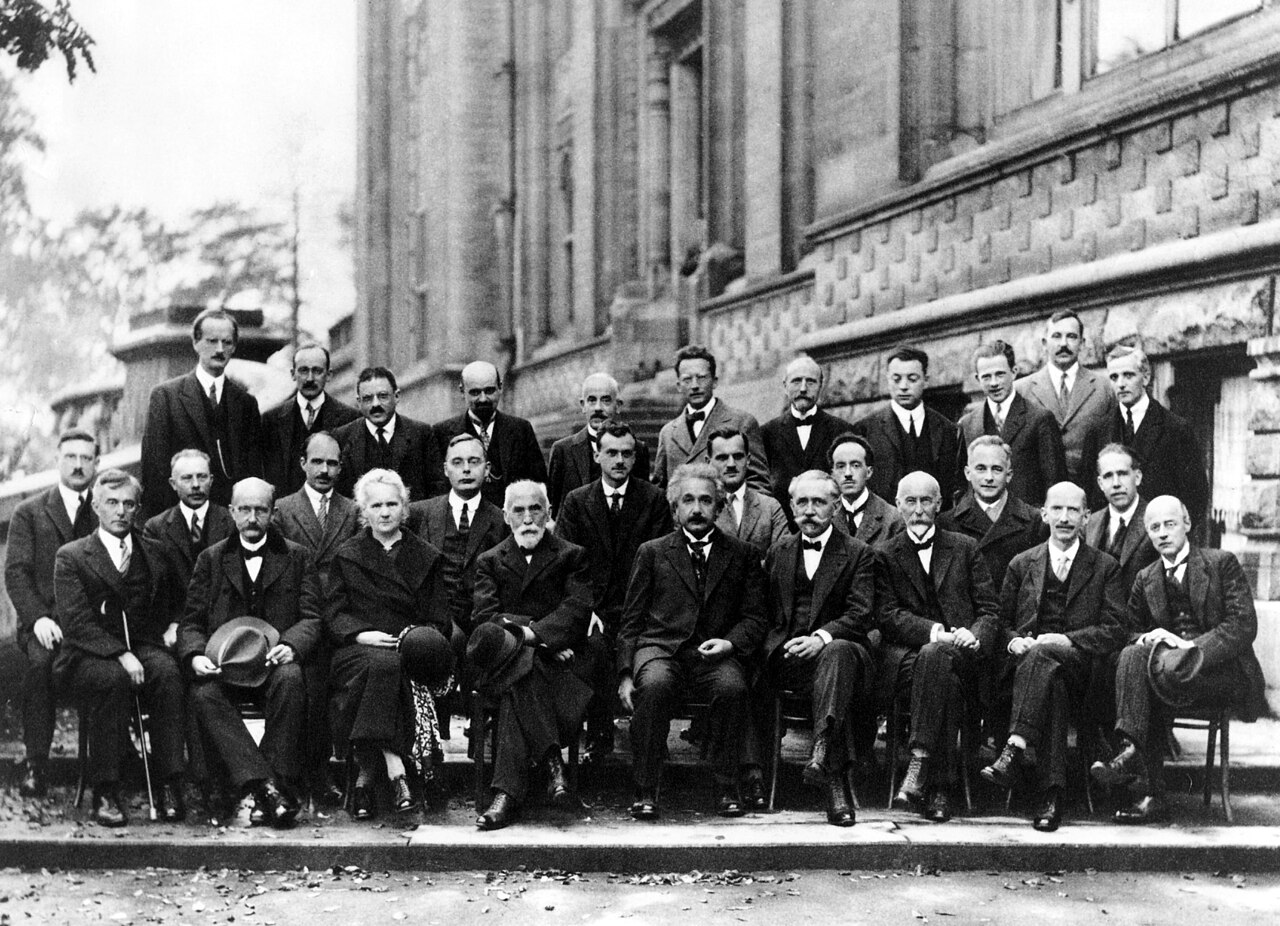 Note the absolute lack of “diversity, inclusion and equity.” I love it because it would drive the woke if they ever come to know about it (unlikely, the woke don’t know history) into fits of conniptions.
They all are Europeans males in three-piece suits and ties, except for Madame Curie (seated third from the left in the front row.) Of the 29 people in the picture, 17 of them had (or later received) Nobel prizes. Marie Curie got two Nobel prizes, the first and only person to get them in two different disciplines.
***
Competition drives advances in the theories and practices of science, technology and engineering. Military conflict is competition, as is the competition for commercial success in the marketplace. But of course, we must remember that the very existence of the variety of life on earth is because of competition, as explained by Charles Darwin and Alfred Wallace around the mid-18oos.
Our hope is that military competition does not become so intense that it spells doom for humanity. The US is the greatest threat to humanity because of the power of its military-industrial complex. The Ukraine war has pushed the world close to falling off the thermonuclear cliff.
I think that the memory of the awful bombs dropped on Hiroshima and Nagasaki in Aug 1945 has receded from human consciousness. People just don’t realize how terrible nuclear weapons are. Some have pushed the idea that a few above-ground nuclear tests should be conducted to demonstrate the danger of nuclear annihilation.
Technology is always a double-edged sword. Like the Nataraja, it’s both a creative and a destructive force. We can’t have one without the other. The best we can do is to recognize the inherent danger of using technology, and then choose to create rather than destroy.
It’s all karma, neh!

 Atanu Dey : Life is a Random Draw
None of this science and experimental physics and Chemistry was possible without abundant access to fossil fuels and the transformation that it brought about for human comfort.
LikeLike