
 Nature is awesome. It inspires awe, especially when it reveals itself in fury such as in tsunamis, earthquakes, fires, and storms. Among storms, tornadoes are particularly impressive. The strongest tornadoes leave death and widespread destruction in their wake.
I have witnessed some of nature’s fury. Having lived in northern California for several decades, I have experienced several earthquakes. The biggest was the 1989 Loma Prieta earthquake of October 17 at 5:04 p.m. local time. Named after the Loma Prieta peak, it was centered in Santa Cruz County section of the San Andreas fault, lasted around 15 seconds and had a magnitude of 6.9 on the Richter scale. It killed 63 people and injured over 3,700 people.
I was at a trade show at the San Jose Convention Center, when it happened. The building began to shake violently and it sounded as if a freight train was passing through. Fifteen seconds is a long time when things are falling all around you. All the lights went out, emergency lights came on, and someone shouted “Don’t run.” We exited the building without any rush.
In California we get inured to earthquakes. When things begin to shake, we just say, “oh, it’s an earthquake” and carry on with whatever we were doing. We don’t freak out because it is not all that infrequent. The San Francisco Bay area sits over many geological faults — the Hayward and San Andreas faults being two of them. It is in the “Ring of Fire“[1].
One time I was in Mexico City, Mexico, visiting the Instituto Thomas Jefferson school, and there was an earthquake. I tweeted about it immediately, before I left the building and I think ABC messaged me saying they’d like to talk to me.
Fires are awesome too. The biggest I have seen is the Oakland Hills fire of October 1991. I was visiting friends in Berkeley (not yet a student at UC). Wiki says,
The Oakland firestorm of 1991 was a large suburban wildland–urban interface conflagration that occurred on the hillsides of northern Oakland, California, and southeastern Berkeley over the weekend of October 19–20, 1991, before being brought under full control on October 23. …The fire ultimately killed 25 people and injured 150 others. The 1,520 acres destroyed included 2,843 single-family dwellings and 437 apartment and condominium units. The economic loss from the fire was estimated at $1.5 billion ($2.7 billion in 2022 dollars).
The fire was up in the hills. A few hours after it began, I stood on Dwight Way in Berkeley, about a mile west of the hillside. You could see houses burning and also realize that there are hundreds more which will also be reduced to ashes in a few hours. The fire-fighters had to retreat and could not save them. It was frightening and sad.[2]
I have drifted from the focus of this post: tornadoes. Time to get back to it. I have never seen a tornado. Many years ago, a friend and I got caught in a massive lightening storm in France. We were driving from Paris to Bordeaux. The road we were on was a rural road through absolutely flat landscape. It was close to dusk; it was raining but not too hard. The lightening show was unbelievable. Dozens of lightening bolts all around every second. It was continuous. My friend Courtenay was frightened but I assured her that we were safe because the car was indeed a Faraday cage. Frightening but also exciting to be in the middle of a storm.

OK, moving on to tornadoes. The US is the world leader in tornadoes. Around three-quarters of global tornadoes happen in the US (followed by Canada and Bangladesh), and that too is concentrated east of the Rockies. The image on the left is one I took at the Denver airport last year November. I wouldn’t want to be in a plane on the ground when a tornado hits the airport.
I spent a lot of time learning about tornadoes over the last few days. It’s a deep rabbit hole I’d not recommend going down. Anyway, here’s a bit of tornado record (click on image below to embiggen; go to the wiki page.)
 The deadliest tornado in recorded history was the Tri-State tornado — Missouri, Illinois, Indiana — of March 18, 1925. The event lasted over three hours and killed 695 people. The deadliest tornado in world history was the Daulatpur–Saturia tornado in Bangladesh on April 26, 1989, which killed approximately 1,300 people.
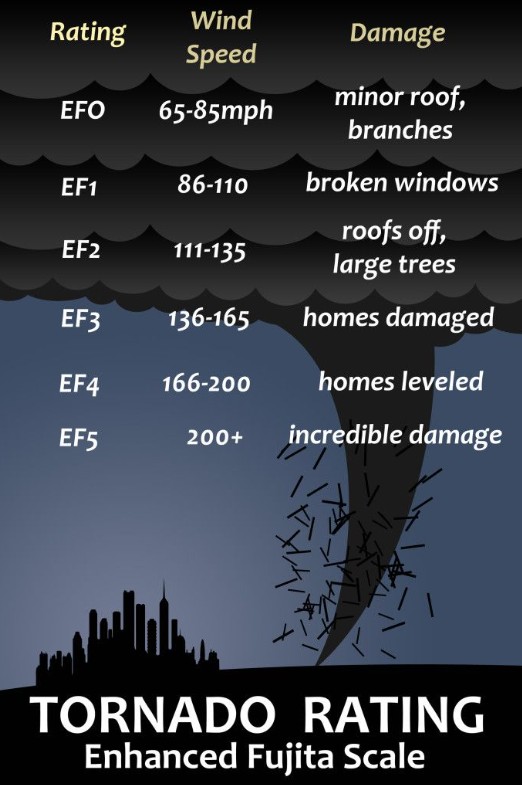 The US gets more than 1,200 tornadoes annually Violent tornadoes—those rated EF4 or EF5 on the Enhanced Fujita scale — occur more often in the United States than in any other country.
Tornadoes kill about 80 people on average in the US. Because they are so spectacular, there are hundreds of people who are dedicated “storm chasers.” During tornado season, the go chasing them. They do provide valuable data to the National Weather Service.
I have been an avid follower of a storm chaser named Pecos Hank. Over the years, I have watched scores of his YouTube videos. This is a great thing about the US. It’s a wealthy enough country that people can make a very good living doing whatever excites them, and what others value.
Pecos Hank loves chasing storms, in the US and also around the world. That’s all he does — and making music as a member of a band. The background music to his videos is from his band “Southern Backtones.” From his videos, one can tell that he’s a lovely person. (Adam Smith wrote, “Man actually desires, not only to be loved, but to be lovely …”.)
With over a million subscribers to his YouTube channel, I am sure that he is loved and respected by his fans and people who belong to the storm-chasing tribe. But more than being loved, I think he is a lovely person. Why? Well, I will leave it to you to figure that out. And you will understand why I say he’s lovely if you watch this video of his.
I like the fact that he doesn’t talk too much. He lets the video speak to you. And when he does talk, his enthusiasm come through loud and clear. Storm chasing is a dangerous hobby but he is good at it. Is he happy because he’s good at it, or is he good because he is happy?
Bertrand Russell, the old codger, said that “the good life is the happy life. By that I don’t mean that if you’re good, you’ll be happy but rather that if you are happy, you’d be good.” (Quoting from memory; too lazy to look up the exact quote.)
I think material prosperity allows people to be good because a certain minimum level of material well-being is a necessary condition for being happy. People trapped in poverty are handicapped and that’s a barrier to being happy, and consequently being good is generally hard. Bad ideologies (communism, socialism, Islam, etc) are not conducive to material prosperity; it’s no surprise that the outcome is dismal under those systems. Unhappy people cannot be good.
Thankfully, it’s a wonderful world. Let this happy man, Louis Armstrong, remind us of that.
My favorite verse —
I hear babies cry, I watch them grow
They’ll learn much more
Than I’ll ever know
And I think to myself
What a wonderful world
Yes, I think to myself
What a wonderful world
Oh yeah!
Be well, do good work, and keep in touch.
NOTES:
[1] “The Ring of Fire, also referred to as the Circum-Pacific Belt, is a path along the Pacific Ocean characterized by active volcanoes and frequent earthquakes. Its length is approximately 40,000 kilometers (24,900 miles). It traces boundaries between several tectonic plates—including the Pacific, Juan de Fuca, Cocos, Indian-Australian, Nazca, North American, and Philippine Plates.
“Seventy-five percent of Earth’s volcanoes—more than 450 volcanoes—are located along the Ring of Fire. Ninety percent of Earth’s earthquakes occur along its path, including the planet’s most violent and dramatic seismic events.” Read more at National Geographic.
[2] Here’s a glimpse of the Oakland Hills fire from a local TV station KPIX:


You might want to check this 3 part series called Storm Chasers on a show called American Innovations produced by the folks at Wondery – https://wondery.com/shows/american-innovations/episode/5656-storm-chasers-tornado-alley/. It is about how storm chasing began, how it went mainstream, and how this thrill-seeking activity became a part of scientific inquiry.
LikeLike
Thanks for the recommendations. I will check them out.
LikeLike